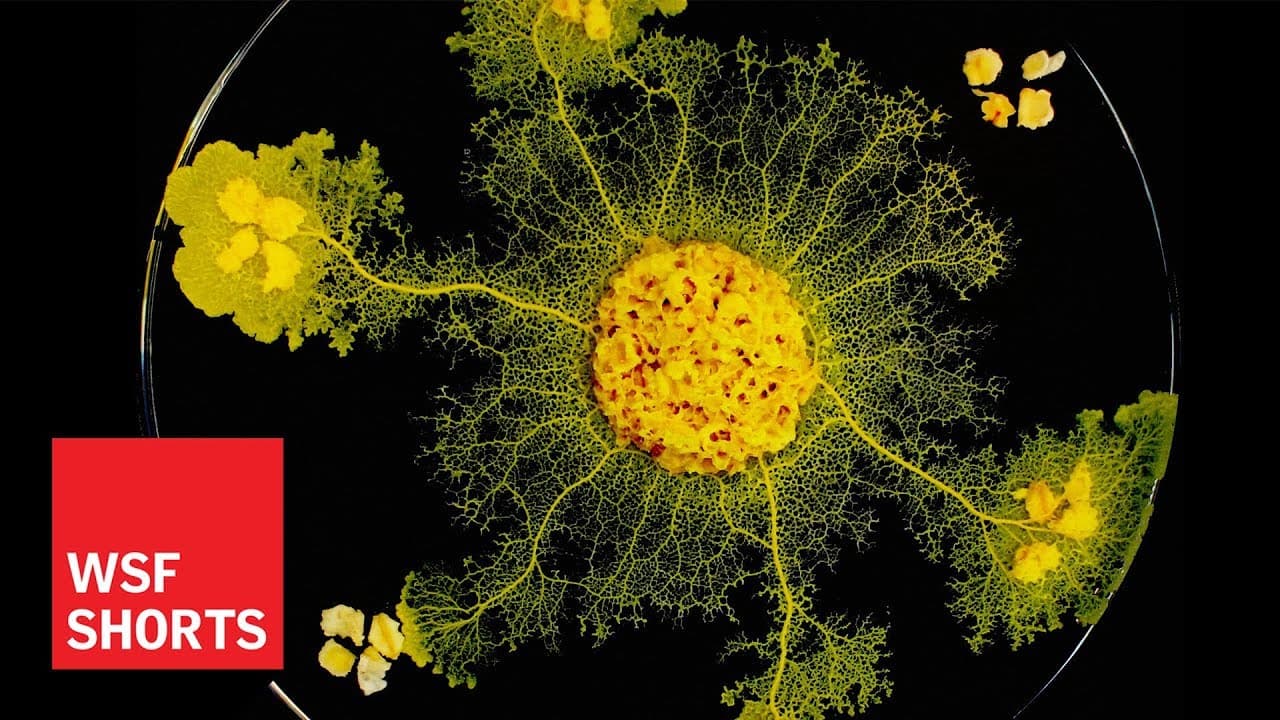
What is Slime Mold and is it Intelligent?
TL;DR
Slime molds, mysterious unicellular organisms, showcase surprising intelligence and problem-solving abilities without brains.
Transcript
tell us what a slime mold is it's not a plant or an animals that are fungus what is another plant it's none of anymore it's none of fungus it's not clear white fits in the tree of life its little scientific name is Maxim I see it I guess that's the way you would pronounce it it's very weird organism there's no question about this it's actually a ne... Read More
Key Insights
- 🌲 Slime molds challenge traditional biological classifications, being unique in the tree of life.
- 🧠 Their ability to solve complex problems without brains underscores their intelligence.
- 💪 Muscle-like contractions enable slime molds to make decisions and distribute resources efficiently.
- 🇲🇩 Researchers study slime molds to uncover the molecular mechanisms behind their remarkable behaviors.
- ☺️ Slime molds' adaptive strategies involve relaxing in favorable conditions to attract resources.
- 💁 Their responsiveness to stimuli showcases a sophisticated form of decision-making.
- 🇲🇩 Understanding slime molds' biology provides insights into intelligence and problem-solving outside traditional frameworks.
Install to Summarize YouTube Videos and Get Transcripts
Explore YouTube Video Summarizer or Get YouTube Transcript Extractor
Questions & Answers
Q: What makes slime molds unique in the tree of life?
Slime molds defy classification as plants, animals, or fungi, being distinct as unicellular organisms with multiple nuclei forming a syncytium structure. Their scientific name, Physarum polycephalum, reflects their exceptional nature.
Q: How do slime molds exhibit problem-solving abilities?
Slime molds surprise researchers by excelling at tasks like the multi-armed bandit problem, typically associated with brain-dependent organisms. They achieve this without neurons, showing remarkable intelligence.
Q: What role do muscles play in slime molds' decision-making process?
Slime molds use muscle-like contractions involving actin-myosin proteins, similar to how human muscles function. This mechanism aids in redistributing biomass and making decisions based on environmental cues.
Q: How do slime molds respond to favorable conditions?
When slime molds encounter a beneficial environment, they relax and accumulate resources in that specific area. This influx of material towards the relaxed region enhances their survival and reproductive success.
Summary & Key Takeaways
-
Slime molds, not plants, animals, or fungi, mystify scientists with their unique biological characteristics.
-
Despite lacking a brain, slime molds can solve complex problems, as shown in a casino experiment.
-
These organisms utilize muscle-like contractions to make decisions and redistribute their biomass effectively.
Read in Other Languages (beta)
Share This Summary 📚
Summarize YouTube Videos and Get Video Transcripts with 1-Click
Try YouTube Summary with ChatGPT & Claude or YouTube Transcript Generator
Explore More Summaries from World Science Festival 📚




Summarize YouTube Videos and Get Video Transcripts with 1-Click
Try YouTube Summary with ChatGPT & Claude or YouTube Transcript Generator