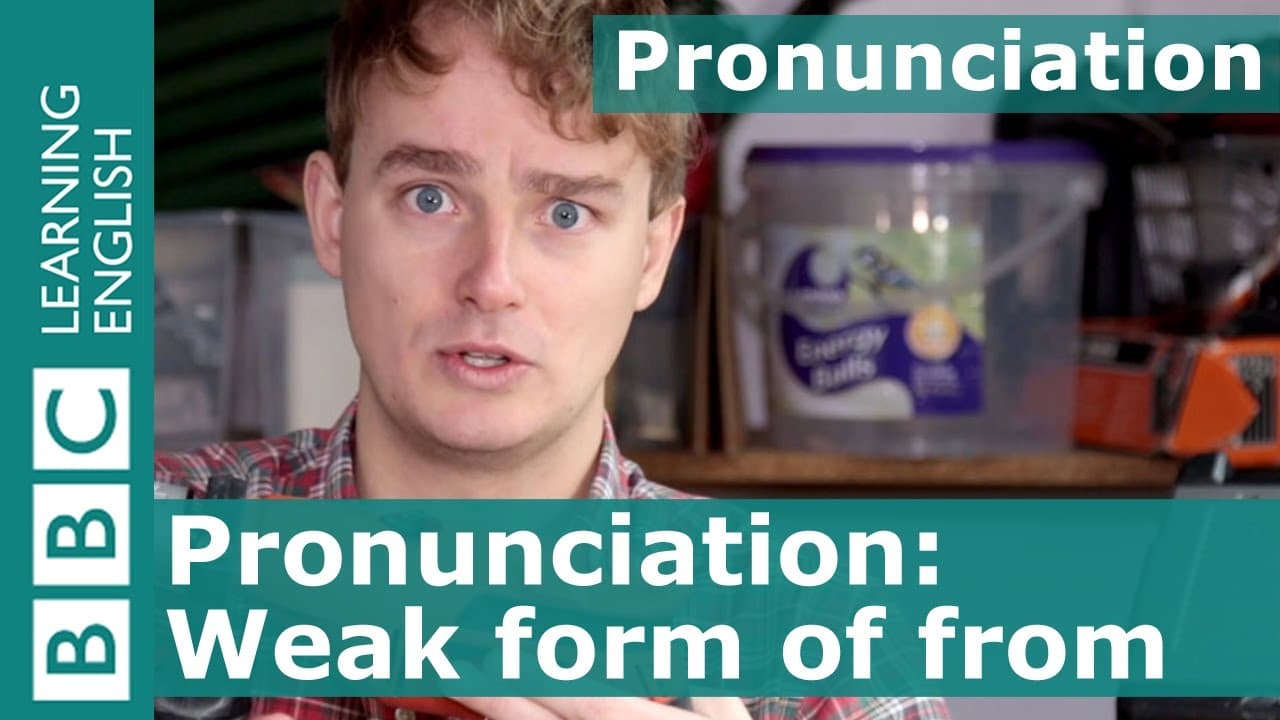
Pronunciation: from
TL;DR
Tim explores the pronunciation of the word 'from' in English.
Transcript
Hi. I'm Tim and this is my Pronunciation workshop. Here I'm going to show you how English is really spoken. Come on, let's go inside. Where were you born? Where do you come from? Here's what we heard when we asked some people in London their names, and where they come from. Now they all used the word from, didn't they? But they didn't pronounce it ... Read More
Key Insights
- The word 'from' is often unstressed in sentences, leading to variations in pronunciation.
- In the phrase 'Where do you come from?', 'from' is unstressed but pronounced /frɒm/.
- When 'from' appears in the middle of a sentence, the vowel sound often changes to a schwa, making it /frəm/.
- This change in pronunciation is an example of a weak form, common in English for less important words.
- Tim provides real-life examples of people from London using the word 'from' in conversation.
- Listeners are encouraged to practice the pronunciation by listening and repeating given examples.
- The workshop emphasizes the practical aspects of spoken English and encourages further learning through the BBC website.
- Tim humorously concludes the workshop by reflecting on his DIY skills, adding a personal touch.
Install to Summarize YouTube Videos and Get Transcripts
Explore YouTube Video Summarizer or Get YouTube Transcript Extractor
Questions & Answers
Q: What is the focus of Tim's pronunciation workshop?
The focus of Tim's pronunciation workshop is on the word 'from' and its pronunciation in different contexts. Tim explains that 'from' is often unstressed in sentences, leading to variations in its pronunciation, such as changing from /frɒm/ to /frəm/ when it appears in the middle of a sentence.
Q: How does the pronunciation of 'from' change in a sentence?
The pronunciation of 'from' changes when it is unstressed and appears in the middle of a sentence. In such cases, the vowel sound /ɒ/ often changes to a schwa, resulting in the pronunciation /frəm/ instead of /frɒm/. This change is an example of a weak form in English.
Q: Why does Tim use real-life examples in his workshop?
Tim uses real-life examples in his workshop to demonstrate how the word 'from' is commonly pronounced by people in everyday conversations. By showcasing examples from people in London, Tim provides practical insights into the natural use of the word, making it easier for learners to understand and practice the correct pronunciation.
Q: What is a weak form in English pronunciation?
A weak form in English pronunciation occurs when less important words in a sentence, such as prepositions or conjunctions, are unstressed and their vowel sounds are reduced, often to a schwa. This results in a different pronunciation compared to when the word is stressed, as seen with the word 'from' changing from /frɒm/ to /frəm/.
Q: How can listeners practice the pronunciation taught in the workshop?
Listeners can practice the pronunciation taught in the workshop by listening to the examples provided by Tim and repeating them. Tim encourages this practice by offering phrases where 'from' is used, allowing listeners to mimic the correct pronunciation and improve their spoken English skills.
Q: What additional resources does Tim recommend for learning pronunciation?
Tim recommends visiting the BBC Learning English website as an additional resource for learning pronunciation. The website offers a variety of materials and courses designed to help learners improve their English pronunciation and understanding of how English is spoken in real-life contexts.
Q: What personal anecdote does Tim share at the end of the workshop?
At the end of the workshop, Tim shares a personal anecdote about his experiences with DIY projects. He humorously reflects on his skills as a craftsman and artisan, mentioning that he plans to do some DIY but decides against it after recalling past mistakes, adding a light-hearted and personal touch to the session.
Q: What is the purpose of Tim's pronunciation workshop?
The purpose of Tim's pronunciation workshop is to teach learners how English is really spoken by focusing on the pronunciation of specific words, like 'from'. The workshop aims to improve learners' spoken English skills by demonstrating common pronunciation patterns, encouraging practice, and providing additional resources for further learning.
Summary & Key Takeaways
-
Tim's pronunciation workshop focuses on the word 'from', highlighting its unstressed pronunciation in sentences. He provides examples from Londoners to illustrate how the word is commonly spoken in real life.
-
Listeners learn that 'from' can change from /frɒm/ to /frəm/ in the middle of sentences, a typical weak form in English. Tim offers practice opportunities to master this pronunciation.
-
The workshop encourages further exploration of English pronunciation through the BBC Learning English website, while Tim adds a personal anecdote about his DIY experiences.
Read in Other Languages (beta)
Share This Summary 📚
Summarize YouTube Videos and Get Video Transcripts with 1-Click
Try YouTube Summary with ChatGPT & Claude or YouTube Transcript Generator
Explore More Summaries from BBC Learning English 📚

Summarize YouTube Videos and Get Video Transcripts with 1-Click
Try YouTube Summary with ChatGPT & Claude or YouTube Transcript Generator