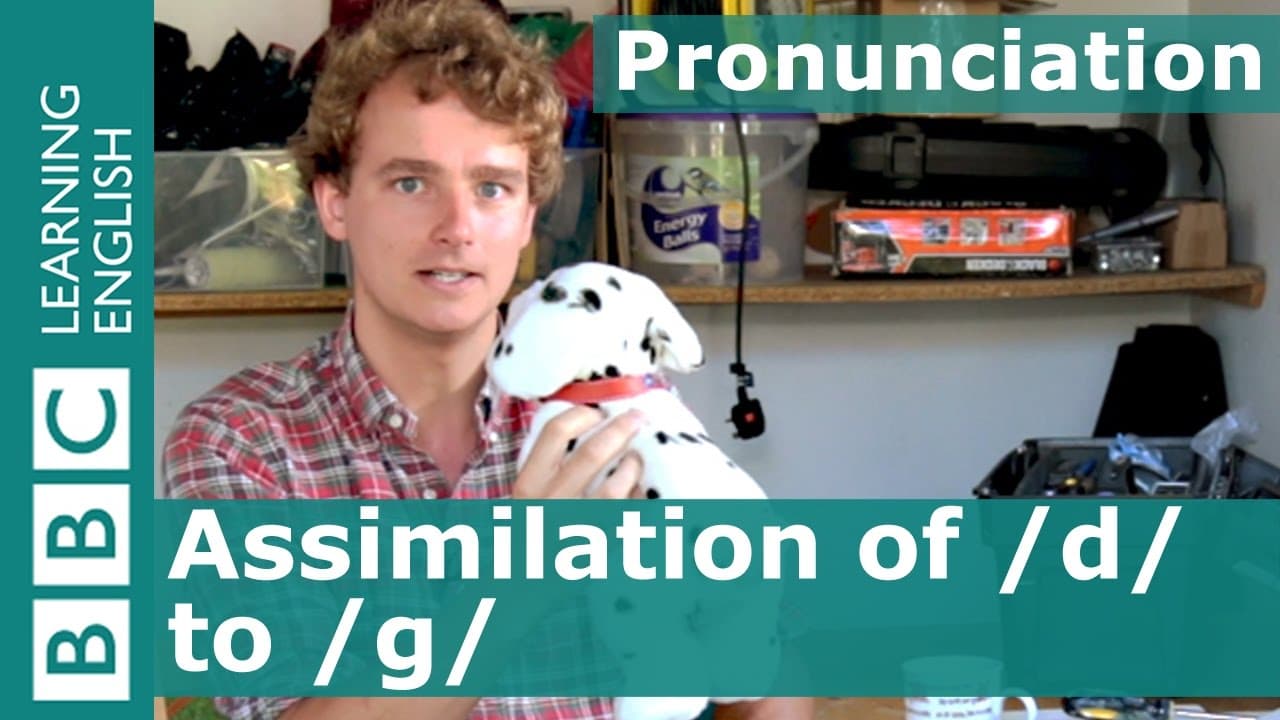
Pronunciation: Assimilation of /d/ to /g/
TL;DR
Tim explains how /d/ changes to /g/ before /g/ or /k/.
Transcript
Hi. I'm Tim and this is my Pronunciation workshop. Here I'm gonna show you how English is really spoken. Come on, let's go inside. In English, we have an expression - man's best friend. Do you know what that refers to? Voice: Beer! Tim: No, not beer. Dogs. A dog is man's best friend. But not always. What would you say to a dog who did this? Bad gi... Read More
Key Insights
- Tim introduces the concept of assimilation in English pronunciation, specifically how the /d/ sound changes to /g/ before a /g/ or /k/ sound.
- The phrase 'bad girl' is used as an example where the /d/ sound assimilates to /g/, becoming 'bagirl' in fluent speech.
- Additional examples provided include phrases like 'good cook' and 'hard copy' where the /d/ changes to /g/ or /k/.
- Tim engages the audience in a listening and repeating exercise to practice the assimilation of the /d/ sound.
- The workshop emphasizes the importance of understanding natural spoken English and the changes that occur in fluent speech.
- Tim humorously interacts with the concept of 'man's best friend,' initially misleading the audience before revealing it's about dogs.
- The workshop encourages viewers to visit the BBC Learning English website for further pronunciation resources.
- Tim concludes with a light-hearted interaction with a dog, reinforcing the lesson with humor and engagement.
Install to Summarize YouTube Videos and Get Transcripts
Explore YouTube Video Summarizer or Get YouTube Transcript Extractor
Questions & Answers
Q: What is the main focus of Tim's pronunciation workshop?
The main focus of Tim's pronunciation workshop is to explain the concept of assimilation in English pronunciation, specifically how the /d/ sound changes to a /g/ sound when it is followed by a /g/ or /k/ sound. He uses practical examples and exercises to help viewers understand and practice this linguistic phenomenon.
Q: How does Tim illustrate the concept of assimilation?
Tim illustrates the concept of assimilation by using the phrase 'bad girl' as an example, where the /d/ sound assimilates to /g/, becoming 'bagirl' in fluent speech. He provides additional examples like 'good cook' and 'hard copy' to show how the /d/ sound changes before /g/ or /k/ sounds in natural spoken English.
Q: What exercise does Tim include in the workshop?
Tim includes a listening and repeating exercise in the workshop, encouraging viewers to practice the assimilation of the /d/ sound. He provides several example phrases, such as 'He's a really good cook' and 'Can you print out a hard copy?' for viewers to listen to and repeat, helping them grasp the concept of assimilation in spoken English.
Q: Why does Tim mention 'man's best friend' in the workshop?
Tim mentions 'man's best friend' as a humorous introduction to the workshop, initially misleading the audience by suggesting it refers to beer, before revealing it actually refers to dogs. This light-hearted approach sets the stage for the lesson on pronunciation and keeps the audience engaged while introducing the topic of assimilation.
Q: What resources does Tim recommend for further learning?
Tim recommends visiting the BBC Learning English website for further resources on pronunciation. He emphasizes that the website offers additional materials and exercises for those interested in improving their understanding and mastery of English pronunciation, particularly in natural spoken contexts.
Q: How does Tim conclude the workshop?
Tim concludes the workshop with a humorous interaction involving a dog, reinforcing the lesson with humor and engagement. He jokes about his preference for cats, then playfully interacts with the dog, calling it a 'good girl' and a 'bad girl,' which ties back to the lesson on the assimilation of the /d/ sound.
Q: What is the significance of the examples Tim uses?
The examples Tim uses, such as 'bad girl,' 'good cook,' and 'hard copy,' are significant because they demonstrate how the /d/ sound changes to /g/ or /k/ in fluent speech. These examples help illustrate the concept of assimilation, making it easier for viewers to understand and apply the concept in their own speech.
Q: What is the purpose of the listening and repeating exercise?
The purpose of the listening and repeating exercise is to provide viewers with practical experience in recognizing and practicing the assimilation of the /d/ sound. By repeating the example phrases, viewers can better understand how these pronunciation changes occur naturally in spoken English, enhancing their overall fluency and comprehension.
Summary & Key Takeaways
-
Tim's pronunciation workshop focuses on how the /d/ sound changes to /g/ when followed by /g/ or /k/ sounds. He uses the example 'bad girl' to demonstrate this linguistic phenomenon, known as assimilation, and provides several other examples to illustrate the concept.
-
The workshop includes a practical exercise where viewers are encouraged to listen and repeat phrases to practice the assimilation of the /d/ sound. Tim highlights the importance of understanding these changes for mastering natural spoken English.
-
Tim humorously interacts with the audience by discussing 'man's best friend' and later joking about his preference for cats. The session ends with an invitation to visit the BBC Learning English website for more resources on pronunciation.
Read in Other Languages (beta)
Share This Summary 📚
Summarize YouTube Videos and Get Video Transcripts with 1-Click
Try YouTube Summary with ChatGPT & Claude or YouTube Transcript Generator
Explore More Summaries from BBC Learning English 📚

Summarize YouTube Videos and Get Video Transcripts with 1-Click
Try YouTube Summary with ChatGPT & Claude or YouTube Transcript Generator