How Do Air Separation Units Work?
TL;DR
Air separation units efficiently divide atmospheric air into nitrogen, oxygen, and argon by employing a series of physical processes. After filtering and compressing the air, impurities are removed before cooling it to cryogenic temperatures, allowing for the liquefaction and subsequent separation of oxygen and argon from nitrogen, which remains gaseous.
Transcript
air separation unit an industrial facility used to separate atmospheric air into its primary components air is mostly a mixture of nitrogen oxygen and argon these elements can be directly recovered in gases or liquid form by passing the ambient air through an air separation unit or ASU the process starts with the ambient air being forced through a ... Read More
Key Insights
- Air separation units (ASUs) are industrial facilities that separate atmospheric air into its primary components: nitrogen, oxygen, and argon, either in gas or liquid form.
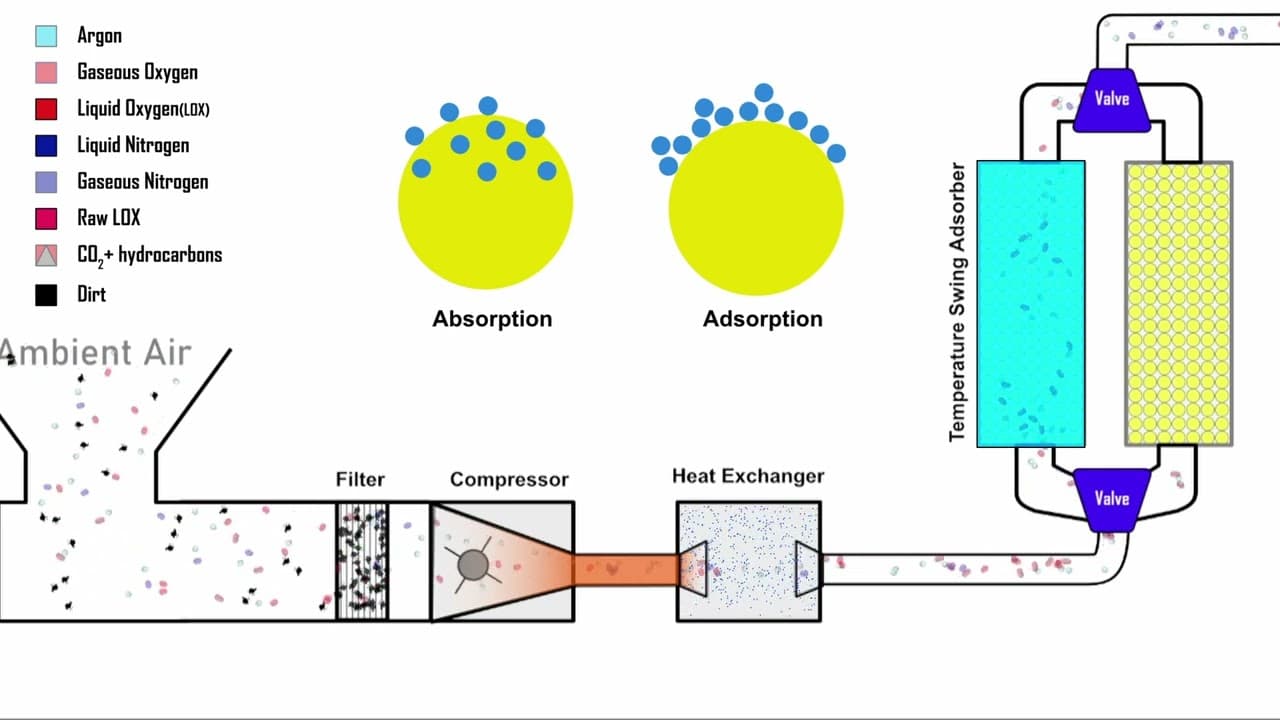
- The process begins with ambient air being filtered to remove dust and small airborne particles before being compressed to six times normal air pressure.
- Compressed air is then cooled using a heat exchanger, reducing its temperature from 90°C to 10°C while maintaining high pressure.
- To prevent blockages, CO2 and hydrocarbons are removed using a temperature swing absorber, which utilizes pellets to capture these compounds.
- The Joule-Thomson cooler further reduces air temperature to -120°C, leveraging the Joule-Thomson effect where gas expansion in isolation results in cooling.
- Air is introduced into a cold box with high and low-pressure chambers, where oxygen and argon liquefy at the bottom due to the cold temperatures.
- Crude liquid oxygen is separated from gaseous argon and nitrogen, with nitrogen being collected at the top and liquefied for further cooling.
- The final separation allows for the extraction of liquid oxygen at the bottom, gaseous argon in the middle, and gaseous nitrogen at the top of the chamber.
Install to Summarize YouTube Videos and Get Transcripts
Explore YouTube Video Summarizer or Get YouTube Transcript Extractor
Questions & Answers
Q: What are the primary components separated in an air separation unit?
An air separation unit primarily separates atmospheric air into nitrogen, oxygen, and argon. These components can be recovered in either gaseous or liquid form for various industrial applications. The separation process involves cooling and filtering the air to isolate these elements efficiently.
Q: How is the air initially prepared for the separation process?
Initially, ambient air is forced through a particulate filter to remove dust and small airborne particles. This filtered air is then compressed to six times the normal air pressure, which prepares it for the initial cooling stage. The compression increases the air temperature, which is later reduced in a heat exchanger.
Q: Why is CO2 removed from the air in the separation process?
CO2 is removed from the air to prevent it from turning into dry ice at low temperatures, which could block the air flow in the system. Additionally, hydrocarbons are removed to avoid flammable mixtures with pure oxygen. The removal is achieved using temperature swing absorbers with specialized pellets.
Q: What role does the Joule-Thomson cooler play in the air separation process?
The Joule-Thomson cooler plays a crucial role in significantly lowering the air temperature. It utilizes the Joule-Thomson effect, where gas expansion in thermal isolation leads to a temperature drop. This cooling prepares the air for further temperature reduction and eventual separation in the cold box.
Q: How does the cold box function in separating air components?
The cold box contains high and low-pressure chambers where the cooled air is introduced. The high-pressure chamber is pre-cooled, causing oxygen and argon to liquefy at the bottom. Nitrogen remains gaseous, allowing for the distinct separation and collection of these components based on their physical states.
Q: What is the significance of the temperature swing absorber in the process?
The temperature swing absorber is significant because it removes unwanted compounds like CO2 and hydrocarbons from the air. It uses pellets that absorb these compounds, preventing them from solidifying or creating flammable mixtures. This step ensures the air is pure before further cooling and separation.
Q: How is nitrogen collected and utilized in the process?
Nitrogen is collected as a gaseous component at the top of the high-pressure chamber in the cold box. It is then passed to a reboiler condenser where it is turned into liquid. This liquid nitrogen is used to cool the upper chamber, facilitating further separation and collection of the air components.
Q: What happens to the crude liquid oxygen in the cold box?
In the cold box, crude liquid oxygen is introduced into the low-pressure chamber, where it flows to the bottom. Due to the chamber's temperature, it slowly vaporizes, separating from argon, which remains gaseous. This separation allows for the extraction of pure liquid oxygen, ready for industrial use.
Summary & Key Takeaways
-
Air separation units are key industrial facilities designed to separate atmospheric air into its primary components: nitrogen, oxygen, and argon. The process involves filtering, compressing, and cooling air, followed by the removal of impurities like CO2 and hydrocarbons to prevent blockages and safety hazards.
-
The cooling process in ASUs is achieved through a series of steps, including using a heat exchanger and a Joule-Thomson cooler. These steps progressively lower the air temperature, preparing it for separation in the cold box, where the actual component separation occurs.
-
In the cold box, air is separated into its components through temperature and pressure manipulation. Oxygen and argon liquefy at the bottom, while nitrogen remains gaseous. This separation allows for the extraction of liquid oxygen, gaseous argon, and gaseous nitrogen, which are collected for industrial use.
Read in Other Languages (beta)
Share This Summary 📚
Summarize YouTube Videos and Get Video Transcripts with 1-Click
Try YouTube Summary with ChatGPT & Claude or YouTube Transcript Generator