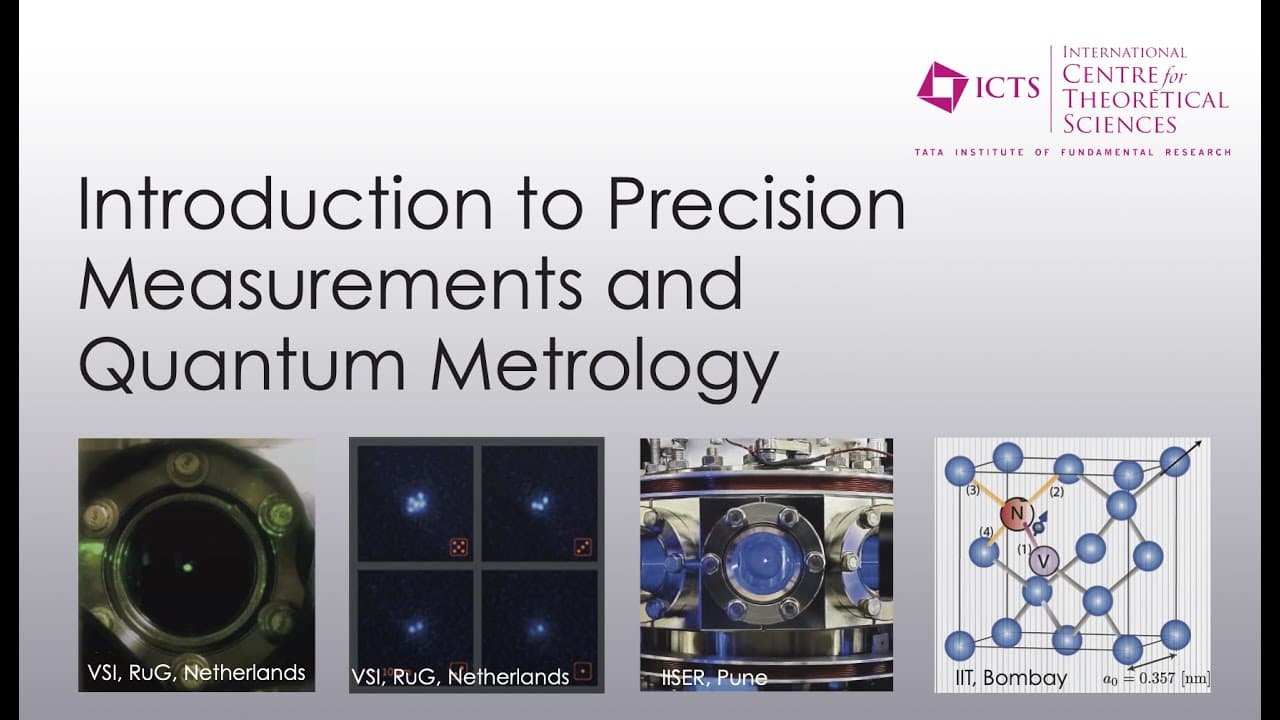
Optical Atomic Clocks (Lecture 1) by Tanja Mehlstäubler
TL;DR
Lecture on optical atomic clocks, focusing on their components and advantages.
Transcript
okay good morning everyone so this is the fifth day of the school and I hope that still you are able to concentrate okay anyhow so today's first talk will be by Professor Tanya Mel strobler from btb in Germany and she will have two lectures today is one and the other one is on Monday right Tuesday Tuesday Tuesday okay and she's goin... Read More
Key Insights
- Optical atomic clocks utilize laser cooling and trapping to achieve unprecedented accuracy, surpassing traditional microwave clocks in precision.
- The development of optical clocks has been driven by innovations like laser cooling, frequency combs, and stable cavities, enabling high-resolution measurements.
- Optical clocks are essential for precision measurements and have applications in fundamental physics, including testing general relativity and searching for dark matter.
- The lecture emphasizes the importance of frequency combs as frequency dividers, crucial for measuring high optical frequencies accurately.
- Ion traps are used in optical clocks to achieve high accuracy, with single ions providing excellent control and minimal systematic errors.
- Multi-ion clocks are being developed to improve stability and accuracy by leveraging quantum metrology techniques, potentially reaching Heisenberg limits.
- Optical clocks are not only valuable for scientific research but also for practical applications, including navigation and geodesy.
- The lecture highlights the synergy between optical clocks and quantum computing, as both fields utilize similar atomic and ion trapping techniques.
Install to Summarize YouTube Videos and Get Transcripts
Explore YouTube Video Summarizer or Get YouTube Transcript Extractor
Questions & Answers
Q: What are the key components of an optical atomic clock?
An optical atomic clock consists of several key components: a laser stabilized to an ultra-stable cavity for short-term stability; an atomic resonance to provide long-term frequency reference; and a frequency comb to measure the high optical frequencies accurately. These components work together to achieve high precision in timekeeping.
Q: How do optical atomic clocks compare to microwave clocks in terms of accuracy?
Optical atomic clocks are significantly more accurate than microwave clocks. They utilize optical frequencies, which provide a finer scale for measurements, leading to smaller relative uncertainties. This allows optical clocks to achieve accuracies at the 10^-18 level, surpassing the capabilities of microwave clocks, which are limited by larger systematic shifts and lower resolution.
Q: What role do frequency combs play in optical atomic clocks?
Frequency combs are essential in optical atomic clocks as they act as frequency dividers, allowing the measurement of high optical frequencies. They convert the optical frequency to a lower, more manageable frequency that can be measured with high precision. This technology is crucial for maintaining the clock's accuracy and stability.
Q: Why are ion traps used in optical atomic clocks?
Ion traps are used in optical atomic clocks because they provide excellent control over individual ions, minimizing systematic errors. The ions can be cooled to near absolute zero, reducing motion and allowing for precise measurement of atomic transitions. Ion traps also enable long coherence times, which are vital for achieving high accuracy in timekeeping.
Q: What are the potential applications of optical atomic clocks?
Optical atomic clocks have numerous applications, including fundamental physics research, such as testing Einstein's general relativity and searching for dark matter. They are also used in practical applications like navigation, geodesy, and synchronization of global positioning systems, where high precision timekeeping is crucial.
Q: How do multi-ion clocks improve the performance of optical atomic clocks?
Multi-ion clocks improve the performance of optical atomic clocks by increasing the number of ions used in the measurement process. This enhances the signal-to-noise ratio and allows for longer interrogation times, leading to improved stability and accuracy. Multi-ion clocks also open the possibility of reaching Heisenberg limits through entangled states.
Q: What is the significance of laser cooling in optical atomic clocks?
Laser cooling is a critical technique in optical atomic clocks as it reduces the thermal motion of atoms or ions, allowing for precise measurement of atomic transitions. By cooling the atoms to near absolute zero, the Doppler effect is minimized, leading to higher accuracy and stability in the clock's timekeeping capabilities.
Q: How do optical clocks contribute to advancements in quantum computing?
Optical clocks contribute to advancements in quantum computing by sharing technological foundations, such as ion trapping and laser cooling techniques. These technologies are essential for controlling quantum systems and have applications in both precision timekeeping and quantum information processing, facilitating cross-disciplinary research and development.
Summary & Key Takeaways
-
The lecture by Tanja Mehlstäubler focuses on optical atomic clocks, explaining their components, advantages, and the scientific principles behind them. It covers the use of laser cooling, frequency combs, and ion traps in achieving high precision measurements.
-
Optical clocks are presented as superior to traditional microwave clocks, with applications in testing fundamental physics and exploring new scientific territories. The lecture also highlights the importance of frequency combs for measuring high optical frequencies.
-
Mehlstäubler discusses the ongoing development of multi-ion clocks to enhance stability and accuracy, leveraging quantum metrology techniques. The synergy between optical clocks and quantum computing is also emphasized, showcasing their shared technological foundations.
Read in Other Languages (beta)
Share This Summary 📚
Summarize YouTube Videos and Get Video Transcripts with 1-Click
Try YouTube Summary with ChatGPT & Claude or YouTube Transcript Generator
Explore More Summaries from International Centre for Theoretical Sciences 📚
Summarize YouTube Videos and Get Video Transcripts with 1-Click
Try YouTube Summary with ChatGPT & Claude or YouTube Transcript Generator