Mastering System Design: Key Concepts for Success
TL;DR
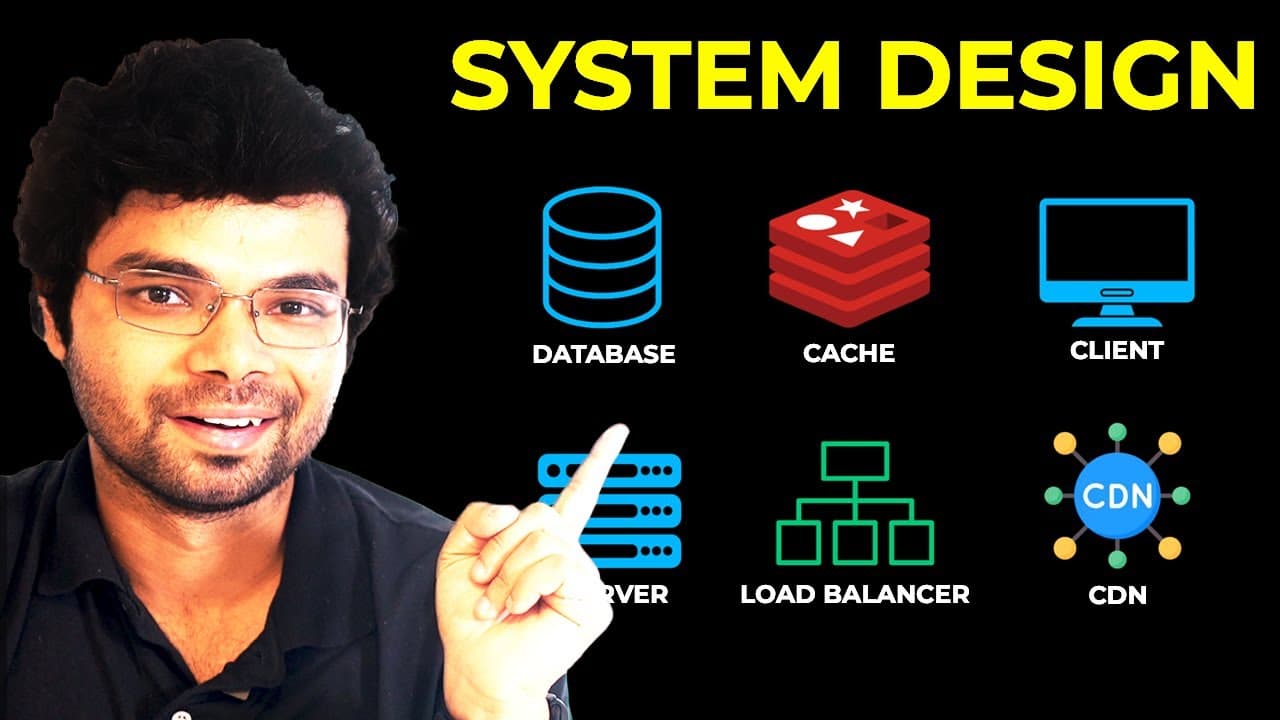
30 critical system design concepts can significantly enhance your software engineering career. This video outlines these concepts, emphasizing the importance of client-server architecture, APIs, and efficient database management, which are essential for building scalable and reliable systems.
Transcript
if you want to level up from a junior developer to a senior engineer or land a high paying job at a big tech company you need to learn system design but where do you start to master system design you first need to understand the core concepts and fundamental building blocks that come up when designing real world systems or tackling system design in... Read More
Key Insights
- Understanding client-server architecture is crucial as it forms the backbone of most web applications, facilitating communication between clients and servers through requests and responses.
- DNS plays a vital role in mapping human-friendly domain names to IP addresses, enabling seamless access to web services without needing to remember complex IP addresses.
- Latency issues can be mitigated by deploying services across multiple data centers globally, allowing users to connect to the nearest server for faster response times.
- APIs, particularly REST and GraphQL, enable structured communication between clients and servers, with REST being simpler and more scalable, while GraphQL offers more efficient data retrieval.
- Choosing between SQL and NoSQL databases depends on data structure needs, with SQL offering strong consistency and NoSQL providing high scalability and flexible schema options.
- Horizontal scaling involves adding more servers to distribute load, enhancing capacity and reliability, while load balancers manage traffic distribution across servers.
- Caching improves performance by storing frequently accessed data in memory, reducing database load, and speeding up data retrieval for repeated requests.
- Microservices architecture allows for independent scaling and deployment of application components, improving manageability and scalability compared to monolithic architectures.
Install to Summarize YouTube Videos and Get Transcripts
Explore YouTube Video Summarizer or Get YouTube Transcript Extractor
Questions & Answers
Q: What is the role of DNS in system design?
DNS, or Domain Name System, is crucial in system design as it maps human-friendly domain names to machine-friendly IP addresses. This allows users to access web services without remembering complex numerical IP addresses, making the internet more accessible and user-friendly. DNS servers respond to queries with the corresponding IP address, enabling browsers to establish connections with the correct server.
Q: How does horizontal scaling improve system reliability?
Horizontal scaling improves system reliability by distributing the workload across multiple servers, rather than relying on a single server. This means if one server fails, others can take over, ensuring continuous service availability. It also increases the system's capacity to handle more traffic, as more servers equate to more resources, making the system more robust and fault-tolerant.
Q: What are the advantages of using a microservices architecture?
Microservices architecture offers several advantages, including independent scaling and deployment of application components, which improves manageability and scalability. Each microservice handles a specific responsibility, allowing teams to develop, deploy, and scale them independently. This architecture also enhances fault isolation, as issues in one microservice do not directly impact others, leading to improved system resilience.
Q: Why is caching important in system design?
Caching is important in system design because it significantly improves performance by storing frequently accessed data in memory. This reduces the need to repeatedly fetch data from the database, which can be time-consuming. Caching speeds up data retrieval for repeated requests, decreases database load, and enhances the overall responsiveness of the application, especially for read-heavy operations.
Q: How do REST and GraphQL APIs differ in data retrieval?
REST and GraphQL APIs differ in their approach to data retrieval. REST APIs follow a structured approach, where data is accessed through predefined endpoints, often leading to over-fetching or under-fetching of data. GraphQL, on the other hand, allows clients to specify exactly what data they need in a single query, reducing network inefficiencies by retrieving only the necessary data. However, GraphQL requires more server-side processing.
Q: What are the trade-offs between SQL and NoSQL databases?
The trade-offs between SQL and NoSQL databases revolve around consistency and scalability. SQL databases offer strong consistency and structured data relationships, making them ideal for applications requiring transactional integrity, like banking systems. NoSQL databases provide high scalability and flexible schema options, suitable for applications with large-scale, unstructured data needs. The choice depends on the specific requirements of the application.
Q: What is the purpose of a load balancer in a distributed system?
A load balancer in a distributed system acts as a traffic manager, distributing incoming client requests across multiple backend servers. This ensures no single server is overwhelmed, enhancing system performance and reliability. Load balancers use algorithms like round-robin or least connections to decide which server should handle each request, automatically redirecting traffic if a server fails, thus maintaining service availability and stability.
Q: Why is rate limiting important for public APIs?
Rate limiting is important for public APIs to prevent abuse and ensure fair usage of resources. By restricting the number of requests a client can make within a specific time frame, rate limiting protects servers from being overwhelmed by excessive requests, which could degrade performance for legitimate users. It also helps in managing server load and maintaining the quality of service by preventing potential denial-of-service attacks.
Summary & Key Takeaways
-
The video emphasizes the importance of mastering system design concepts for career growth, especially for software engineers aiming for senior roles or positions in big tech companies. It covers essential topics like client-server architecture, DNS, and latency reduction strategies to improve application performance.
-
APIs, particularly REST and GraphQL, are highlighted for their roles in facilitating communication between clients and servers. While REST is known for its simplicity and scalability, GraphQL offers precise data retrieval, reducing network inefficiencies.
-
Database management is explored, comparing SQL and NoSQL options based on consistency and scalability needs. The video also discusses horizontal scaling, load balancing, caching, and microservices architecture as strategies for building scalable and reliable systems.
Read in Other Languages (beta)
Share This Summary 📚
Summarize YouTube Videos and Get Video Transcripts with 1-Click
Try YouTube Summary with ChatGPT & Claude or YouTube Transcript Generator
Explore More Summaries from Ashish Pratap Singh 📚


Summarize YouTube Videos and Get Video Transcripts with 1-Click
Try YouTube Summary with ChatGPT & Claude or YouTube Transcript Generator