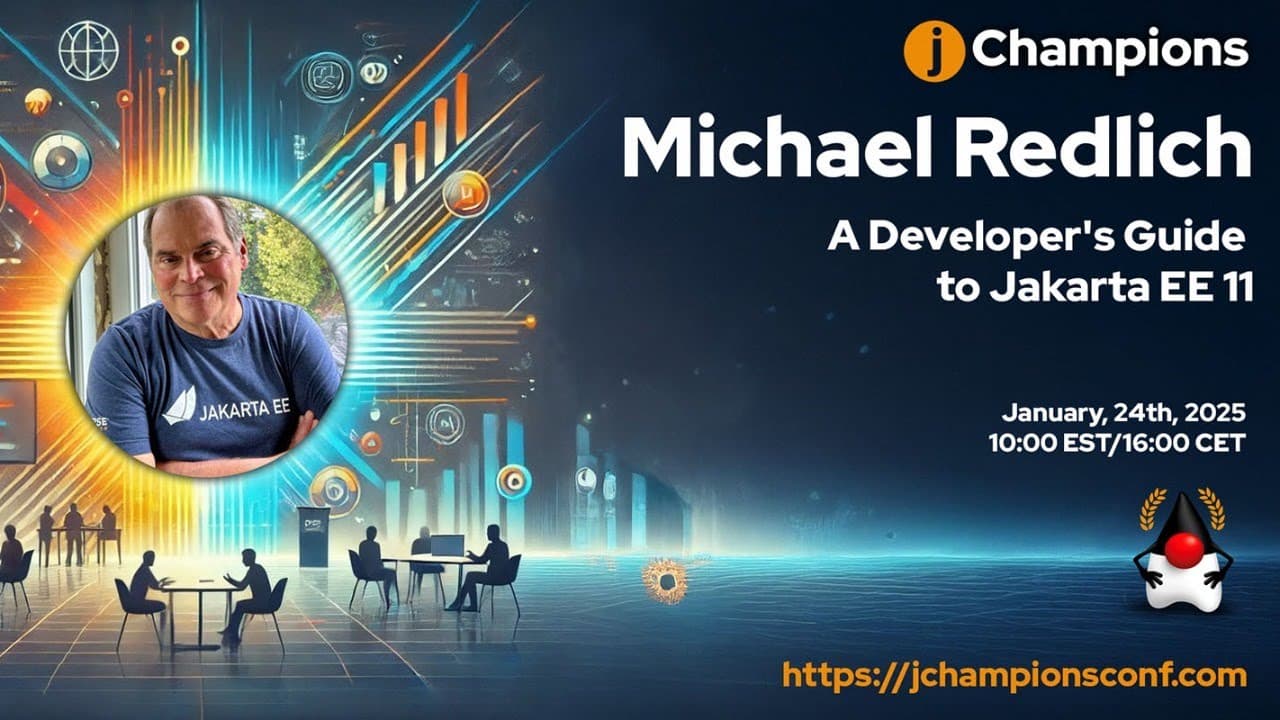
A Developer's Guide to Jakarta EE 11
TL;DR
Comprehensive guide to Jakarta EE 11 features and updates.
Transcript
hello and welcome to yet another session at J Champions conference uh here today we have a great pleasure of having Michael with me my name is rustam and I'll be uh your host and uh the uh speaker for today for this session is Michael that will be talking about developers guide to Jakarta E1 um to all of you on the stream we would love to h... Read More
Key Insights
- Jakarta EE 11 builds on its predecessors, focusing on productivity and innovation with updates to 16 specifications.
- The introduction of Jakarta Data in EE 11 enhances database interaction, offering new repository interfaces and annotations.
- Jakarta EE 11 aligns with Java 21 LTS, ensuring compatibility with the latest Java features and improvements.
- The Core Profile, introduced in EE 10, is designed for cloud and microservices architectures, supporting smaller runtimes.
- The removal of the Legacy Managed Bean annotation and Security Manager references ensures a more modern and streamlined framework.
- Collaboration between Jakarta Security and MicroProfile JWT aims to eliminate duplication and foster interoperability.
- Jakarta EE 11 supports virtual threads for concurrency, improving scalability and performance in high-load environments.
- The platform encourages community involvement and open-source contributions, emphasizing the importance of collective development.
Install to Summarize YouTube Videos and Get Transcripts
Explore YouTube Video Summarizer or Get YouTube Transcript Extractor
Questions & Answers
Q: What is the significance of Jakarta Data in EE 11?
Jakarta Data is a new specification introduced in EE 11, designed to simplify and enhance database interactions. It provides a standardized approach for repository interfaces, supporting common operations like find, insert, update, and delete. This addition aims to streamline persistence logic and improve developer productivity.
Q: How does Jakarta EE 11 support cloud-native development?
Jakarta EE 11 supports cloud-native development through its Core Profile, which is optimized for smaller runtimes and microservices. This profile is ideal for cloud environments, providing a lightweight and efficient framework for developing scalable applications. The platform's alignment with Java 21 also ensures compatibility with modern cloud technologies.
Q: What changes have been made to the Security Manager in EE 11?
In Jakarta EE 11, references to the Security Manager have been removed, following its deprecation in JDK 17. This change aligns with the platform's goal of modernizing its architecture and reducing dependencies on legacy components. The removal simplifies security management and encourages the use of more current security practices.
Q: How does Jakarta EE 11 improve concurrency handling?
Jakarta EE 11 introduces support for virtual threads, a feature that enhances concurrency handling by allowing applications to manage a large number of lightweight threads efficiently. This improvement is particularly beneficial for high-load applications, providing better scalability and performance compared to traditional thread management.
Q: What is the role of community involvement in Jakarta EE's development?
Community involvement is crucial in Jakarta EE's development, as it is an open-source platform driven by collective contributions. The platform encourages developers to participate in discussions, contribute code, and improve documentation, fostering a collaborative environment that ensures the platform meets the needs of its diverse user base.
Q: How does Jakarta EE 11 ensure compatibility with the latest Java technologies?
Jakarta EE 11 sets Java 21 as its baseline, ensuring compatibility with the latest long-term support (LTS) release. This alignment allows developers to leverage new Java features and improvements, such as virtual threads and enhanced language constructs, while maintaining a stable and robust enterprise platform.
Q: What are the benefits of removing the Legacy Managed Bean annotation?
Removing the Legacy Managed Bean annotation in Jakarta EE 11 streamlines the framework by promoting a consistent use of CDI (Contexts and Dependency Injection) across the platform. This change reduces complexity, encourages best practices, and aligns with modern development paradigms, making the platform more accessible and efficient for developers.
Q: How does Jakarta EE 11 handle interoperability with MicroProfile?
Jakarta EE 11 enhances interoperability with MicroProfile through initiatives like the JWT Bridge, which fosters collaboration between Jakarta Security and MicroProfile JWT Authentication. This integration reduces duplication of effort and ensures seamless interaction between the two frameworks, providing a more cohesive development experience for enterprise applications.
Summary & Key Takeaways
-
Jakarta EE 11 continues to evolve the enterprise Java ecosystem with a focus on productivity and modern development practices. It introduces Jakarta Data, updates 16 specifications, and aligns with Java 21 LTS, ensuring developers have access to the latest Java technologies.
-
The session highlights the historical evolution from Java EE to Jakarta EE, emphasizing the platform's commitment to innovation and community-driven development. It also showcases practical examples and demos of new features.
-
Key changes in Jakarta EE 11 include the removal of outdated components, enhanced support for cloud-native applications, and improved interoperability with MicroProfile, positioning the platform as a robust choice for enterprise applications.
Read in Other Languages (beta)
Share This Summary 📚
Summarize YouTube Videos and Get Video Transcripts with 1-Click
Try YouTube Summary with ChatGPT & Claude or YouTube Transcript Generator