Bay.Area.AI: DSPy: Prompt Optimization for LM Programs, Michael Ryan
TL;DR
DSPy enhances AI by optimizing LM programs, not just prompts.
Transcript
hi everyone I'm Michael uh I am working on dspi I am a master student at Stanford and this summer I'm a research intern at snowflake uh so I got involved uh with dspi working on the prompt optimization part of dsy along with Christa opsal along and Josh pel uh so we make up the prompt optimization team within dspi um and the title s... Read More
Key Insights
- DSPy focuses on optimizing entire language model programs rather than just individual prompts, allowing for more robust and reliable AI systems.
- Language models often exhibit errors and hallucinations, which can lead to real-world consequences, highlighting the need for better optimization techniques.
- DSPy enables the creation of modular AI applications that can be rigorously tested and optimized, similar to traditional software systems.
- The framework abstracts prompt optimization, allowing it to adapt to new advancements in language model technology seamlessly.
- MIPROv2, a key component of DSPy, optimizes both prompt instructions and few-shot demonstrations, significantly improving AI performance.
- DSPy supports structured outputs and allows for enforcement of specific formats through assertions and suggestions.
- The optimization process in DSPy involves bootstrapping task demonstrations and proposing instruction candidates using Bayesian learning.
- DSPy has shown significant performance improvements in various tasks, often outperforming human prompt engineering efforts.
Install to Summarize YouTube Videos and Get Transcripts
Explore YouTube Video Summarizer or Get YouTube Transcript Extractor
Questions & Answers
Q: What is the main focus of DSPy?
DSPy focuses on optimizing entire language model programs rather than just individual prompts. This approach allows for the creation of more robust and reliable AI systems that can be rigorously tested and optimized, similar to traditional software systems. By abstracting prompt optimization, DSPy can adapt to new advancements in language model technology seamlessly.
Q: How does DSPy handle prompt optimization?
DSPy handles prompt optimization by allowing the creation of modular AI applications that can be rigorously tested and optimized. The framework abstracts prompt optimization, enabling it to adapt to new advancements in language model technology seamlessly. This ensures that AI systems built with DSPy are future-proof and can incorporate the latest developments in AI research.
Q: What is MIPROv2 and its role in DSPy?
MIPROv2 is a key component of DSPy, serving as an advanced optimization algorithm that significantly enhances AI performance. It optimizes both prompt instructions and few-shot demonstrations, leading to improved accuracy and efficiency in language model programs. This makes it one of the most performant optimizers available within the DSPy framework.
Q: How does DSPy ensure structured output generation?
DSPy ensures structured output generation by supporting the enforcement of specific formats through assertions and suggestions. These mechanisms allow developers to define the expected structure of outputs, such as XML tags, and ensure that the generated outputs adhere to these specifications. This capability enhances the reliability and consistency of AI applications built with DSPy.
Q: What are the key steps in DSPy's optimization process?
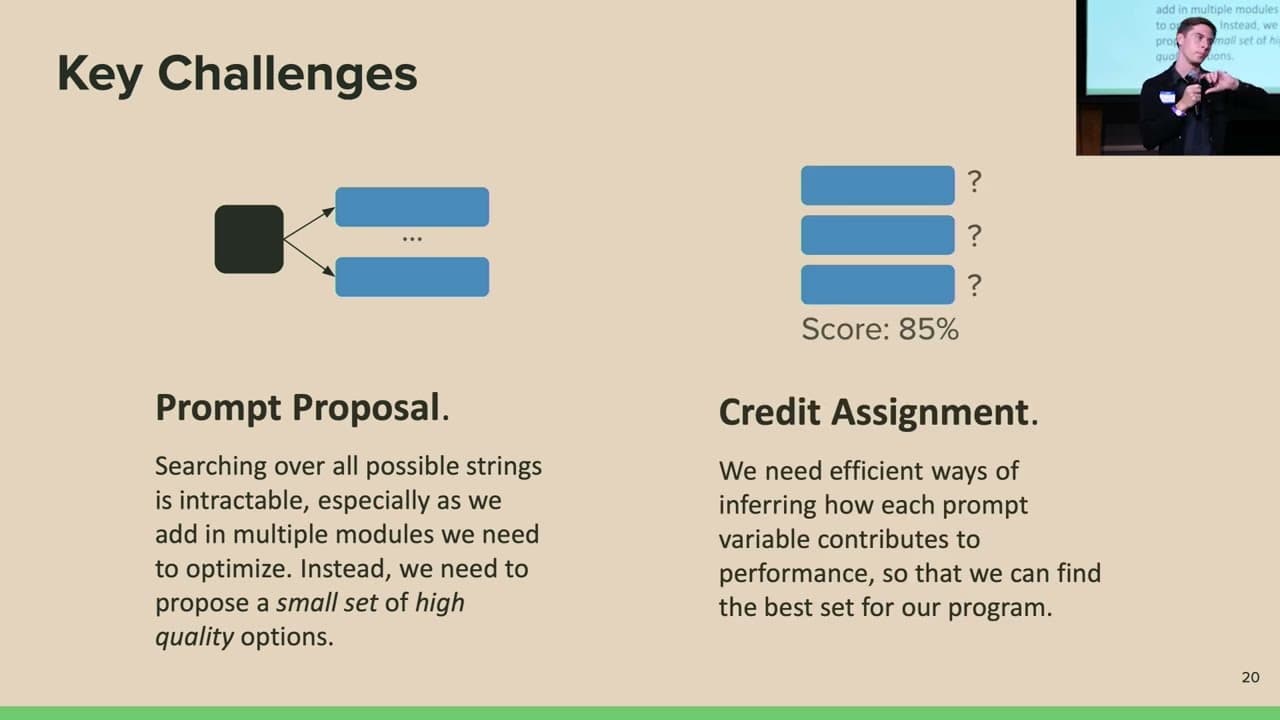
The key steps in DSPy's optimization process include bootstrapping task demonstrations and proposing instruction candidates using Bayesian learning. This involves running language model programs to generate outputs, evaluating them against a metric, and selecting the best-performing combinations of prompts and demonstrations. The process ensures that AI systems built with DSPy achieve optimal performance.
Q: Can DSPy work with different language models?
Yes, DSPy can work with different language models and is designed to be adaptable to various AI technologies. The framework's abstraction of prompt optimization allows it to integrate seamlessly with new advancements in language model technology, ensuring that AI systems built with DSPy remain up-to-date and incorporate the latest developments in AI research.
Q: How does DSPy compare to human prompt engineering?
DSPy often outperforms human prompt engineering efforts by automating the optimization of language model programs. The framework's advanced algorithms, such as MIPROv2, allow for the efficient optimization of both prompts and weights, leading to significant performance improvements. This automation reduces the time and effort required for prompt engineering, making DSPy a powerful tool for AI development.
Q: What are the future directions for DSPy?
Future directions for DSPy include expanding its capabilities to support reinforcement learning optimization, improving documentation, and enhancing production readiness. The framework aims to incorporate human-in-the-loop optimization, allowing developers to collaborate with AI in the optimization process. Additionally, DSPy seeks to build routing functions that determine the best prompts for specific tasks, further enhancing AI performance.
Summary & Key Takeaways
-
Michael Ryan discusses DSPy, a framework designed to optimize language model programs rather than just prompts, improving AI reliability and efficiency. He highlights the adaptability of DSPy to new language model advancements, making it a future-proof solution for AI development.
-
DSPy allows for the creation of modular AI systems that can be rigorously tested and optimized, similar to traditional software systems. Michael introduces MIPROv2, an advanced optimization algorithm that enhances AI performance by optimizing both prompts and weights.
-
DSPy supports structured output generation and allows for the enforcement of specific formats. The optimization process involves bootstrapping task demonstrations and proposing instruction candidates using Bayesian learning, leading to significant performance improvements.
Read in Other Languages (beta)
Share This Summary 📚
Summarize YouTube Videos and Get Video Transcripts with 1-Click
Try YouTube Summary with ChatGPT & Claude or YouTube Transcript Generator