How Do You Derive the One-Dimensional Heat Equation?
TL;DR
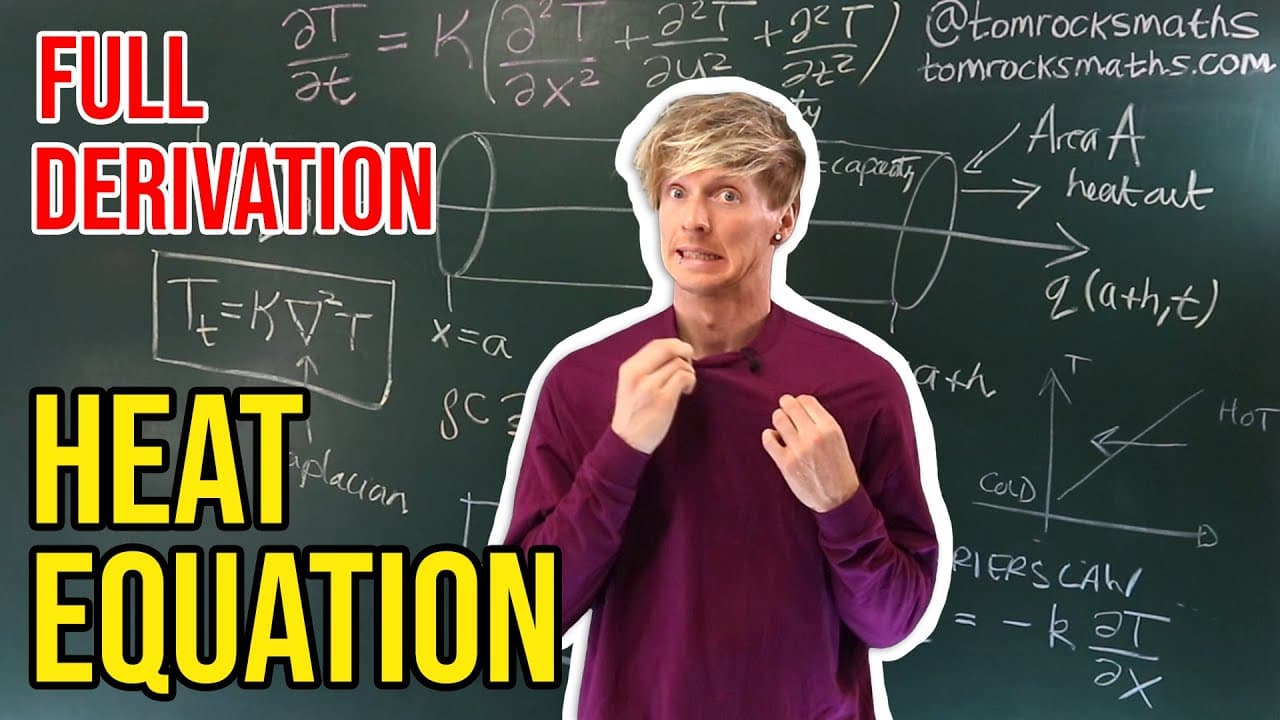
To derive the one-dimensional heat equation, relate the time rate of temperature change to the second spatial derivative of temperature. This is achieved by analyzing a long rod's internal energy changes and applying Fourier's law, which states that heat flux is proportional to the negative temperature gradient. The resulting equation describes heat conduction in materials and can be generalized to higher dimensions.
Transcript
hello maths fans dr tom crawford here at the university of oxford with another video in the oxford calculus series today we're going to be deriving the heat equation this is one of the first pdes you will see as a maths undergrad as it can be solved by looking for a separable solution and using the technique of fourier series both of these topics w... Read More
Key Insights
- 🥵 The one-dimensional heat equation relates the time derivative of temperature to the second spatial derivative of temperature.
- 🥵 Separable solutions and Fourier series can be used to solve the heat equation.
- 🤔 The derivation involves considering a long, thin cylinder and studying the change in internal energy within a small segment of the rod.
- 🥵 Fourier's law states that the heat flux is proportional to the negative gradient of temperature.
- 🪜 The derivation can be extended to two dimensions and three dimensions by adding appropriate spatial derivatives.
- 🥵 The Maple Learn worksheet provides interactive practice and visualization of solutions to the heat equation.
- 🥵 The heat equation is a fundamental equation in heat transfer and has various applications in physics and engineering.
Install to Summarize YouTube Videos and Get Transcripts
Explore YouTube Video Summarizer or Get YouTube Transcript Extractor
Questions & Answers
Q: What is the heat equation in one dimension?
The one-dimensional heat equation is a partial differential equation that relates the time derivative of temperature to the second spatial derivative of temperature. It is commonly used to model heat transfer in materials.
Q: How can the heat equation be solved?
The heat equation can be solved by finding separable solutions, where the temperature function can be expressed as a product of separate functions of time and space. Fourier series can also be used to find the solution by decomposing the temperature into a sum of sine and cosine functions.
Q: Why is the cross-sectional area of the rod important in the derivation?
The cross-sectional area of the rod is important because it allows us to calculate the internal energy of a segment of the rod. The change in internal energy depends on the heat flux entering and leaving the rod, which is determined by the cross-sectional area.
Q: How does Fourier's law relate to the heat equation?
Fourier's law states that the heat flux is proportional to the negative gradient of temperature. In the heat equation derivation, Fourier's law is used to substitute for the heat flux, resulting in a relationship between the temperature and its spatial derivatives.
Key Insights:
- The one-dimensional heat equation relates the time derivative of temperature to the second spatial derivative of temperature.
- Separable solutions and Fourier series can be used to solve the heat equation.
- The derivation involves considering a long, thin cylinder and studying the change in internal energy within a small segment of the rod.
- Fourier's law states that the heat flux is proportional to the negative gradient of temperature.
- The derivation can be extended to two dimensions and three dimensions by adding appropriate spatial derivatives.
- The Maple Learn worksheet provides interactive practice and visualization of solutions to the heat equation.
- The heat equation is a fundamental equation in heat transfer and has various applications in physics and engineering.
- Understanding and solving the heat equation is an important topic in mathematics education and research.
Summary & Key Takeaways
-
The video discusses the derivation of the one-dimensional heat equation, which relates the time derivative of temperature to the second spatial derivative of temperature.
-
It explains the concept of separable solutions and Fourier series, which are used to solve the heat equation.
-
The derivation involves considering a long, thin cylinder and studying the change in internal energy within a small segment of the rod.
-
The video emphasizes the importance of using the Maple Learn worksheet for interactive practice and understanding the behavior of solutions.
Read in Other Languages (beta)
Share This Summary 📚
Summarize YouTube Videos and Get Video Transcripts with 1-Click
Try YouTube Summary with ChatGPT & Claude or YouTube Transcript Generator