How Does Kolb's Learning Cycle Enhance Education?
TL;DR
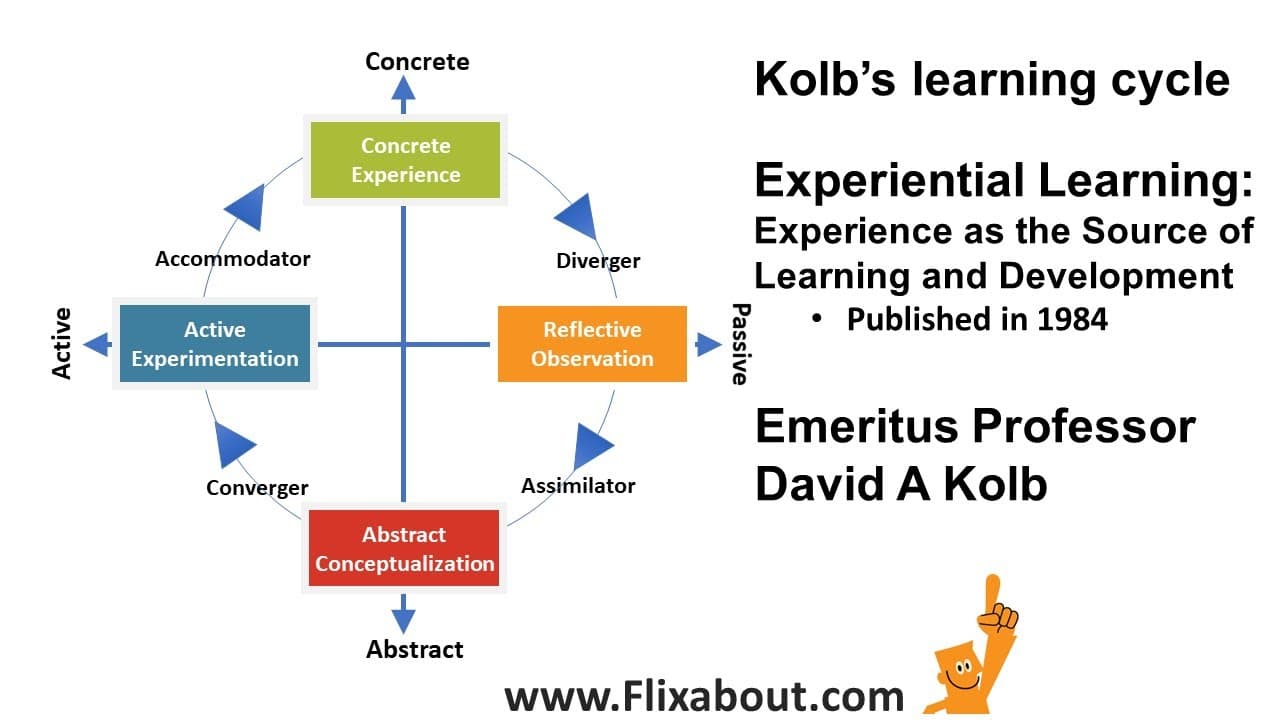
Kolb's Experiential Learning Model illustrates the learning process through four key elements: concrete experience, reflective observation, abstract conceptualization, and active experimentation. By recognizing the four learning styles—diverger, assimilator, converger, and accommodator—educators can tailor their approaches to different learners, ultimately fostering more effective learning experiences.
Transcript
david kolb is an american emeritus professor of organizational behavior he is a learning specialist and he developed the experiential learning model also called kolb's learning cycle the model was published in the book experiential learning in 1984. the model provides an insight into how individuals learn the model contains different learning style... Read More
Key Insights
- David A. Kolb developed the Experiential Learning Model, emphasizing the importance of understanding individual learning styles to enhance learning processes.
- Kolb's model consists of two dimensions: four elements of learning and four learning styles, each influencing how individuals process and perceive information.
- The four elements of learning are concrete experience, reflective observation, abstract conceptualization, and active experimentation, forming a continuous learning cycle.
- The four learning styles—diverger, assimilator, converger, and accommodator—are combinations of active/passive and concrete/abstract approaches.
- Divergers focus on innovative approaches and are motivated by understanding the 'why' of situations through feeling and watching.
- Assimilators prefer organized information and are motivated by the 'what' of learning, emphasizing watching and thinking.
- Convergers emphasize practical applications and are motivated by the 'how' of learning, focusing on doing and thinking.
- Accommodators thrive on active participation and are motivated by exploring 'what if' scenarios through doing and feeling.
Install to Summarize YouTube Videos and Get Transcripts
Explore YouTube Video Summarizer or Get YouTube Transcript Extractor
Questions & Answers
Q: What is the primary focus of Kolb's Experiential Learning Model?
Kolb's Experiential Learning Model primarily focuses on understanding how individuals learn through experiences. It emphasizes the importance of recognizing different learning styles to tailor educational approaches that align with individual preferences. The model outlines a cyclical process involving four key elements: concrete experience, reflective observation, abstract conceptualization, and active experimentation.
Q: How do the four elements of learning function in Kolb's model?
In Kolb's model, the four elements of learning—concrete experience, reflective observation, abstract conceptualization, and active experimentation—function as a continuous cycle. Learners can enter the cycle at any point, engaging in experiences, reflecting on them, conceptualizing new ideas, and experimenting with these ideas in practice. This cyclical approach supports comprehensive, experiential learning.
Q: What are the characteristics of the diverger learning style?
The diverger learning style is characterized by a preference for innovative and imaginative approaches. Divergers are motivated by understanding the 'why' of situations, often using feeling and watching to learn. They excel in viewing concrete situations from multiple perspectives and prefer activities like cooperative group work and brainstorming, where they can explore ideas and emotions.
Q: How does the assimilator learning style approach learning?
Assimilators approach learning by seeking organized and accurate information, often focusing on the 'what' aspect of learning. They prefer to watch and think, valuing expert knowledge and structured presentations. Assimilators enjoy creating models and theories and are comfortable following detailed instructions and structured exercises to gain a comprehensive understanding of a subject.
Q: What motivates convergers in their learning process?
Convergers are motivated by discovering the 'how' of a situation, emphasizing practical applications and problem-solving. They prefer to engage in doing and thinking, often tackling technical problems and decision-making tasks. Convergers benefit from interactive instructional methods, such as computer-assisted instruction and problem sets, that allow them to apply their understanding in practical contexts.
Q: Describe the accommodator's approach to learning.
Accommodators thrive on active participation and are motivated by exploring 'what if' scenarios. They prefer doing and feeling, often using trial and error rather than reflection to solve problems. Accommodators excel in dynamic environments, adapting to changing circumstances and discovering new learning through hands-on experiences. They ask challenging questions and enjoy being active participants in their learning journey.
Q: How can Kolb's model be applied in organizational settings?
In organizational settings, Kolb's model can be applied to tailor learning experiences to suit individual learning styles, enhancing overall learning outcomes. Leaders can use the model to identify employees' preferred learning styles and design training programs that align with these preferences. This approach can improve engagement, facilitate skill development, and support organizational learning and development initiatives.
Q: What are some criticisms of Kolb's Experiential Learning Model?
Some criticisms of Kolb's Experiential Learning Model include its focus on the cognitive dimension of learning, overlooking psychodynamic and societal factors. Critics argue that the model lacks guidance on when to shift between different learning styles and does not address the challenges learners may face in doing so. Despite these criticisms, the model is praised for its holistic approach to learning and development.
Summary & Key Takeaways
-
David A. Kolb's Experiential Learning Model provides insights into how individuals learn through experiences, emphasizing the significance of understanding different learning styles to enhance learning effectiveness. The model consists of two dimensions: four elements of learning and four distinct learning styles, each influencing how information is processed and perceived.
-
The four elements of learning—concrete experience, reflective observation, abstract conceptualization, and active experimentation—form a continuous cycle that individuals can enter at any point. The model highlights the importance of experiencing, reflecting, conceptualizing, and experimenting to achieve comprehensive learning.
-
Kolb's model identifies four learning styles: diverger, assimilator, converger, and accommodator. Each style combines active/passive and concrete/abstract approaches, influencing how individuals prefer to learn. Understanding these styles can help leaders tailor learning experiences to suit different individuals, enhancing overall learning outcomes.
Read in Other Languages (beta)
Share This Summary 📚
Summarize YouTube Videos and Get Video Transcripts with 1-Click
Try YouTube Summary with ChatGPT & Claude or YouTube Transcript Generator
Explore More Summaries from flixabout.com 📚
Summarize YouTube Videos and Get Video Transcripts with 1-Click
Try YouTube Summary with ChatGPT & Claude or YouTube Transcript Generator