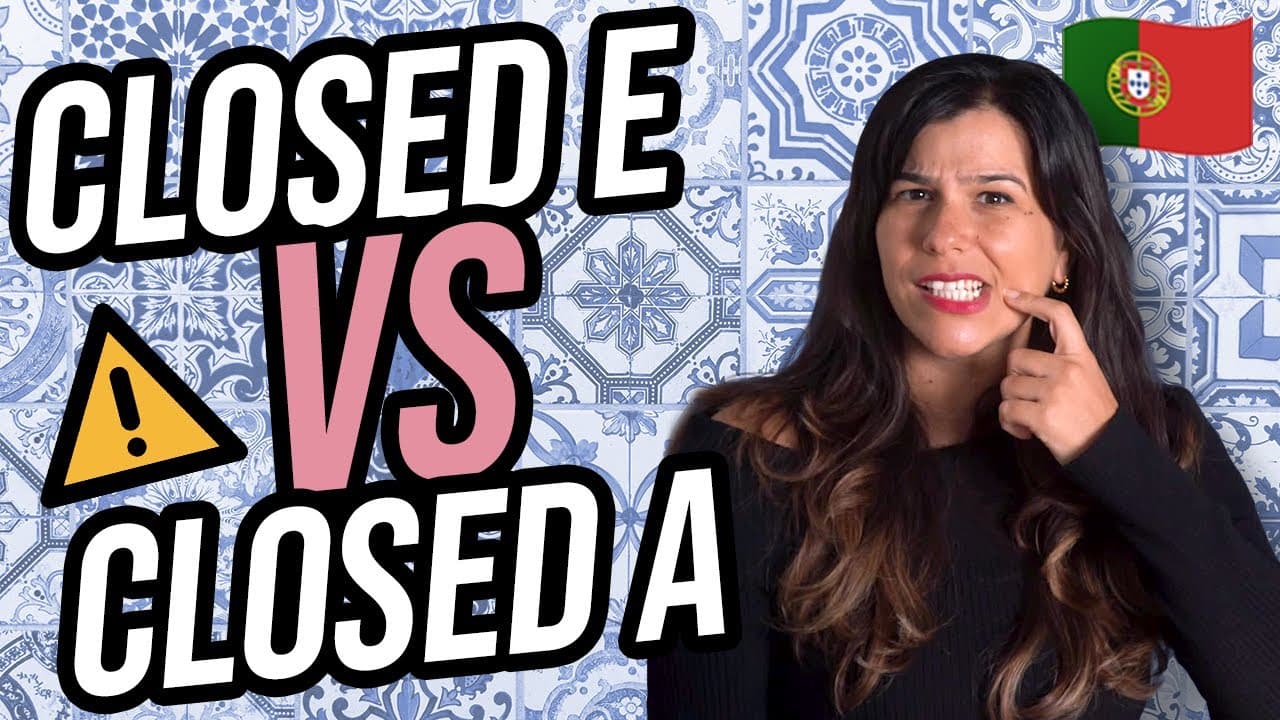
Improve Your Accent: The Difference Between Closed A and Closed E in Portuguese
TL;DR
Learn to pronounce closed vowels for authentic Portuguese accent.
Transcript
Do you still feel like you don't quite sound Portuguese enough when you speak? Well, mastering the pronunciation of closed vowels could be the game changer that you've been searching for. If you caught my recent video on how to hear those hidden syllables in Portuguese, you already know how crucial closed vowels are in sounding authentic in Portugu... Read More
Key Insights
- Pronunciation of closed vowels in Portuguese is crucial for sounding authentic and avoiding being identified as a foreigner.
- Closed e and a sounds are essential for achieving a natural Portuguese accent, with the closed e being particularly challenging for English speakers.
- Understanding and mastering closed vowels can significantly improve comprehension of spoken Portuguese, as these sounds are often reduced in fast speech.
- The closed e sound does not exist in English or Spanish, making it difficult for speakers of these languages to master without practice.
- The closed a sound is similar to the English 'a' in 'away,' making it easier for English speakers to grasp.
- Proper pronunciation can impact social interactions, as using the wrong vowel sound may unintentionally convey rudeness or familiarity.
- Listening to Portuguese music, like 'Grandula Va Morena,' can be an effective way to practice and internalize the sounds of closed vowels.
- Mastering closed vowels enhances both speaking and listening skills, leading to more confident and successful conversations in Portuguese.
Install to Summarize YouTube Videos and Get Transcripts
Explore YouTube Video Summarizer or Get YouTube Transcript Extractor
Questions & Answers
Q: Why are closed vowels important in Portuguese pronunciation?
Closed vowels are crucial in Portuguese pronunciation as they significantly contribute to sounding authentic and avoiding being identified as a foreign speaker. Mastering these sounds can elevate your Portuguese conversations, making you sound more natural and helping you to be understood clearly by native speakers.
Q: What makes the closed e sound challenging for English speakers?
The closed e sound is challenging for English speakers because it does not exist in the English language. This lack of familiarity makes it difficult to master without specific practice. Unlike the closed a sound, which is similar to sounds in English, the closed e requires focused attention and practice to perfect.
Q: How can understanding closed vowels improve comprehension of spoken Portuguese?
Understanding closed vowels improves comprehension of spoken Portuguese by helping listeners recognize reduced sounds that occur in natural speech. These vowels are often unstressed and reduced, making them less pronounced. Mastering closed vowels allows learners to better understand the nuances of fast, fluent Portuguese speech.
Q: What impact does proper pronunciation have on social interactions in Portuguese?
Proper pronunciation impacts social interactions by ensuring that you convey the correct level of formality and politeness. Using the wrong vowel sound can unintentionally make you sound rude or overly familiar, particularly in formal settings. Correct pronunciation helps in maintaining appropriate social etiquette and communication.
Q: What role does music play in practicing Portuguese pronunciation?
Music plays a valuable role in practicing Portuguese pronunciation by providing a fun and engaging way to internalize sounds. Songs like 'Grandula Va Morena' use closed vowels repeatedly, offering learners an opportunity to hear and practice these sounds in context, reinforcing their learning and improving their pronunciation.
Q: How does mastering closed vowels affect Portuguese speaking and listening skills?
Mastering closed vowels enhances both speaking and listening skills by allowing learners to produce and recognize these sounds accurately. This proficiency leads to clearer communication and better understanding of native speakers, ultimately boosting confidence and effectiveness in conversations, and reducing the likelihood of misunderstandings.
Q: Why is the closed a sound easier for English speakers to learn?
The closed a sound is easier for English speakers to learn because it is similar to the 'a' sound in the English word 'away.' This similarity makes it more familiar and accessible, allowing English speakers to grasp and reproduce the sound with less difficulty compared to the unfamiliar closed e sound.
Q: What are the benefits of mastering closed vowels in Portuguese?
The benefits of mastering closed vowels in Portuguese include sounding more authentic, improving comprehension of native speech, and enhancing social interactions. Learners who master these sounds are often perceived as more proficient, leading to more successful and confident conversations, and reducing the need for native speakers to switch to English.
Summary & Key Takeaways
-
Mastering closed vowels in Portuguese is key to sounding authentic and avoiding being identified as a foreign speaker. The video focuses on the closed e and a sounds, which are crucial for a natural accent. Proper pronunciation can significantly improve comprehension and social interactions in Portuguese-speaking environments.
-
The closed e sound is challenging for English speakers as it doesn't exist in English or Spanish. However, the closed a sound is similar to the English 'a' in 'away,' making it easier to learn. Understanding these sounds helps in better understanding spoken Portuguese and achieving a more authentic accent.
-
Using Portuguese music, such as 'Grandula Va Morena,' can help practice closed vowels. Proper pronunciation of these sounds affects interactions, as incorrect usage may convey unintended rudeness or familiarity. Mastering closed vowels enhances both speaking and listening skills, boosting confidence in Portuguese conversations.
Read in Other Languages (beta)
Share This Summary 📚
Summarize YouTube Videos and Get Video Transcripts with 1-Click
Try YouTube Summary with ChatGPT & Claude or YouTube Transcript Generator
Explore More Summaries from Talk the Streets 📚



Summarize YouTube Videos and Get Video Transcripts with 1-Click
Try YouTube Summary with ChatGPT & Claude or YouTube Transcript Generator