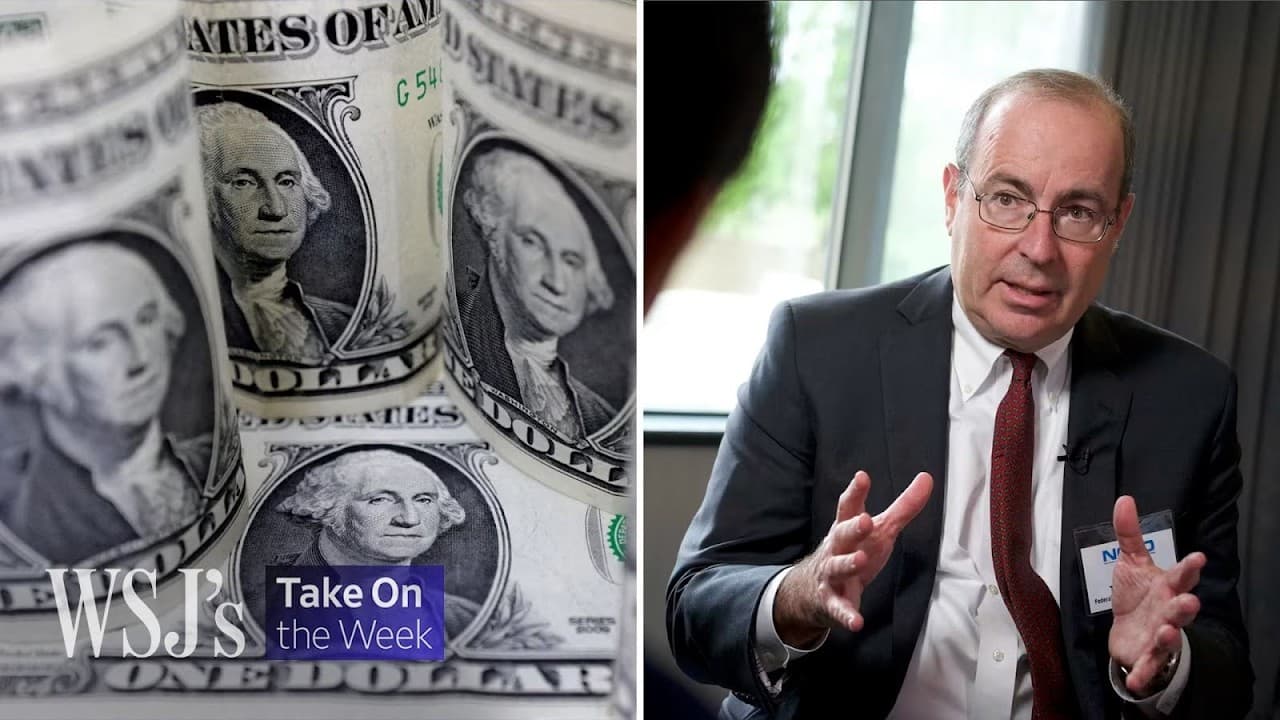
Why This Fed President Is in No Rush to Cut Interest Rates | WSJ’s Take On the Week
TL;DR
Tom Barkin explains why the Fed isn't rushing to cut rates.
Transcript
- The reason consumers are unhappy is fear of inflation. What we learned in 2022, consumer sentiment dropped, but they kept spending. That's because people basically hate inflation, it's unfair. Uncertainty feels like you've not getting appropriately rewarded, they just hate it. That doesn't mean they stop spending, they're just unhappy about it. -... Read More
Key Insights
- Tom Barkin emphasizes that the Fed is cautious about cutting interest rates due to the current economic uncertainty, likening it to 'driving through fog.'
- Despite consumer dissatisfaction with inflation, spending remains steady, indicating a disconnect between sentiment and actual economic behavior.
- Economic forecasting is challenging due to unpredictable external factors, making it difficult to rely on traditional indicators like the yield curve.
- Barkin suggests that the impact of tariffs on the economy might become more apparent by the summer, as delayed effects work through the supply chain.
- The media's constant coverage of economic issues like tariffs and inflation can influence consumer sentiment, contributing to elevated inflation expectations.
- Barkin notes that AI could significantly alter the job market, creating new roles while eliminating others, which could affect recent graduates.
- The Fed is prepared to adjust rates based on evolving economic conditions, whether to combat inflation or support employment.
- Barkin believes that the U.S. economy can withstand higher tariffs without falling into a recession, as seen in previous years.
Install to Summarize YouTube Videos and Get Transcripts
Explore YouTube Video Summarizer or Get YouTube Transcript Extractor
Questions & Answers
Q: Why is the Federal Reserve hesitant to cut interest rates?
Tom Barkin explains that the Federal Reserve is cautious about cutting interest rates due to the current economic uncertainty, which he likens to 'driving through fog.' With unpredictable factors such as tariffs and potential policy changes, the Fed prefers to maintain a steady course until the economic outlook becomes clearer.
Q: How does consumer sentiment relate to spending in the current economic climate?
Despite consumer dissatisfaction with inflation, spending remains steady, indicating a disconnect between sentiment and actual economic behavior. Barkin notes that while sentiment might suggest caution, hard data shows that consumer spending continues, driven by factors such as low unemployment and stable wages.
Q: What challenges does economic forecasting face according to Barkin?
Economic forecasting is challenging due to unpredictable external factors like political decisions and global events. Traditional indicators, such as the yield curve, have not consistently predicted economic outcomes. Barkin highlights that unexpected events often drive recessions, making it difficult to rely solely on forecasts.
Q: When will the economic impact of tariffs become evident?
Barkin suggests that the impact of tariffs on the economy might become more apparent by the summer, as delayed effects work through the supply chain. Retailers and manufacturers are currently negotiating costs, and price adjustments are expected to reflect in consumer prices in the coming months.
Q: How does media coverage affect consumer sentiment?
The media's constant coverage of economic issues like tariffs and inflation can influence consumer sentiment, contributing to elevated inflation expectations. Barkin notes that the omnipresence of media can amplify concerns, affecting how consumers perceive economic conditions, even if actual spending remains unaffected.
Q: What role does AI play in the future job market?
Barkin notes that AI could significantly alter the job market, creating new roles while eliminating others, particularly affecting recent graduates. As AI technologies advance, they may replace certain entry-level tasks, prompting shifts in employment patterns and necessitating new skill sets for emerging job opportunities.
Q: Is the U.S. economy at risk of a recession due to tariffs?
Barkin believes that the U.S. economy can withstand higher tariffs without falling into a recession, as seen in previous years. While tariffs introduce uncertainty, the overall economic fundamentals, such as strong consumer spending and low unemployment, provide resilience against potential downturns.
Q: What conditions would prompt the Fed to adjust interest rates?
The Fed is prepared to adjust rates based on evolving economic conditions. If inflation becomes more persistent, rates might increase, whereas a weakening employment market could prompt rate cuts. The Fed aims to balance its dual mandate of controlling inflation and supporting employment, adapting to changes as necessary.
Summary & Key Takeaways
-
Tom Barkin, president of the Richmond Fed, discusses the current economic landscape, highlighting the challenges of forecasting due to unpredictable factors. He emphasizes the Fed's cautious approach in adjusting interest rates amidst economic uncertainty.
-
Despite consumer dissatisfaction with inflation, spending remains robust, suggesting a disconnect between sentiment and behavior. Barkin notes that the media's influence on sentiment can skew perceptions, but hard data on spending is more reliable.
-
Barkin anticipates the effects of tariffs will become evident in economic data by summer as they work through supply chains. He also discusses how AI might reshape the job market, impacting employment patterns and opportunities.
Read in Other Languages (beta)
Share This Summary 📚
Summarize YouTube Videos and Get Video Transcripts with 1-Click
Try YouTube Summary with ChatGPT & Claude or YouTube Transcript Generator
Explore More Summaries from WSJ Podcasts 📚


Summarize YouTube Videos and Get Video Transcripts with 1-Click
Try YouTube Summary with ChatGPT & Claude or YouTube Transcript Generator