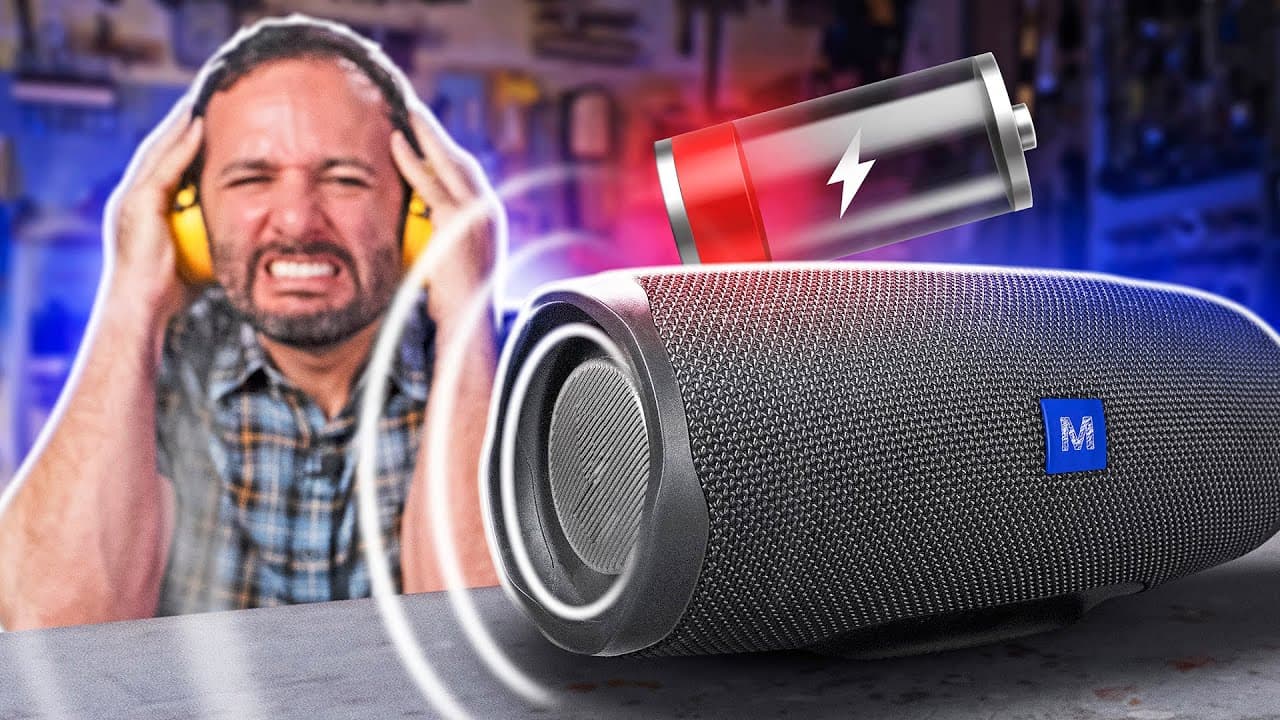
MÚSICA ALTA gasta MAIS BATERIA da CAIXINHA de SOM?
TL;DR
High volume significantly drains speaker battery faster than low volume.
Transcript
Today we are going to test whether the speakers at maximum volume consume more battery than if they are at low volume. This question was asked on Iberê Responde and I thought it was really cool to test. And first of all, is there any basis for this? Will it really be that if we put on one of those Bluetooth headphones with maximum volume, it will u... Read More
Key Insights
- Speakers consume more energy at high volumes due to increased vibration, requiring more power to move air and produce sound.
- In a controlled experiment, two different speakers were tested to compare battery consumption at high and low volumes.
- The small speaker lasted 5.5 hours at high volume and 17 hours at low volume, showing a significant difference in battery consumption.
- The large speaker lasted 6 hours at high volume and 38.5 hours at low volume, indicating that volume greatly affects battery life.
- The experiment confirmed that high volume settings consume battery much faster than low volume settings.
- Sound insulation measures were taken to prevent noise disturbance during the experiment, highlighting practical considerations in real-world settings.
- Recording equipment was used to monitor when each speaker stopped playing, ensuring accurate measurement of battery life.
- The experiment demonstrated that using speakers at lower volumes can significantly extend their battery life, making them more efficient for prolonged use.
Install to Summarize YouTube Videos and Get Transcripts
Explore YouTube Video Summarizer or Get YouTube Transcript Extractor
Questions & Answers
Q: Why does high volume drain more battery in speakers?
High volume drains more battery in speakers because producing louder sounds requires more energy. The speaker must vibrate more forcefully to move air and create sound waves, which demands more power from the battery, resulting in faster energy consumption.
Q: How was the experiment conducted to test battery consumption?
The experiment involved using two different speakers, playing music at both high and low volumes. The duration each speaker lasted was recorded using audio equipment to determine when they stopped playing, providing data on battery consumption at different volume levels.
Q: What were the results of the small speaker's battery test?
The small speaker lasted 5.5 hours at high volume and 17 hours at low volume. This significant difference in duration demonstrates that playing music at lower volumes conserves battery life much more effectively than at higher volumes.
Q: How did the large speaker perform in the battery test?
The large speaker lasted 6 hours at high volume and 38.5 hours at low volume. This result highlights the substantial impact of volume on battery consumption, with lower volumes allowing the speaker to operate for much longer periods.
Q: What precautions were taken during the experiment to avoid noise disturbance?
Sound insulation measures were implemented, including sealing studio windows and using soundproofing materials, to prevent noise from disturbing neighbors. This ensured the experiment could be conducted without external interference or complaints.
Q: What role did recording equipment play in the experiment?
Recording equipment was used to capture audio continuously, allowing researchers to identify precisely when each speaker stopped playing. This method ensured accurate measurement of battery life and provided reliable data for analysis.
Q: What did the experiment reveal about energy efficiency in speakers?
The experiment revealed that playing speakers at lower volumes significantly extends battery life, making them more energy-efficient. This finding suggests that users can conserve battery by opting for lower volume settings during prolonged use.
Q: What practical advice can be derived from the experiment's findings?
From the experiment's findings, it is advisable to use speakers at lower volumes to extend battery life, especially in situations where prolonged use is required. This approach not only conserves energy but also reduces the need for frequent recharging.
Summary & Key Takeaways
-
The experiment tested whether playing speakers at high volume drains the battery faster than at low volume. Two speakers were used, and their battery life was measured at different volumes, revealing a significant difference in energy consumption based on volume levels.
-
High volume settings require more energy due to increased vibration needed to produce louder sounds. This was demonstrated in the experiment, where both small and large speakers consumed more battery when played at maximum volume compared to low volume.
-
The results showed that the small speaker lasted 5.5 hours at high volume and 17 hours at low volume, while the large speaker lasted 6 hours at high volume and 38.5 hours at low volume, proving that lower volumes are more energy-efficient.
Read in Other Languages (beta)
Share This Summary 📚
Summarize YouTube Videos and Get Video Transcripts with 1-Click
Try YouTube Summary with ChatGPT & Claude or YouTube Transcript Generator
Explore More Summaries from Manual do Mundo 📚


Summarize YouTube Videos and Get Video Transcripts with 1-Click
Try YouTube Summary with ChatGPT & Claude or YouTube Transcript Generator