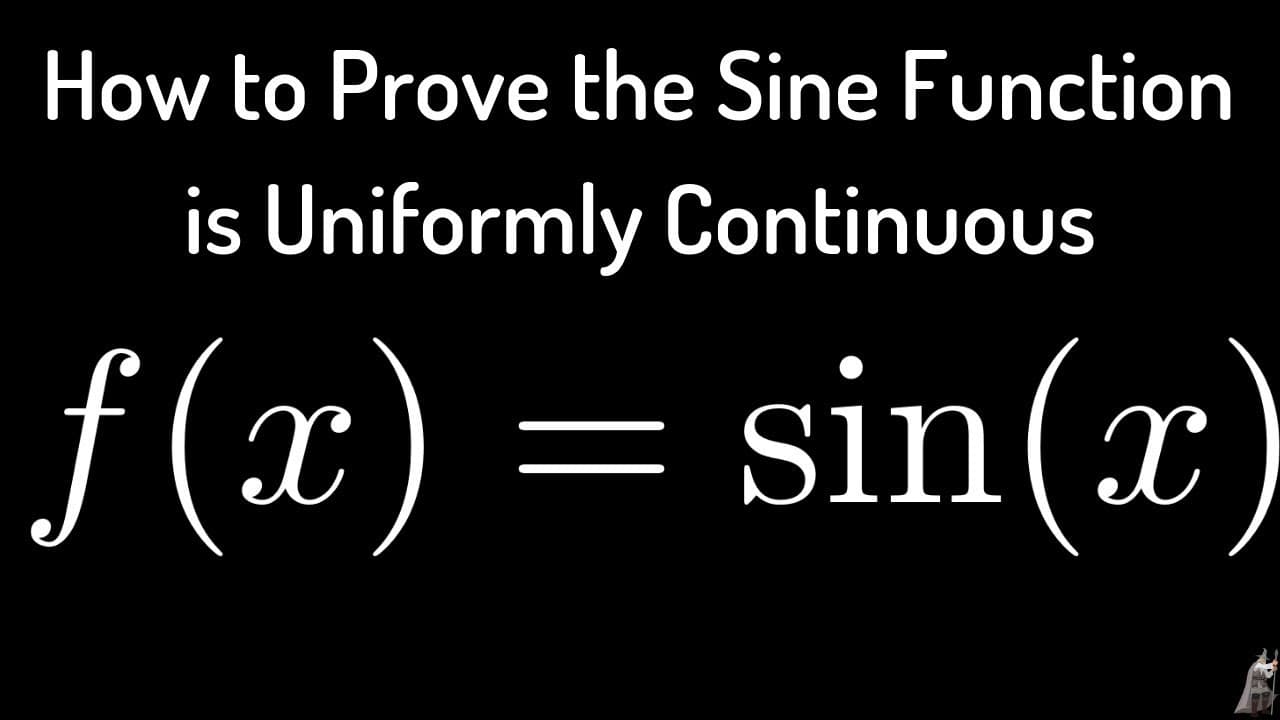
How to Prove the Uniform Continuity of the Sine Function
TL;DR
The sine function is uniformly continuous on the real numbers because for every epsilon greater than 0, we can choose delta equal to epsilon. By using trigonometric identities and properties, it can be shown that the distance between sin(x) and sin(y) is less than epsilon when the distance between x and y is less than delta.
Transcript
hi YouTube in this video we're going to prove that the sine function is uniformly continuous on the set of real numbers recall what it means for a function to be uniformly continuous so f is uniformly continuous uniformly continuous on the set of real numbers are if for every epsilon greater than 0 we can find some delta greater than 0 such that fo... Read More
Key Insights
- 🖐️ Trigonometric identities play a crucial role in proving the uniform continuity of functions.
- ❓ Understanding inequalities and properties of trigonometric functions is essential for mathematical proofs.
- 🤩 Manipulating expressions and recognizing key steps are vital in proving mathematical theorems.
- 🥋 Applying definitions and criteria of uniform continuity helps establish the behavior of functions.
- ⚾ Choosing appropriate delta values based on epsilon ensures the continuity of functions.
- 👻 The interchangeability of trigonometric functions allows for simplification and manipulation in proofs.
- 👍 Utilizing properties of trig functions like sine and cosine aids in proving mathematical concepts.
Install to Summarize YouTube Videos and Get Transcripts
Explore YouTube Video Summarizer or Get YouTube Transcript Extractor
Questions & Answers
Q: What is the definition of uniform continuity in functions?
Uniform continuity in functions means for every epsilon, there exists a delta where the distance between x and y is small enough that the function's values are guaranteed to be close.
Q: How is trigonometry utilized to prove the uniform continuity of the sine function?
Trigonometric identities and inequalities are applied to manipulate the difference between sine x and sine y into an expression involving the absolute value of x minus y, ultimately showing the function is uniformly continuous.
Q: Why is recognizing and applying trig identities crucial in proving the sine function's uniform continuity?
Trig identities help simplify complex expressions and allow us to manipulate them to fit the criteria of uniform continuity, making the proof more accessible and understandable.
Q: How does the proof conclude that the sine function is uniformly continuous on the set of real numbers?
By showing that the absolute value of x minus y is less than epsilon, where epsilon is chosen as the delta, it is proven that the sine function satisfies the conditions of uniform continuity.
Summary & Key Takeaways
-
Uniform continuity means for every epsilon, there exists a delta where the distance between x and y is small.
-
Proving sine function's uniform continuity involves applying trigonometric identities and inequalities.
-
By manipulating trig functions and inequalities, the proof shows that the distance between f(x) and f(y) is less than epsilon.
Read in Other Languages (beta)
Share This Summary 📚
Summarize YouTube Videos and Get Video Transcripts with 1-Click
Try YouTube Summary with ChatGPT & Claude or YouTube Transcript Generator
Explore More Summaries from The Math Sorcerer 📚


Summarize YouTube Videos and Get Video Transcripts with 1-Click
Try YouTube Summary with ChatGPT & Claude or YouTube Transcript Generator