What Is Beer Lambert's Law and How Does It Work?
TL;DR
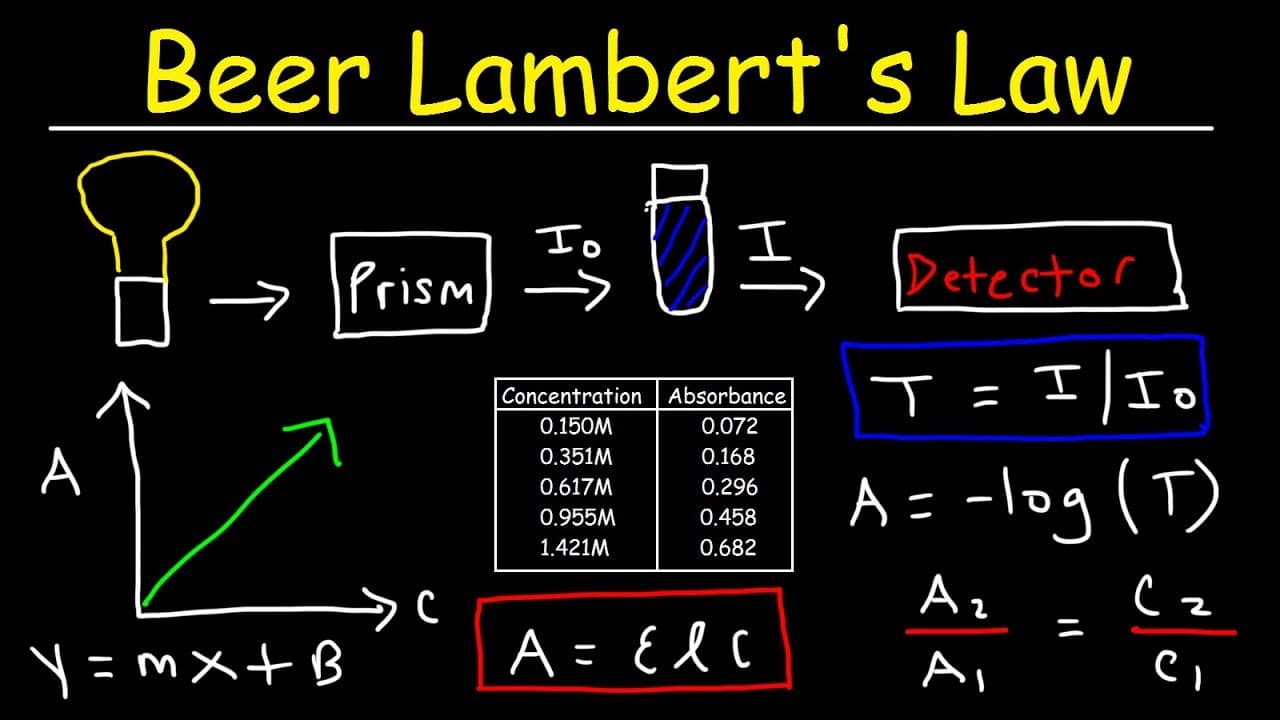
Beer Lambert's Law states that absorbance is directly proportional to the concentration of a solution when light passes through it. Absorbance can be calculated using the formula A = εlc, where A is absorbance, ε is molar absorptivity, l is path length, and c is concentration. Transmittance, the fraction of light that passes through the sample, is inversely related to absorbance.
Transcript
in this video we're going to go over spectrophotometry and cover some problems on beer lambert's law so let's start with this one the intensity of the incident light on a sample is 0.5 watts per square meter and the intensity of light entering the detector is 0.36 watts per square meter calculate the transmittance and determine the absorbance so le... Read More
Key Insights
- 🙂 Transmittance is the ratio of the intensity of light entering the detector to the incident intensity, indicating the amount of light passing through a sample.
- ❎ Absorbance is the negative logarithm of transmittance and can be used to quantify the concentration of a substance in a sample.
- 🙂 Molar absorptivity is a measure of how strongly a substance absorbs light and can be used to calculate the concentration of a solution.
- ❓ The relationship between absorbance and concentration can be determined using a linear equation.
- 😵 The absorbance and concentration can be calculated using the absorbance-concentration relationship or by cross-multiplying ratios.
- 🏑 Spectrophotometry and Beer Lambert's Law are important tools in the field of analytical chemistry for qualitative and quantitative analysis.
- 🙂 The path length of light passing through the sample and the nature of the sample molecules influence the absorbance and transmittance values.
Install to Summarize YouTube Videos and Get Transcripts
Explore YouTube Video Summarizer or Get YouTube Transcript Extractor
Questions & Answers
Q: What is spectrophotometry?
Spectrophotometry is a technique used to measure the intensity of light passing through a sample to determine the concentration of a substance in the sample.
Q: How is transmittance calculated?
Transmittance is calculated by dividing the intensity of light entering the detector by the incident intensity and represents the amount of light that passes through the sample.
Q: What is the relationship between transmittance and absorbance?
As transmittance increases, absorbance decreases. Transmittance cannot be more than 1, indicating 100% passage of light, while absorbance is the negative logarithm of transmittance.
Q: How is molar absorptivity determined?
Molar absorptivity is determined by dividing the absorbance by the product of the path length and the concentration of the solution.
Summary & Key Takeaways
-
Spectrophotometry involves the measurement of the intensity of light that passes through a sample, known as incident intensity.
-
Transmittance is the ratio of the intensity of light entering the detector to the incident intensity, and can be used to determine the amount of light absorbed by the sample.
-
Absorbance is the negative logarithm of transmittance and can be used to quantify the concentration of a solution using Beer Lambert's Law.
Read in Other Languages (beta)
Share This Summary 📚
Summarize YouTube Videos and Get Video Transcripts with 1-Click
Try YouTube Summary with ChatGPT & Claude or YouTube Transcript Generator
Explore More Summaries from The Organic Chemistry Tutor 📚



Summarize YouTube Videos and Get Video Transcripts with 1-Click
Try YouTube Summary with ChatGPT & Claude or YouTube Transcript Generator