Synchronous Induction Motor | Maximum mechanical power developed | Synchronous Machines | Lec-40
TL;DR
Understanding how to maximize mechanical power in electrical systems.
Transcript
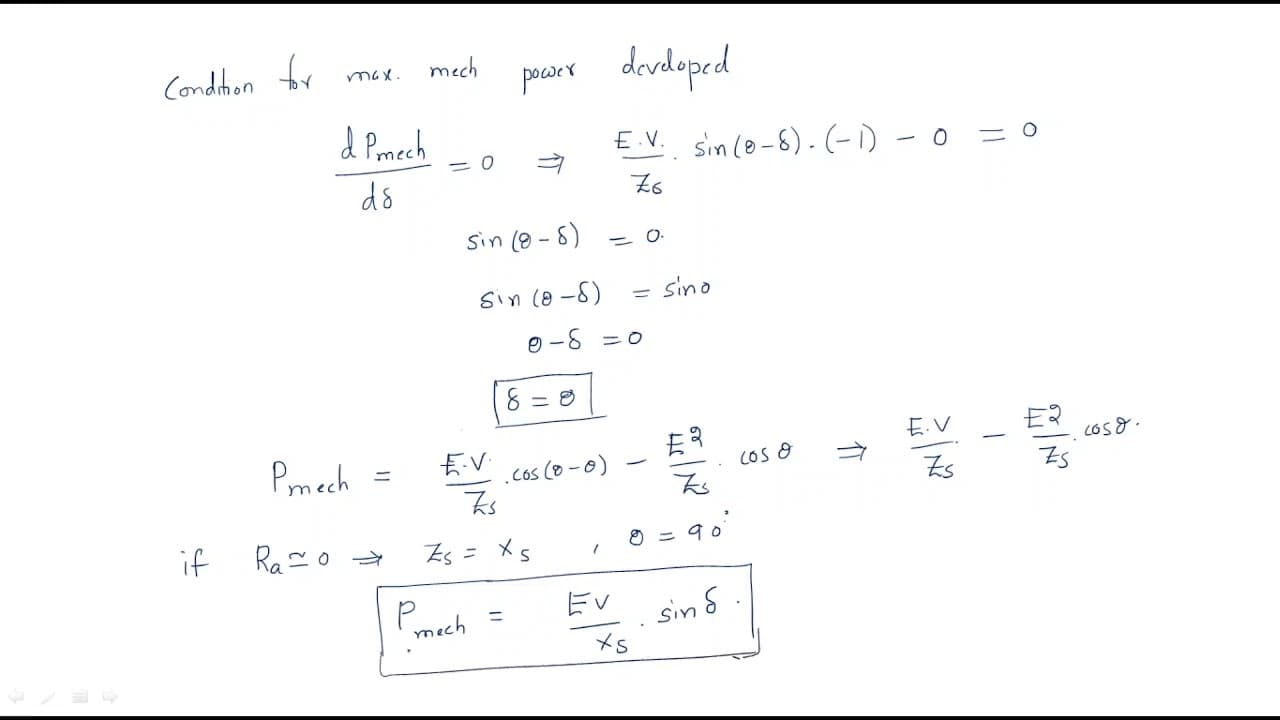
hello everyone in the last session we discussed about the mechanical Power input the mechanical Power input value is mechanical Power input value is mechanical Power input value this is the mechanical Power input that is e v by Z is cos Theta minus Del minus E Square by Z is cos Theta now we will find out condition for maximum mechanical Power deve... Read More
Key Insights
- ✊ The relationship between mechanical power and load angle is critical for optimizing electrical machine performance, derived through calculus.
- ✊ The maximum mechanical power occurs when the load angle equals the reference angle, leading to significant adjustments in power output.
- ✊ Sinusoidal waveforms illustrate the cyclical nature of power and torque as they correlate with varying load angles in motors and generators.
- 🧑🦼 The analysis of torque versus load angle reveals different operational characteristics for motors and generators, influencing their stability and efficiency.
- ✊ Understanding the parameters of power calculations helps in designing electrical systems that avoid instability and optimize performance.
- 🤩 The differentiation of mechanical power signals key operational changes, guiding technicians and engineers on optimal performance angles.
- 🖐️ Armature resistance plays a crucial role in simplifying the equations used to calculate maximum power, impacting the overall system efficiency.
Install to Summarize YouTube Videos and Get Transcripts
Explore YouTube Video Summarizer or Get YouTube Transcript Extractor
Questions & Answers
Q: What is the importance of the load angle in maximizing mechanical power?
The load angle, often denoted as Delta (Del), is crucial in determining the maximum mechanical power developed in electrical systems. By differentiating the mechanical power equation with respect to Del and setting the derivative to zero, we find that the optimal condition occurs when Del equals Theta. This alignment maximizes the output power, playing a significant role in the efficiency of motors and generators.
Q: How is the maximum mechanical power equation derived?
The maximum mechanical power equation is derived by starting with the basic mechanical power formula, then differentiating it with respect to the load angle, Del. Setting the derivative to zero reveals that the sine of the angle (Theta - Del) must equal zero, leading to the conclusion that Del should equal Theta, simplifying the power expression to a maximum value based on the constants involved in the system.
Q: Can you explain how torque and power relate to load angle?
Torque and power are intrinsically linked in electrical machines, with both influenced by the load angle. As load angle increases, the relation between torque and power manifests through sinusoidal waveforms. For generators, torque is stable between 0 to 90 degrees, while motors exhibit different torque characteristics as the load angle changes, significantly impacting the operational stability in these machines.
Q: What does the sinusoidal waveform represent in this context?
The sinusoidal waveform represents how mechanical power varies with the load angle in electrical systems. As the load angle changes, the sinusoidal function captures the oscillatory nature of power output, highlighting periods of maximum power and relating to the angular frequency. These waveforms help visualize performance and operational limits of generators and motors across different load angles.
Q: How does the armature resistance impact the maximum power calculation?
When the armature resistance is deemed negligible, the synchronous impedance simplifies to synchronous reactance, making the analysis of maximum mechanical power more straightforward. The angle of impedance becomes critical as it can reach the value of 90 degrees, significantly altering the relationship between mechanical power and load conditions, resulting in an optimized performance scenario.
Q: Why is understanding the power versus load angle curve important?
Understanding the power versus load angle curve is essential for optimizing the performance of electrical machines. This curve indicates stable operating conditions and helps engineers design systems that maximize efficiency and power output. By analyzing these curves, operators can predict operational behavior under varying load conditions and ensure stable performance across a range of scenarios.
Summary & Key Takeaways
-
The content discusses the relationship between mechanical power input, load angle, and maximizing power in electrical machines, focusing on the equations that define these relationships.
-
It explains the derivation of maximum mechanical power using calculus, highlighting the conditions under which optimal power is achieved through the differentiation process.
-
A comparison is made between power versus load angle and torque versus load angle, indicating stable and unstable operational conditions in generators and motors.
Read in Other Languages (beta)
Share This Summary 📚
Summarize YouTube Videos and Get Video Transcripts with 1-Click
Try YouTube Summary with ChatGPT & Claude or YouTube Transcript Generator