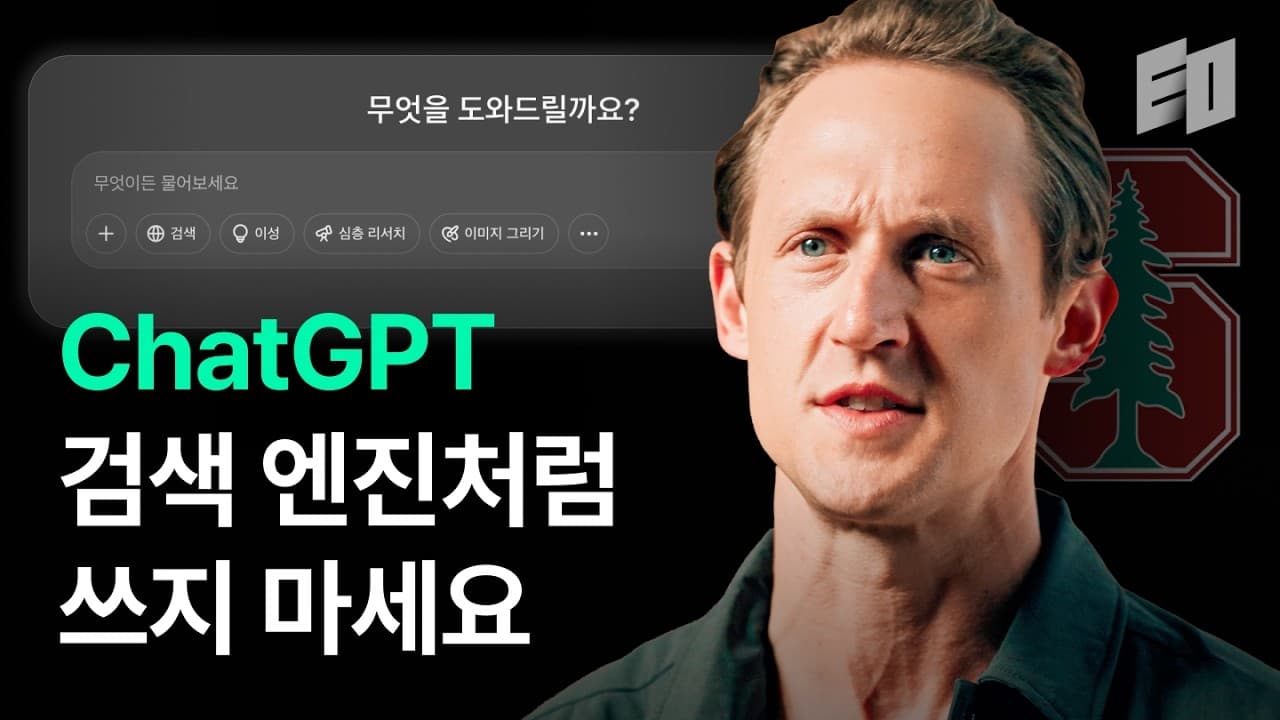
스탠포드가 가르치는 AI시대 창의력 훈련법 | 스탠포드 교수 제레미 어틀리
TL;DR
AI can enhance creativity if treated as a collaborator, not a tool.
Transcript
technology has trained us in very bad ways for example the Google search box anytime our brains see a box that looks like that we go "Oh I know what to do here." And when you open an LLM and you treat it like a Google search you are not even scratching the surface of its capabilities your familiarity with the Google search is actually undermining y... Read More
Key Insights
- Jeremy Utley emphasizes the importance of treating AI as a collaborator rather than a mere tool, which can significantly enhance creativity and productivity.
- AI's potential is often underutilized due to familiar habits, such as treating it like a search engine rather than leveraging its full capabilities.
- The transition from using fingers to voice when interacting with AI can unlock new levels of productivity by offloading cognitive burdens.
- Non-technical professionals can achieve remarkable results with AI, as demonstrated by a park ranger who developed a tool saving thousands of workdays.
- AI can self-evaluate and guide users on how best to leverage its capabilities, unlike traditional software like Excel or PowerPoint.
- The realization gap highlights that while AI can enhance work quality, few professionals fully exploit its potential due to a lack of foundational training.
- Successful AI users treat it as a teammate, coaching and giving feedback, which leads to better outcomes than treating it as a simple tool.
- Creativity in the AI age remains unchanged; it's about pushing beyond initial ideas to achieve exceptional results through volume and variation.
Install to Summarize YouTube Videos and Get Transcripts
Explore YouTube Video Summarizer or Get YouTube Transcript Extractor
Questions & Answers
Q: How does Jeremy Utley suggest we should interact with AI?
Jeremy Utley suggests that we should interact with AI as a collaborator, not just a tool. By treating AI as a teammate, users can provide feedback, coach it, and engage in a more dynamic interaction that can lead to enhanced creativity and productivity. This approach contrasts with using AI merely for straightforward tasks or as a search engine replacement.
Q: What is the realization gap mentioned in the content?
The realization gap refers to the discrepancy between the potential productivity and creativity enhancements AI can offer and the actual gains realized by most professionals. Despite AI's ability to improve work quality and efficiency, only a small percentage of users fully exploit its capabilities due to a lack of foundational understanding and training in effectively collaborating with AI.
Q: Can AI teach users how to use itself effectively?
Yes, AI has the unique ability to teach users how to use itself effectively. Unlike traditional software, AI can self-evaluate and provide guidance on its optimal use. Users can engage AI in a dialogue to understand where it can be best leveraged in their workflows, allowing for more insightful and tailored applications of AI technology.
Q: What example demonstrates the power of AI for non-technical professionals?
An example demonstrating AI's power for non-technical professionals is the case of a park ranger who developed a tool using AI that significantly reduced paperwork time. This tool, created in just 45 minutes, was projected to save the National Park Service 7,000 days of human labor annually, showcasing that even those without technical expertise can achieve remarkable efficiency gains with AI.
Q: How does using voice instead of fingers change AI interaction?
Using voice instead of fingers changes AI interaction by allowing users to offload the cognitive burden of organizing thoughts. This method enables more fluid and natural communication with AI, leading to enhanced productivity as users can express ideas freely without the constraints of typing, thereby unlocking new levels of creativity and collaboration.
Q: What is a key factor in achieving creative outcomes with AI?
A key factor in achieving creative outcomes with AI is shifting the mindset from seeking 'good enough' solutions to exploring volume and variation. By pushing beyond initial ideas and leveraging AI's capabilities for generating diverse outputs, users can achieve world-class results. This approach requires time and effort to sort and process AI-generated content effectively.
Q: Why might AI make some users less creative?
AI might make some users less creative if they treat it merely as a tool rather than a collaborator. Users who fail to engage AI dynamically or provide feedback may not fully tap into its creative potential. This limited interaction can result in less innovative outcomes, as users may not explore the breadth of possibilities AI offers.
Q: How can AI be a teammate in difficult conversations?
AI can be a teammate in difficult conversations by role-playing scenarios and providing feedback. Users can have AI simulate conversation partners, construct psychological profiles, and offer insights into how to approach discussions. This interactive process allows users to prepare more effectively and gain a deeper understanding of potential conversation dynamics.
Summary & Key Takeaways
-
Jeremy Utley from Stanford discusses how AI can enhance creativity if approached as a collaborator rather than a tool. He highlights the potential productivity gains when users shift from traditional search engine habits to leveraging AI's full capabilities, particularly by using voice interactions.
-
The discussion includes examples of non-technical professionals achieving significant results with AI, such as a park ranger who created a tool that saved thousands of workdays. Utley emphasizes the importance of foundational training to bridge the realization gap where many don't fully exploit AI's potential.
-
Utley explains that creativity's definition hasn't changed with AI; it's about pushing past initial solutions. He encourages creators to engage deeply with AI, using it as a teammate for better outcomes, and stresses the importance of volume and variation in achieving exceptional creative results.
Read in Other Languages (beta)
Share This Summary 📚
Summarize YouTube Videos and Get Video Transcripts with 1-Click
Try YouTube Summary with ChatGPT & Claude or YouTube Transcript Generator
Explore More Summaries from EO Korea 📚

Summarize YouTube Videos and Get Video Transcripts with 1-Click
Try YouTube Summary with ChatGPT & Claude or YouTube Transcript Generator