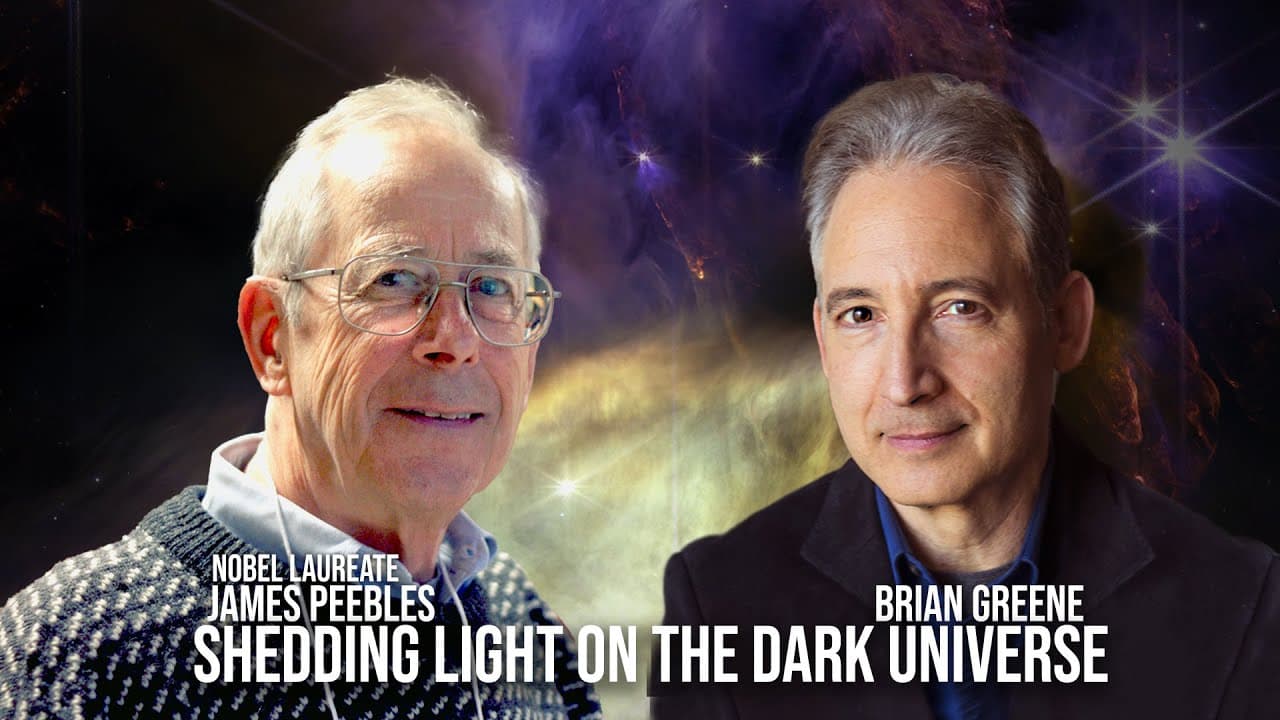
Shedding Light on the Dark Universe
TL;DR
Scientists unravel the mysteries of dark matter and dark energy, revealing the hidden majority of the cosmos.
Transcript
on a clear dark night we can all Marvel at a crystal Sky brimming with stars and Beyond what we can see with the naked eye powerful telescopes confirm an expansive Cosmos chalk full of galaxies and stars and swirling clouds of gas and dust and planets and comets and asteroids but here is the amazing realization telling the mass and energy of everyt... Read More
Key Insights
- 🕶️ Dark matter and dark energy dominate the cosmos, posing a challenge to scientific understanding.
- ❓ James Peebles' contributions to cosmology, including decoding the cosmic microwave background radiation, have been pivotal in advancing our knowledge.
- 🧑🔬 Historical anecdotes about the discovery of cosmic radiation highlight the collaborative efforts and persistence of scientists.
- 🥺 The interplay between theory and observation in cosmology leads to refining models and overcoming challenges.
- 💁 Outstanding cosmic questions, such as galaxy formation mysteries and early Universe anomalies, drive further exploration and research.
- 🖤 The unresolved nature of dark matter and cosmic black holes leaves room for innovation and future discoveries in cosmology.
- 👶 Challenges in understanding the structure and dynamics of galaxies prompt new computational studies and theoretical investigations.
Install to Summarize YouTube Videos and Get Transcripts
Explore YouTube Video Summarizer or Get YouTube Transcript Extractor
Questions & Answers
Q: How do scientists indirectly deduce the existence of the Dark Universe?
Scientists infer the presence of dark matter and dark energy through their impacts on the visible universe, like gravitational effects and cosmic background radiation analysis.
Q: What was James Peebles' role in advancing cosmological understanding?
James Peebles played a critical role in significant discoveries, such as cosmic microwave background radiation analysis, leading to refining cosmological theories and earning him the 2019 Nobel Prize in Physics.
Q: Why was the observation of Cyanogen in interstellar space significant in understanding the early Universe?
Cyanogen absorption observations hinted at the presence of thermal radiation in the early Universe, which later led to the crucial discovery of the cosmic microwave background radiation.
Q: How did the detection of the cosmic microwave background radiation change cosmological perspectives?
The observation of the cosmic microwave background radiation provided strong evidence for the hot Big Bang theory, establishing a close link between cosmological predictions and observational data.
Summary & Key Takeaways
-
Scientists explore the dark side of the cosmos, with dark matter and dark energy making up over 95% of the universe.
-
James Peebles, a prominent cosmologist, discusses his journey and contributions to understanding the cosmic dark side.
-
Discoveries like the cosmic microwave background radiation shed light on the unseen universe.
Read in Other Languages (beta)
Share This Summary 📚
Summarize YouTube Videos and Get Video Transcripts with 1-Click
Try YouTube Summary with ChatGPT & Claude or YouTube Transcript Generator
Explore More Summaries from World Science Festival 📚



Summarize YouTube Videos and Get Video Transcripts with 1-Click
Try YouTube Summary with ChatGPT & Claude or YouTube Transcript Generator