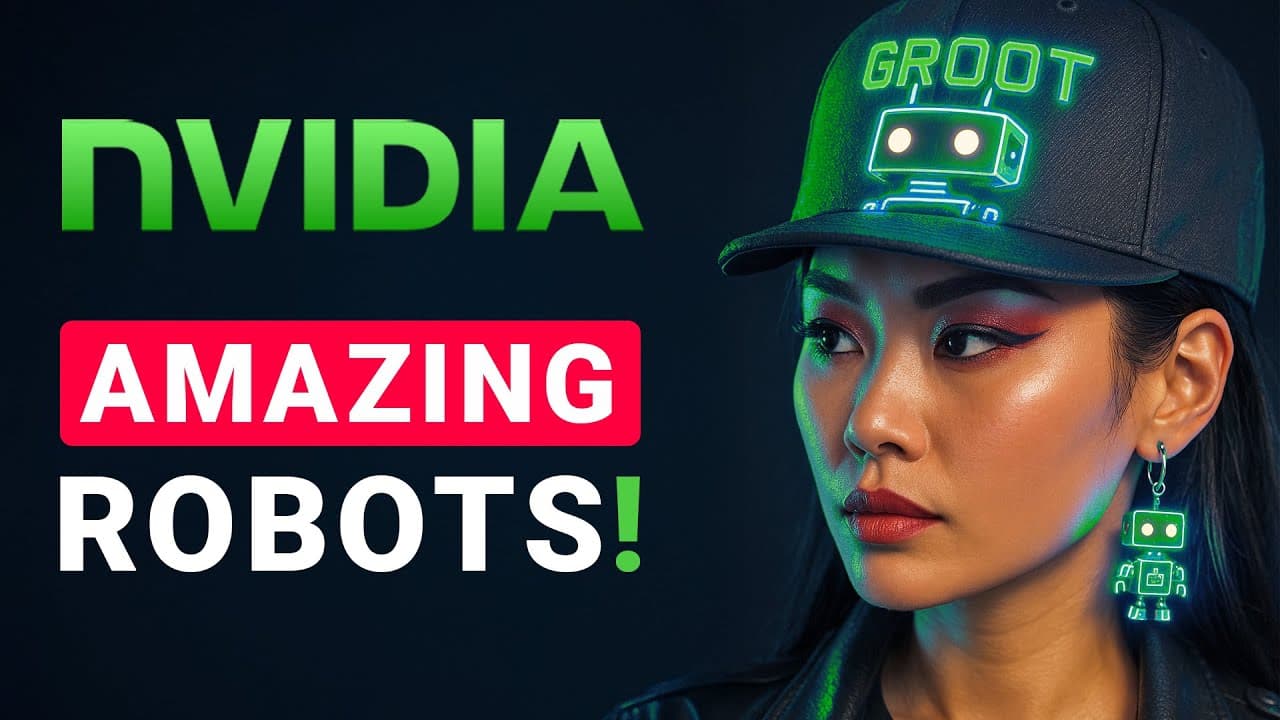
NVIDIA’s New AI: Insanely Good!
TL;DR
A groundbreaking paper introduces an open model for training humanoid robots using innovative data generation techniques.
Transcript
This is a historic paper, GR00T-N1, which is going to set off a robotics revolution by giving us…yup. An open foundation model for humanoid robotics. All open, all free for all of us. Wow. And, everyone’s favorite, the super cute robots are coming hopefully soon. Okay, so what is going on here? Is this important? Well, when it comes to rob... Read More
Key Insights
- 🤗 GR00T-N1 serves as an open foundation model, fostering accessibility and innovation in humanoid robotics research.
- 👻 Utilizing the Omniverse allows for the creation of accurate training environments that can simulate real-world physics.
- ⌛ The model's synthetic data generation capabilities minimize the time and labor typically required for data labeling.
- 🎮 AI-driven methods for labeling videos enable the extraction of valuable training information from existing, unlabeled video data.
- ❓ Achieving a leap from 46% to 76% in task success demonstrates the model's capacity to enhance robotic learning outcomes significantly.
- 🤖 The approach incorporates collaborative research, building on previous studies to create a better learning framework for robots.
- 🌍 While advancements are promising, the model is still developing, with limitations in application to intricate, real-world tasks.
Install to Summarize YouTube Videos and Get Transcripts
Explore YouTube Video Summarizer or Get YouTube Transcript Extractor
Questions & Answers
Q: What is the significance of the GR00T-N1 paper in robotics?
The GR00T-N1 paper introduces a groundbreaking open model that aims to enhance humanoid robotics. By providing a free and accessible framework, it enables researchers and developers to innovate and improve robotic capabilities, paving the way for significant advancements in the field.
Q: How does the model tackle the challenge of data labeling for robot training?
The model employs a system called Omniverse to create realistic simulations of environments for training, generating vast amounts of labeled data through video game-like scenarios. Additionally, it integrates an AI-driven method to extract actionable information from unlabeled videos, further enriching the training dataset with essential annotations.
Q: What are the key components of the GR00T-N1 training methodology?
GR00T-N1's methodology combines several innovative techniques, including using the Omniverse for simulation, a video data labeling AI, and a vision-language model to improve understanding of environmental interactions. This multifaceted approach enhances the robot's ability to plan and execute actions effectively.
Q: What improvements in robotic learning success rates does GR00T-N1 achieve?
The GR00T-N1 model achieved an impressive increase in robotic task success rates, rising from a 46% success rate to 76%. This substantial improvement demonstrates the effectiveness of the model's integrated learning techniques and suggests a significant leap forward in robotics.
Q: What limitations does the GR00T-N1 model currently have?
While GR00T-N1 offers exciting advancements, it is not a fully turnkey solution for everyday tasks, and it currently focuses on short tasks often limited to manipulating objects on a table. It requires further development and tuning for broader applications in real-world scenarios.
Q: How can researchers utilize the GR00T-N1 model in their work?
Researchers can access the GR00T-N1 model freely, allowing them to experiment and refine it for their specific tasks. This flexibility encourages innovation across various applications and enhances collaborative efforts in the robotics community.
Q: How does GR00T-N1 integrate different levels of robot learning?
The GR00T-N1 model incorporates two cognitive strategies—System 1 for real-time motor actions and System 2 for slower reasoning and planning. This dual approach allows the robot to understand its environment and act effectively at a moment’s notice.
Q: Why is the timing of this paper’s release significant for the robotics field?
The release of the GR00T-N1 paper is timely as it coincides with a growing interest in humanoid robotics. By making a sophisticated model publicly available, it encourages collaborative exploration and rapid advancement within the field, which has previously faced data and training challenges.
Summary & Key Takeaways
-
The GR00T-N1 paper presents an open foundational model that aims to revolutionize humanoid robotics by enhancing training methods for robots, making them more efficient and accessible.
-
The model leverages a digital simulation environment called Omniverse and a video data labeling system, allowing for rapid generation of training videos that accurately reflect real-world physics.
-
GR00T-N1 combines various data sources and neural networks to achieve significant advancements in robot learning, showcasing an impressive increase in success rates for robotic tasks.
Read in Other Languages (beta)
Share This Summary 📚
Summarize YouTube Videos and Get Video Transcripts with 1-Click
Try YouTube Summary with ChatGPT & Claude or YouTube Transcript Generator
Explore More Summaries from Two Minute Papers 📚



Summarize YouTube Videos and Get Video Transcripts with 1-Click
Try YouTube Summary with ChatGPT & Claude or YouTube Transcript Generator