Inverter delays | nMOS | Calculation | VLSI | Lec-42
TL;DR
This video explains how to calculate the time delay of cascaded NMOS inverters.
Transcript
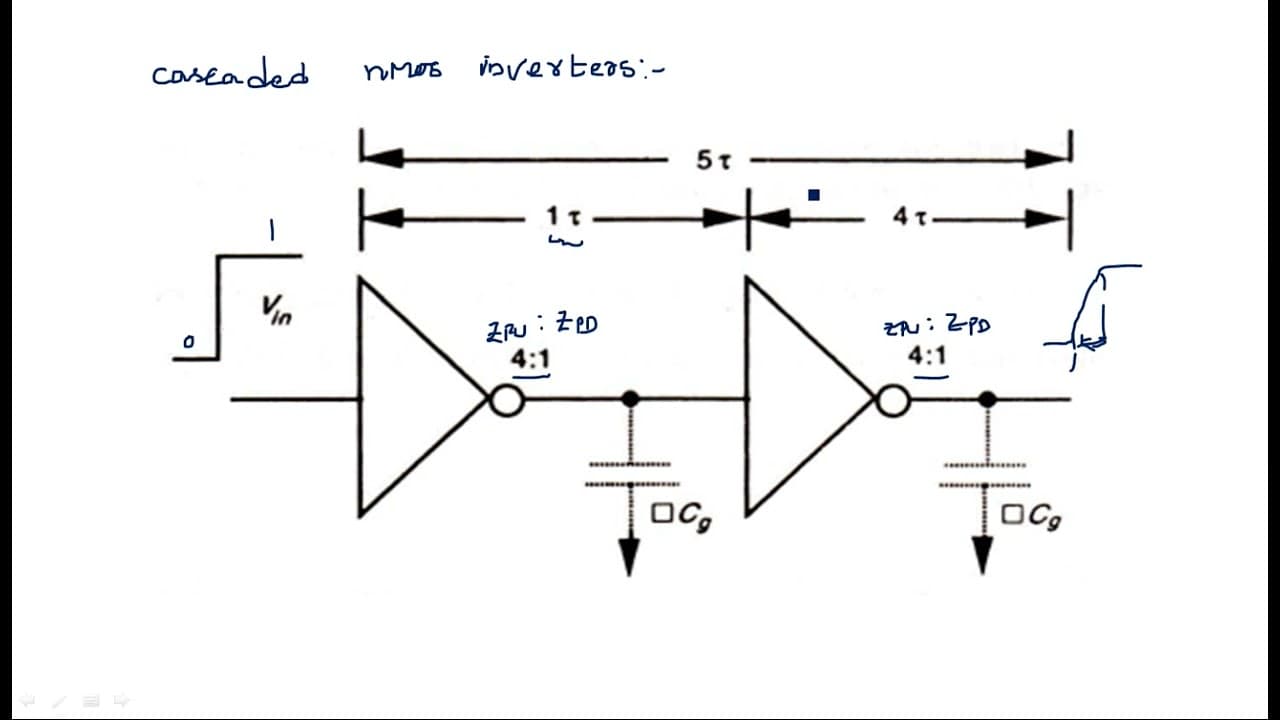
hi everyone in this video you are going to learn how to calculate the inverter delay okay if you are taking an nmos inverter in Cascade suppose two inverters are there in Cascade how to calculate the overall time delay between input and output so coming to these inverters there are two types of inverters in this vlsi subjects offer whatever we have... Read More
Key Insights
- ❓ NMOS inverters utilize different configurations of pull-up and pull-down transistors, affecting their delay characteristics significantly.
- 🥡 The delay unit, Tau, is essential for quantifying how long it takes for an inverter to respond to input changes in digital circuits.
- 🚄 Cascaded NMOS inverters aggregate delays, necessitating precise calculations essential for designing high-speed circuits.
- 📡 The delay can vary with the signal transition type, illustrating the importance of understanding inverter behavior under different operational conditions.
- 🥳 The relationship between pull-up and pull-down ratios plays a crucial role in optimizing inverter performance in circuit designs.
- 👻 Characterizing the delay of inverters allows designers to align circuit performance with timing requirements, crucial for effective VLSI design.
- ❓ Accurate delay calculations are integral to achieving efficient and reliable digital circuit operation in modern electronics.
Install to Summarize YouTube Videos and Get Transcripts
Explore YouTube Video Summarizer or Get YouTube Transcript Extractor
Questions & Answers
Q: What is the purpose of calculating the time delay in NMOS inverters?
The time delay calculation in NMOS inverters helps in determining the speed at which a digital circuit can process information. Understanding the delay is essential for ensuring that circuits operate correctly within given timing constraints, especially in high-speed electronic applications.
Q: How is Tau defined in the context of inverter delay?
Tau is defined as the product of resistance (RS) and the square of gate capacitance (Cg). Specifically, Tau indicates the time constant, representing how quickly the inverter can charge or discharge, impacting the overall speed of the circuit.
Q: What happens when two NMOS inverters are cascaded?
When two NMOS inverters are cascaded, the overall delay is a sum of the delays from both inverters. This results in increased time delay due to each inverter adding its own time constant, which for two inverters leads to an overall delay of 5 Tau under specific conditions.
Q: What factors affect the time delay of an NMOS inverter?
The time delay is influenced by the pull-up to pull-down ratio of the inverters, the resistance values, and the capacitance associated with the gate. The type of inverter configuration and the input signal's transition also play critical roles in determining the delay.
Q: Can the delay calculation for NMOS inverters apply to other types of inverters?
While the principles of delay calculation can be similar, the specific equations and factors will vary based on the inverter type, such as CMOS inverters. Each type has unique characteristics requiring tailored calculations to account for their operational differences.
Q: How does the pull-up to pull-down ratio impact inverter delay?
The pull-up to pull-down ratio directly affects the drive strength and time delay of NMOS inverters. A higher ratio, such as 4:1, means a stronger pull-up, which can reduce delay. Conversely, a lower ratio may result in longer delays due to weaker drive capabilities.
Summary & Key Takeaways
-
The video discusses NMOS inverters and their pull-up to pull-down ratios, emphasizing their significance in delay calculations when multiple inverters are connected in cascade.
-
It introduces the delay unit, Tau, as a function of resistance and capacitance, explaining how to use this for determining inverter delays.
-
The overall time delay for two cascaded NMOS inverters is established as 5 Tau, highlighting the calculations involved and the variation in time delays based on input signal transitions.
Read in Other Languages (beta)
Share This Summary 📚
Summarize YouTube Videos and Get Video Transcripts with 1-Click
Try YouTube Summary with ChatGPT & Claude or YouTube Transcript Generator