Products
Features
YouTube Video Summarizer
Summarize YouTube videos
Web & PDF Highlighter
Highlight web pages & PDFs
Chat with PDF
Ask any PDF questions with AI
Ask AI Clone
Chat with your highlights & memories
Audio Transcriber
Transcribe audio files to text
Glasp Reader
Read and highlight articles
Kindle Highlight Export
Export your Kindle highlights
Idea Hatch
Hatch ideas from your highlights
Integrations
Obsidian Plugin
Notion Integration
Pocket Integration
Instapaper Integration
Medium Integration
Readwise Integration
Snipd Integration
Hypothesis Integration
Apps & Extensions
Chrome Extension
Safari Extension
Edge Add-ons
Firefox Add-ons
iOS App
Android App
Discover
Discover
Ideas
Discover new ideas and insights
Articles
Curated articles and insights
Books
Book recommendations by great minds
Posts
Essays and notes from readers
Quotes
Inspiring quotes collection
Videos
Curated videos and summaries
Explore Glasp
Glasp Story
How we grew from 0 to 3 million users
Glasp Newsletter
Weekly insights and updates
Glasp Talk
Interview series with great minds
Glasp Blog
Latest news and articles
Glasp Use Cases
Learn how others use Glasp
Build & Support
Glasp API
Access Glasp's API for developers
MCP Connector
Connect Glasp to Claude & ChatGPT
Community
Glasp Reddit Community
Students
Student discount and benefits
FAQs
Frequently Asked Questions
AboutPricing
DashboardLog inSign up

#30 AI for Good Specialization [Course 1, Week 3, Lesson 1]
419 views
•
July 27, 2023
by
DeepLearningAI
YouTube video player
#30 AI for Good Specialization [Course 1, Week 3, Lesson 1]

TL;DR

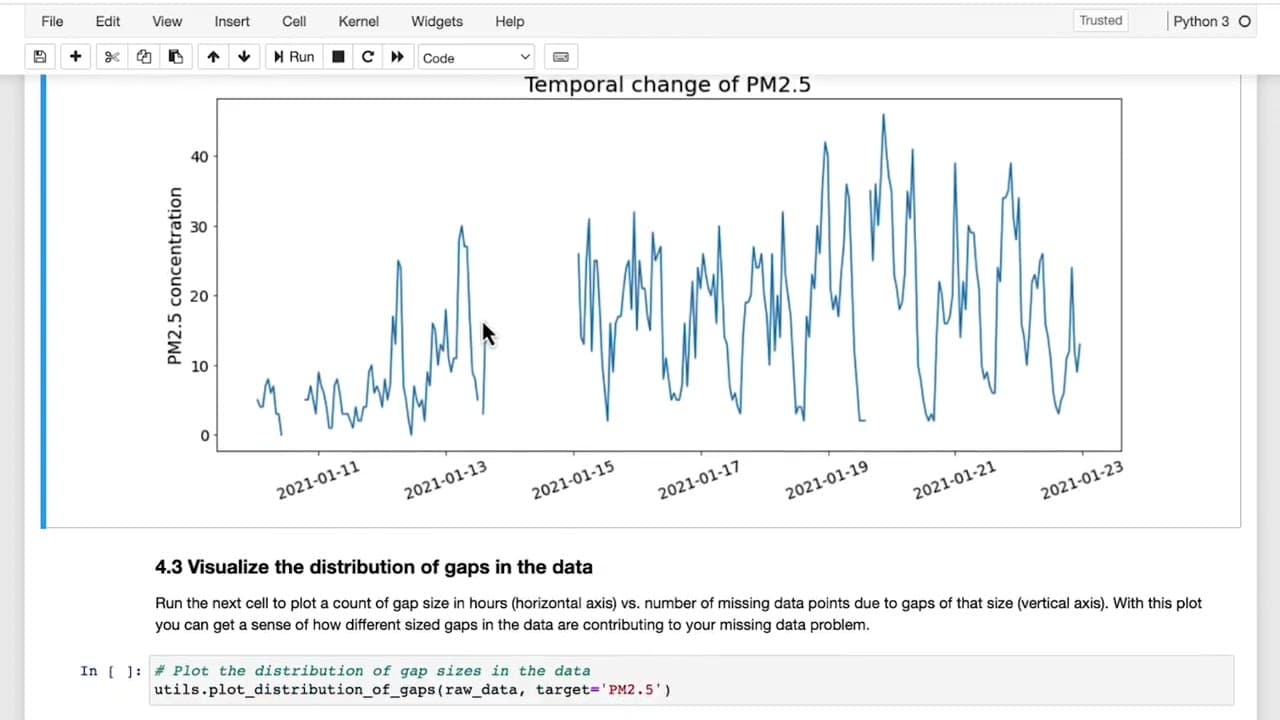
Analyzing and testing methods for estimating missing sensor values in a lab setting without complex AI solutions.

Transcript

in the previous video we looked at the idea of estimating missing sensor values using two different methods one taking the most recent measurement from that sensor and the other using the current measurement from the closest sensor now I'm going to walk through the lab section we will test out these methods and establish a baseline for how well you... Read More

Key Insights

  • 🆘 Establishing a simple baseline can help determine the effectiveness of estimation methods.
  • 🌥️ Large data gaps present challenges in accurately estimating missing sensor values.
  • 📈 The mean absolute error is used as a metric to measure the accuracy of estimation methods.
  • ❓ Testing methods on simulated data can provide insights into their performance.
  • 🛀 The nearest neighbor method shows variable results but does not degrade significantly with larger gap sizes.
  • 💨 Mean absolute error provides a simple way to compare the accuracy of different models.
  • 🤒 The average error of 8 micrograms per meter cubed suggests a margin of error around recommended PM 2.5 levels.

Install to Summarize YouTube Videos and Get Transcripts

Explore YouTube Video Summarizer or Get YouTube Transcript Extractor

Questions & Answers

Q: What are the two methods for estimating missing sensor values?

The two methods are taking the most recent measurement from the sensor or using data from the closest sensor station.

Q: Why is it essential to establish a simple baseline before implementing complex AI solutions?

Establishing a baseline helps determine if simpler methods are sufficient, potentially saving time, costs, and simplifying result interpretation.

Q: How is the nearest neighbor method tested on simulated data?

The method is tested across various gap sizes in the data to calculate the mean absolute error, providing an accuracy baseline for comparisons.

Summary & Key Takeaways

  • Exploring two methods for estimating missing sensor values: using the most recent measurement or data from the closest sensor.

  • Establishing a simple baseline to determine the effectiveness of these methods before implementing complex AI algorithms.

  • Testing the nearest neighbor method on simulated data to calculate the mean absolute error as a baseline for accuracy.


Read in Other Languages (beta)

English

Share This Summary 📚

Summarize YouTube Videos and Get Video Transcripts with 1-Click

Download browser extensions on:

Try YouTube Summary with ChatGPT & Claude or YouTube Transcript Generator

Explore More Summaries from DeepLearningAI 📚
Train/Dev/Test Sets (C2W1L01) thumbnail
Train/Dev/Test Sets (C2W1L01)
DeepLearningAI
A Chat with Andrew on MLOps: From Model-centric to Data-centric AI thumbnail
A Chat with Andrew on MLOps: From Model-centric to Data-centric AI
DeepLearningAI
How to Select and Label Data Effectively for Machine Learning thumbnail
How to Select and Label Data Effectively for Machine Learning
DeepLearningAI
What Are Effective Career Paths in Data Science and AI? thumbnail
What Are Effective Career Paths in Data Science and AI?
DeepLearningAI
Bias and Variance With Mismatched Data (C3W2L05) thumbnail
Bias and Variance With Mismatched Data (C3W2L05)
DeepLearningAI
#33 Machine Learning Specialization [Course 1, Week 3, Lesson 1] thumbnail
#33 Machine Learning Specialization [Course 1, Week 3, Lesson 1]
DeepLearningAI

Summarize YouTube Videos and Get Video Transcripts with 1-Click

Download browser extensions on:

Try YouTube Summary with ChatGPT & Claude or YouTube Transcript Generator

Apps & Extensions

  • Chrome Extension
  • Safari Extension
  • Edge Add-ons
  • Firefox Add-ons
  • iOS App
  • Android App

Key Features

  • YouTube Video Summarizer
  • Web & PDF Summarizer
  • Web & PDF Highlighter
  • Chat with PDF
  • Ask AI Clone
  • Audio Transcriber
  • Glasp Reader
  • Kindle Highlight Export
  • Idea Hatch

Integrations

  • Obsidian Plugin
  • Notion Integration
  • Pocket Integration
  • Instapaper Integration
  • Medium Integration
  • Readwise Integration
  • Snipd Integration
  • Hypothesis Integration

More Features

  • APIs
  • MCP Connector
  • Blog & Post
  • Embed Links
  • Image Highlight
  • Personality Test
  • Quote Shots
  • Open Graph Checker

Company

  • About us
  • Our Story
  • Blog
  • Community
  • FAQs
  • Job Board
  • Newsletter
  • Pricing
Terms

•

Privacy

•

Guidelines

© 2026 Glasp Inc. All rights reserved.