Comparing LLMs with LangChain
TL;DR
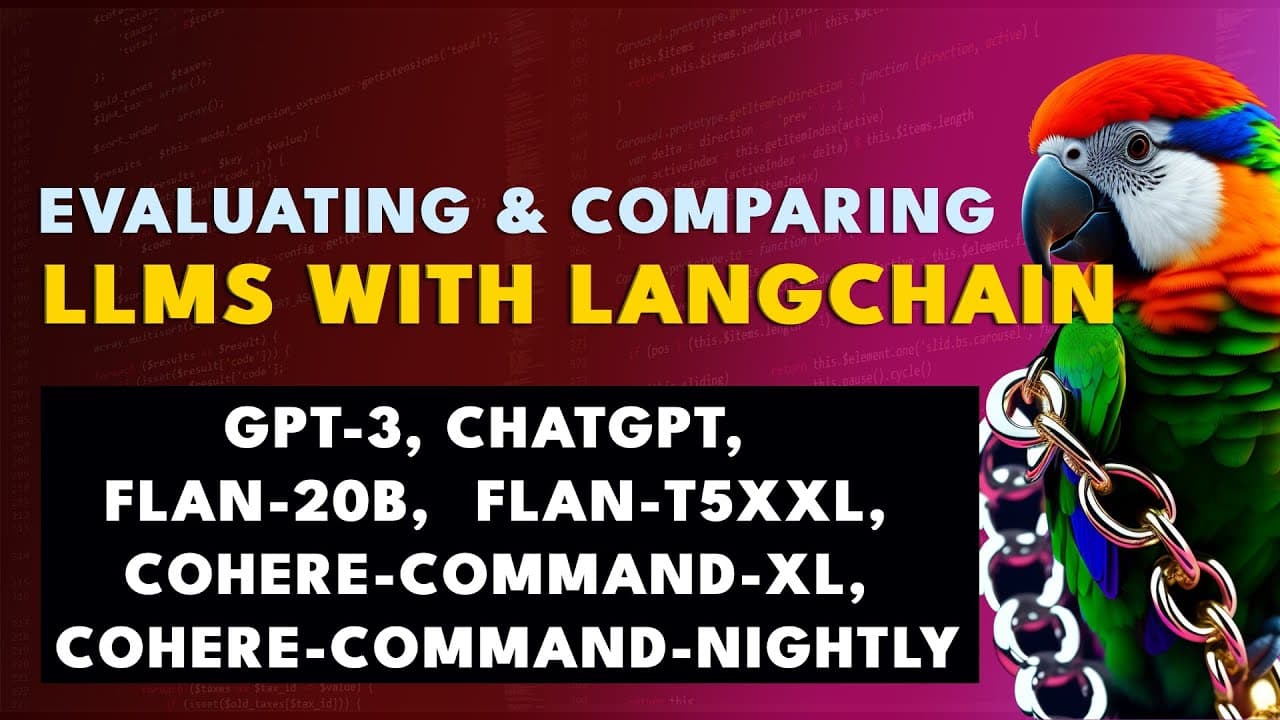
This video explores the process of comparing and evaluating large language models using chain of thought prompting to determine their suitability for different tasks.
Transcript
in this video we're going to be looking at comparing and evaluating large language models using blank chain so one of the issues that a number of people have asked me questions about is how do I know if this model is going to be good for production Etc basically if I compare it to chat gbt it's nowhere near as good the obvious thing is that of cour... Read More
Key Insights
- ⚾ Evaluating and comparing language models using prompt-based testing helps determine their suitability for specific tasks.
- ✍️ Different models may excel in different areas, such as classification, fact extraction, or creative writing.
- 🗯️ Choosing the right model for a task can save costs by using a cheaper model or one available on the Hugging Face Hub.
- 🧚 Prompt templates and consistent testing methods enable fair comparisons between models.
- 🧑🏭 Factors like model size, fine-tuning, and training data affect the performance of language models.
- 🍵 Problems requiring common-sense reasoning may be better handled by larger language models.
- 🧑🏭 Smaller models can still perform well for simpler tasks like fact extraction.
Install to Summarize YouTube Videos and Get Transcripts
Explore YouTube Video Summarizer or Get YouTube Transcript Extractor
Questions & Answers
Q: How can we determine if a language model is suitable for production?
By comparing it to other models and performing prompt-based testing, we can assess its performance on specific tasks and evaluate its suitability for production use.
Q: Are all language models as good as ChatGPT?
No, language models vary in their fine-tuning, training data, size, and performance. Some models may excel at certain tasks like classification or fact extraction, while others may be better suited for creative writing.
Q: How can we compare different language models?
By setting up prompt templates and testing various models with the same prompts, we can compare their outputs and evaluate their performance in terms of accuracy, reasoning, and relevance.
Q: Can cheaper models be used instead of the ChatGPT API?
Yes, depending on the task at hand, certain models may provide satisfactory results at a lower cost. Using models available on the Hugging Face Hub can be a cost-effective alternative to using the ChatGPT API.
Key Insights:
- Evaluating and comparing language models using prompt-based testing helps determine their suitability for specific tasks.
- Different models may excel in different areas, such as classification, fact extraction, or creative writing.
- Choosing the right model for a task can save costs by using a cheaper model or one available on the Hugging Face Hub.
- Prompt templates and consistent testing methods enable fair comparisons between models.
- Factors like model size, fine-tuning, and training data affect the performance of language models.
- Problems requiring common-sense reasoning may be better handled by larger language models.
- Smaller models can still perform well for simpler tasks like fact extraction.
- Repetition penalty and other tuning parameters can impact the performance of language models in prompt-based testing.
Summary & Key Takeaways
-
The video discusses the importance of evaluating language models for different tasks and explains how chain of thought prompting can be used for this purpose.
-
Various models, including Flan 20 billion, Flan T5 XXL, GPT Neo XT 20 billion, Bloom 7 billion, GPT j6b, ChatGPT Turbo, Text DaVinci 003, Cohere Command XL, and Cohere XL Nightly, are compared and evaluated through prompt-based testing.
-
The models are assessed for their performance in tasks like answering questions, solving problems, generating stories, and extracting facts.
Read in Other Languages (beta)
Share This Summary 📚
Summarize YouTube Videos and Get Video Transcripts with 1-Click
Try YouTube Summary with ChatGPT & Claude or YouTube Transcript Generator
Explore More Summaries from Sam Witteveen 📚
Summarize YouTube Videos and Get Video Transcripts with 1-Click
Try YouTube Summary with ChatGPT & Claude or YouTube Transcript Generator