How to Use Prepositions for Time in English
TL;DR
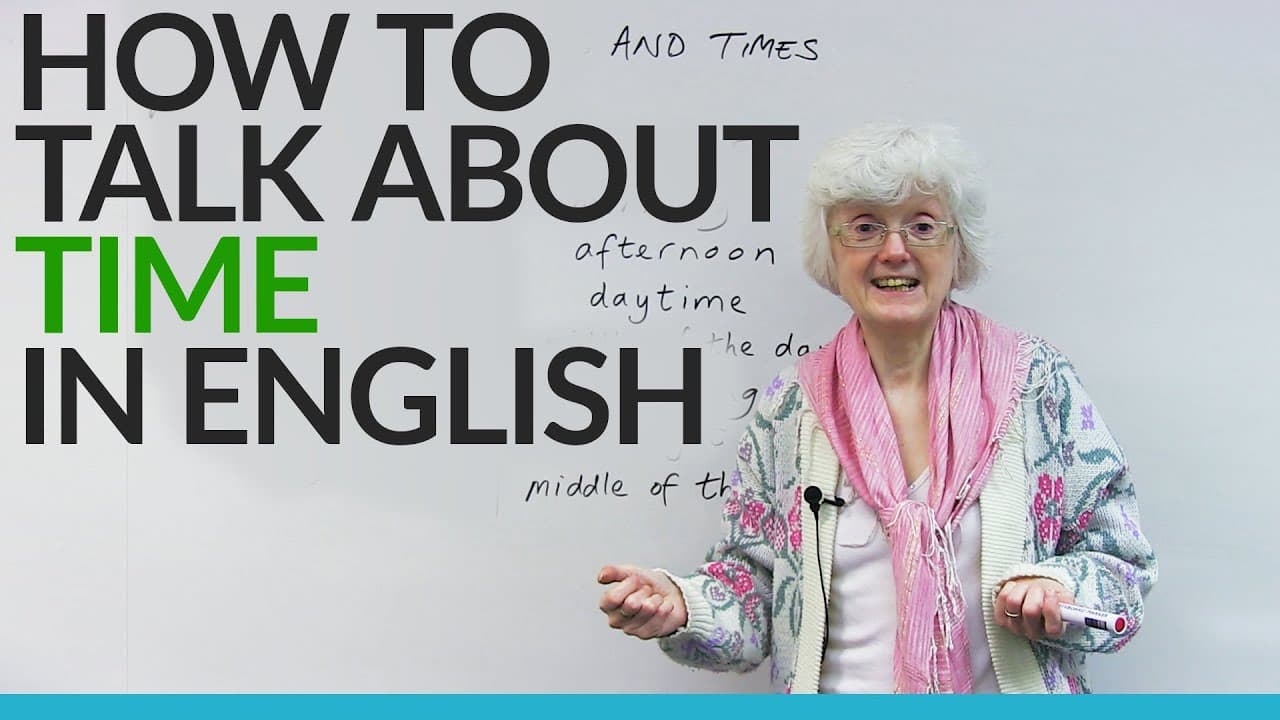
To use prepositions for time correctly in English, use 'at' for specific times and mealtimes, and 'in' for periods of the day like morning and evening. Additionally, use terms like 'yesterday,' 'today,' and 'tomorrow' for past, present, and future references, and know that 'ago' indicates how much time has passed, while 'fortnight' means two weeks.
Transcript
Hello. I'm Gill at www.engvid.com, and today's lesson, we're looking at how to talk about days and times. And we're going to start by looking at prepositions, because sometimes it's a little bit confusing which preposition to use for particular references to the day or the time. Okay? So, there are two main prepositions. There's "at" and there's "i... Read More
Key Insights
- ⌛ Prepositions "at" and "in" are essential for correctly indicating specific times and meal periods.
- ⌛ Understanding words like "yesterday," "today," and "tomorrow" helps in effective time communication.
- 🎁 Knowing how to use "last," "this," and "next" with days of the week is crucial for expressing past, present, or future references.
- 🫤 The term "ago" is used for past time instances, while "fortnight" signifies a period of two weeks.
Install to Summarize YouTube Videos and Get Transcripts
Explore YouTube Video Summarizer or Get YouTube Transcript Extractor
Questions & Answers
Q: How can prepositions "at" and "in" help us talk about specific times and mealtimes?
Preposition "at" is used for specific clock times and mealtimes like breakfast, lunch, teatime, and dinner. In contrast, "in" is used for parts of the day like morning, afternoon, evening, and night.
Q: Can one use "this morning" and "this afternoon" interchangeably for the present and past?
Yes, "this morning" and "this afternoon" can be used for both present and past contexts. For example, you can say, "This morning we are going to do something" or "This morning we had our breakfast at 9:00".
Q: How do we talk about days of the week in the past, present, and future?
Days of the week can be discussed in the past with "last Monday," in the present with "this Monday," and in the future with "next Monday." This pattern applies to other time references like "last week," "this week," and "next week."
Q: What is the significance of the word "ago" and the term "fortnight" in time expressions?
"Ago" is used to refer to a specific time in the past, like "A week ago, I was on holiday." On the other hand, "fortnight" means two weeks or 14 nights, commonly used in British English.
Summary & Key Takeaways
-
Prepositions "at" and "in" are crucial for indicating specific times like mealtimes and clock times.
-
Understanding the usage of "yesterday," "today," and "tomorrow" along with parts of the day like morning, afternoon, evening, and night is essential.
-
Learn how to correctly use words related to past, present, and future, and also grasp the meaning of "ago" and "fortnight" in time references.
Read in Other Languages (beta)
Share This Summary 📚
Summarize YouTube Videos and Get Video Transcripts with 1-Click
Try YouTube Summary with ChatGPT & Claude or YouTube Transcript Generator
Explore More Summaries from Learn English with Gill · engVid 📚





Summarize YouTube Videos and Get Video Transcripts with 1-Click
Try YouTube Summary with ChatGPT & Claude or YouTube Transcript Generator