What Is the Cube Shadow Theorem and Its Implications?
TL;DR
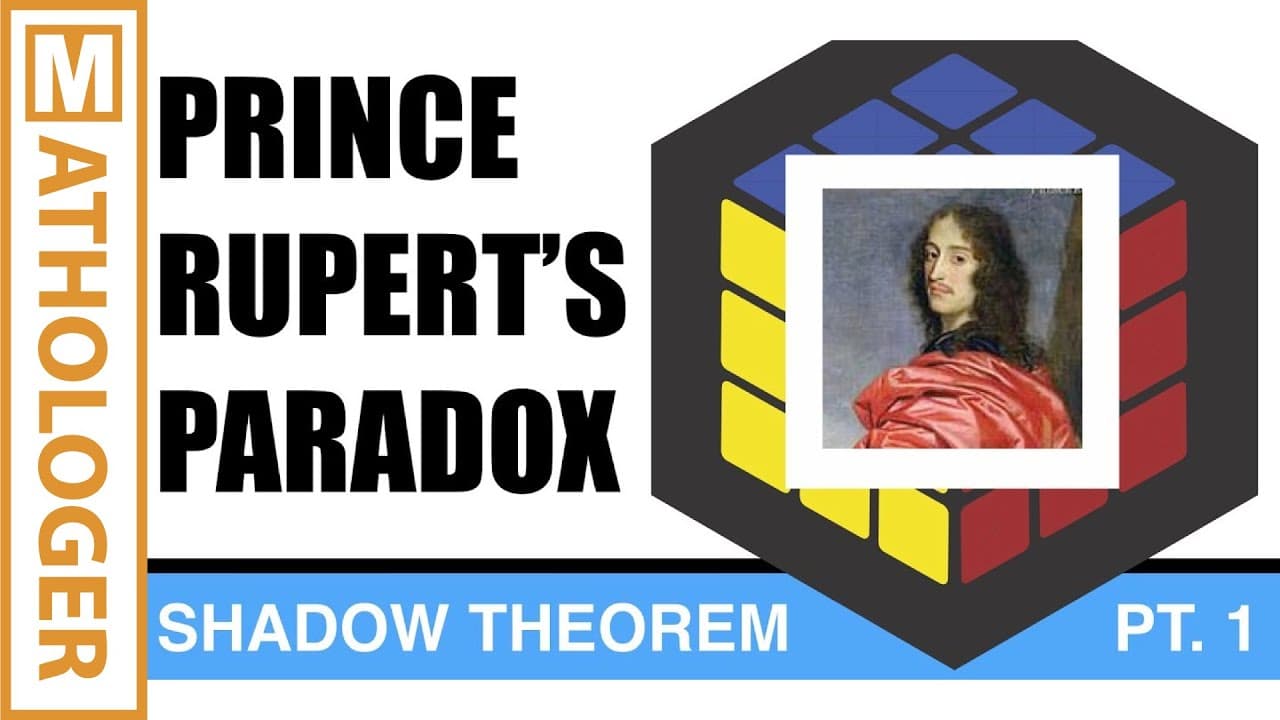
The cube shadow theorem states that for a unit cube, the area of its shadow and the height difference between its top and bottom points are always equal, regardless of its orientation in space. This concept helps in calculating the smallest and largest possible shadows of a cube and was first noted by mathematician Peter McMullen in 1985.
Transcript
Welcome to a different kind of Mathologer video. All my students at uni know that I have a bit of a cube fetish-- mathematically cubes, Rubik's cubes, anything goes. What I want to do today is introduce you to some very recently discovered mind-boggling facts about cubes that hardly anybody knows about, not even mathematicians. Alright, so I've got... Read More
Key Insights
- 🧊 Cubes can have shapes other than a traditional six-sided cube, such as the Skewb's rhombic dodecahedron shape.
- 🧊 The area of a cube's shadow and the height difference of the cube are equal when dealing with a unit cube.
- 🧊 The shadow theorem simplifies calculations for determining the smallest and largest possible shadows of a cube.
- ❎ It is possible to pass a cube through itself by drilling a hole with a square cross-section.
- 🧊 The concept of passing a cube through itself was discovered by Prince Rupert in the 17th century.
- 😎 The Prince Rupert's drop, a glass tadpole with unique properties, is unrelated to the concept of passing a cube through itself.
- 🥳 The video is divided into two parts, with part 1 introducing basic facts and part 2 delving deeper into the mathematics.
Install to Summarize YouTube Videos and Get Transcripts
Explore YouTube Video Summarizer or Get YouTube Transcript Extractor
Questions & Answers
Q: What is the shape of a Skewb?
A Skewb is a twisty puzzle that is cube-shaped but not a cube itself. It has a shape known as a rhombic dodecahedron, consisting of twelve rhombuses.
Q: How does the shadow theorem work?
When dealing with a unit cube, the area of the cube's shadow and the height difference of the cube will always be equal, regardless of its orientation or the shape of the shadow.
Q: What practical applications does the shadow theorem have?
The shadow theorem allows us to determine the smallest and largest possible shadows of a cube by finding the smallest and largest possible height differences.
Q: How is it possible to pass a cube through itself?
By drilling a square hole through the cube, it becomes possible to pass another cube of the same size through the hole. This can be repeated with progressively larger holes and cubes.
Summary & Key Takeaways
-
The video introduces some lesser-known facts about cubes, such as the shape of a Skewb and the 2D shadow of a 666-dimensional cube.
-
The shadow theorem states that the area of a shadow and the height difference of a cube will be equal when the cube is a unit cube.
-
These facts have practical applications, such as determining the smallest and largest possible shadows of a cube.
Read in Other Languages (beta)
Share This Summary 📚
Summarize YouTube Videos and Get Video Transcripts with 1-Click
Try YouTube Summary with ChatGPT & Claude or YouTube Transcript Generator
Explore More Summaries from Mathologer 📚
Summarize YouTube Videos and Get Video Transcripts with 1-Click
Try YouTube Summary with ChatGPT & Claude or YouTube Transcript Generator