Number Systems | No of ways | Example | Aptitude | Part- 08 | Bharath Kumar
TL;DR
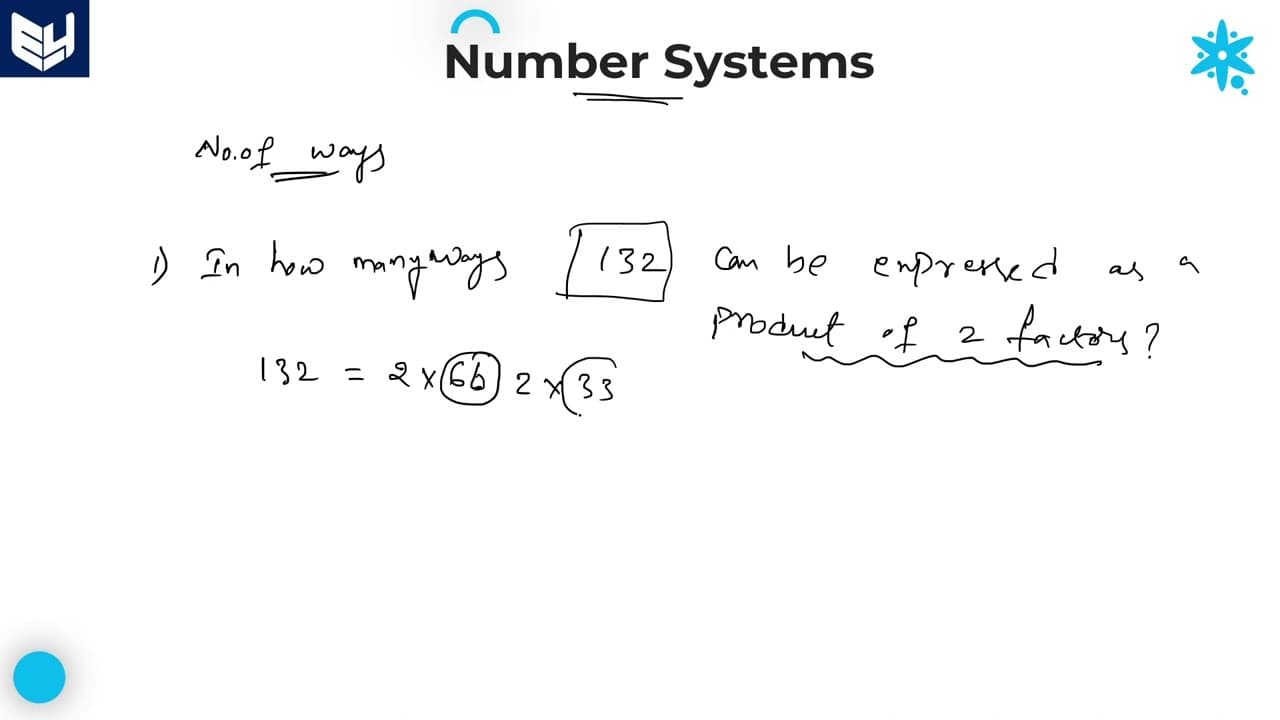
The session explains calculating the number of ways to express numbers as products of factors.
Transcript
hi everyone welcome to the session in this session we'll discuss about the topic number systems in the last session we have discussed about the concept of number of ways we have discussed about the concept of number of ways now i will explain the problems related to number of ways how to solve the big uh number of ways for big numbers for small num... Read More
Key Insights
- #️⃣ The concept of number systems relies heavily on factorization, which is key to solving various mathematical problems.
- #️⃣ Finding the prime factorization is the foundational step in determining the number of factors for any given number.
- 🧑🏭 Even and odd counts of factors yield different methods for calculating the number of ways a number can be expressed as a product of factors.
- #️⃣ Perfect square numbers yield unique properties due to their odd number of factors, influencing counting methods.
- 🧑🏭 The approach of adding one to the powers of prime factors to count total factors is a fundamental principle in number theory.
- 👻 Understanding factors allows for a greater grasp of mathematical principles in combinatorics and problem-solving.
- 🏑 The session emphasizes the practical implications of these number theories in fields like data encryption and algorithm design.
Install to Summarize YouTube Videos and Get Transcripts
Explore YouTube Video Summarizer or Get YouTube Transcript Extractor
Questions & Answers
Q: What is the significance of prime factorization in determining the number of factors?
Prime factorization plays a critical role as it allows us to express any number in its simplest multiplicative form. By writing a number as a product of prime factors, we can easily apply the formula for finding the total number of factors, which directly influences how we can represent that number as products of factors.
Q: How does the parity of the number of factors affect the way we count the number of ways?
When the total number of factors is even, the number of ways to express a number as a product of two factors is simply half the total number of factors. Conversely, if the number is odd, additional considerations must be accounted for based on whether the product involves distinct factors or not, leading to different calculations for the number of ways.
Q: Can you explain the method used to count factors?
To count the number of factors, you first express the number as a product of its prime factors. Then, add 1 to each of the powers of these prime factors and multiply the resulting values together. This formula helps efficiently determine how many unique combinations (or factors) can be derived from the original number.
Q: What is the first step in solving a problem related to expressing numbers as products?
The first step is determining the prime factorization of the given number. Once the number is written in terms of its prime factors, we can then count the total number of factors, which is crucial for calculating how many different ways the number can be expressed as a product of two factors.
Q: How does the session’s discussion apply to real-world applications?
Understanding number systems and factorization has applications in various fields, including cryptography, computer science, and combinatorics. Knowledge of how to manipulate factors is foundational for solving problems across mathematics, making this topic vital for students and professionals in technical disciplines.
Q: Why is it essential to distinguish between product of two different factors and product of two factors?
Distinguishing between these two forms is crucial because it alters the final count of product representations. For example, having an odd number of factors indicates that there will be instances where factors can be repeated, while different factors must be counted separately. This understanding is necessary for accurate calculations in problem-solving.
Summary & Key Takeaways
-
The session covers how to determine the number of ways to express a number as a product of factors, emphasizing the importance of prime factorization.
-
Examples are given with both composite and perfect square numbers, illustrating how to calculate the number of factors and subsequently, the number of ways to express the number.
-
A focus is placed on understanding the distinction between even and odd factors in relation to the method of determining the number of ways to express numbers.
Read in Other Languages (beta)
Share This Summary 📚
Summarize YouTube Videos and Get Video Transcripts with 1-Click
Try YouTube Summary with ChatGPT & Claude or YouTube Transcript Generator