How Nuclear Fusion Reactors Work | Dennis Whyte and Lex Fridman
TL;DR
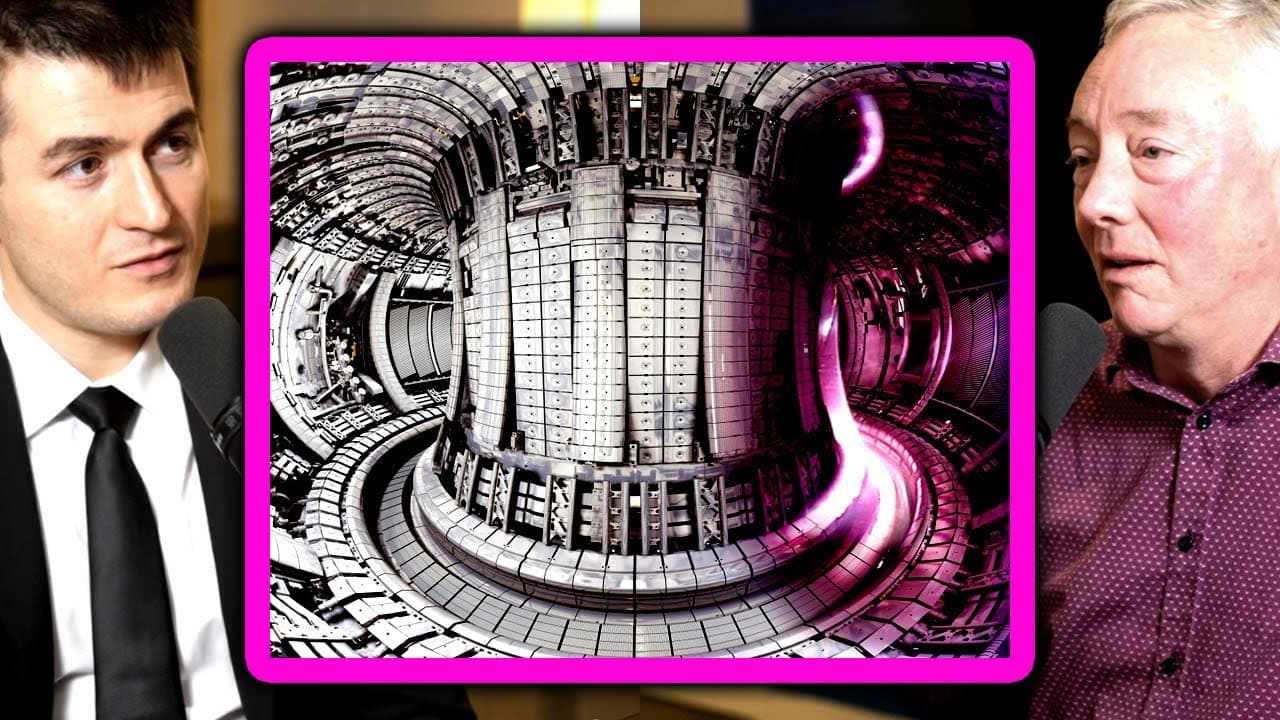
Nuclear fusion reactors require high temperatures and confinement to achieve fusion reactions, and the energy confinement time and particle density are key factors in successful fusion.
Transcript
so if I can try to summarize what a nuclear fusion reactor is supposed to do so you have what a couple of elements what are usually the elements usually deuterium and tritium which are the heavy forms of hydrogen hydrogen you have those and you start heating it and then as you start heating it I forgot the temperature you said about 100 million no ... Read More
Key Insights
- ✋ Fusion reactions require high temperatures, usually around 100 million degrees, to have a significant probability of occurring.
- 👻 Quantum tunneling allows particles to overcome energy barriers and get within the required distances for fusion reactions.
- 😅 Fusion reactions in stars, like the Sun, rely on their own fusion reactions to stay hot and maintain their temperature.
- ⌛ Energy confinement time is a measure of how long it takes for the energy to leave the system, and longer confinement times are desirable.
- 🧑🏭 Temperature and particle density are critical factors in successful fusion reactions.
- 🛩️ Visible light is just one part of the electromagnetic spectrum, and humans have evolved to detect only a small portion of it.
- 🙌 Ionizing radiation, such as X-rays, can have an impact on human health, but humans have no natural ability to detect it.
Install to Summarize YouTube Videos and Get Transcripts
Explore YouTube Video Summarizer or Get YouTube Transcript Extractor
Questions & Answers
Q: What elements are typically used in nuclear fusion reactors?
Deuterium and tritium, which are heavy forms of hydrogen, are commonly used in nuclear fusion reactors.
Q: How does temperature affect the probability of fusion reactions?
At lower temperatures, below about 10,000 degrees, the probability of fusion reactions occurring is almost zero. The reactions become more rapid as the temperature increases.
Q: What is the significance of energy confinement time?
Energy confinement time refers to how long it takes for the energy released or applied to the fuel to dissipate. A longer confinement time allows for more fusion reactions to occur.
Q: Why is particle density important in fusion reactors?
There must be enough density of fusion particles for the reactions to occur, but not too much that it becomes difficult to achieve fusion. The balance of particle density is crucial.
Summary & Key Takeaways
-
Nuclear fusion reactors involve heating elements like deuterium and tritium to create a plasma at temperatures of around 10,000 degrees, where fusion reactions can occur.
-
The probability of fusion reactions increases as the ions collide with each other, and the ions must be prevented from hitting the walls of the reactor.
-
The requirements for successful fusion include high temperatures, long energy confinement times, and sufficient particle density.
Read in Other Languages (beta)
Share This Summary 📚
Summarize YouTube Videos and Get Video Transcripts with 1-Click
Try YouTube Summary with ChatGPT & Claude or YouTube Transcript Generator
Explore More Summaries from Lex Clips 📚




Summarize YouTube Videos and Get Video Transcripts with 1-Click
Try YouTube Summary with ChatGPT & Claude or YouTube Transcript Generator