Electric Current & Circuits Explained, Ohm's Law, Charge, Power, Physics Problems, Basic Electricity
TL;DR
This video explains the basics of electric current and Ohm's Law, including the relationships between voltage, current, and resistance. It also demonstrates how to solve practice problems involving these concepts.
Transcript
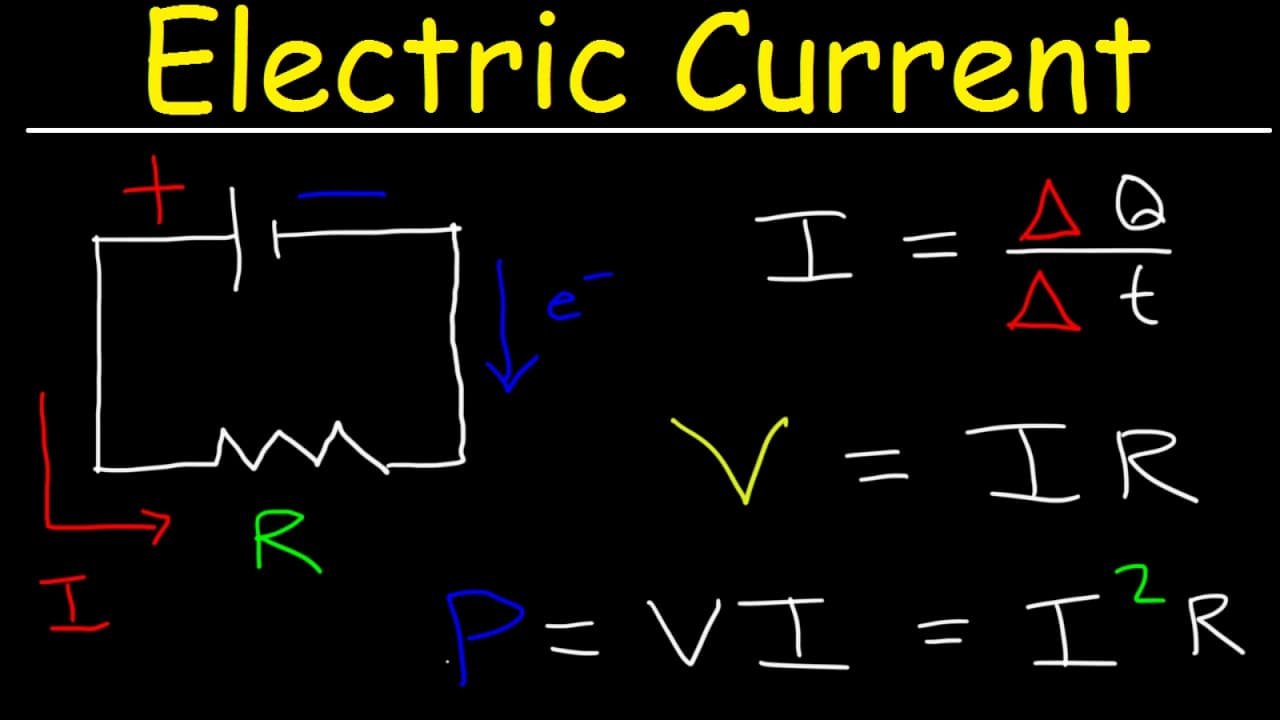
in this video we're going to go over a few basic equations and work on some practice problems involving electric current and ohm's law so let's say if we have a battery the long side of the battery is the positive terminal and here's a resistor conventional current states that current flows from the positive terminal to the negative terminal curren... Read More
Key Insights
- 💐 Conventional current represents the flow of positive charge, while electron flow represents the actual movement of electrons.
- ☠️ Current is the rate of charge flow and is measured in amperes.
- ⚡ Ohm's Law relates voltage, current, and resistance, and can be used to solve various circuit problems.
- ⚡ Increasing voltage increases current, while increasing resistance decreases current.
- ☠️ Electric power is the rate at which energy is transferred and is measured in watts.
- 🔌 Electric charge is proportional to the number of electrons.
- ✊ Ohm's Law can be used to calculate power by substituting known values into the equation.
Install to Summarize YouTube Videos and Get Transcripts
Explore YouTube Video Summarizer or Get YouTube Transcript Extractor
Questions & Answers
Q: How is conventional current different from electron flow?
Conventional current represents the flow of positive charge, while electron flow represents the actual movement of electrons from the negative to the positive terminal.
Q: What is the equation for calculating current?
Current is defined as the rate of charge flow, calculated by dividing the charge by time. The equation is I = Q/t, where I is current, Q is charge, and t is time.
Q: How does increasing voltage affect current?
Increasing voltage causes an increase in current, as long as the resistance remains constant. Voltage and current are directly related.
Q: What is the relationship between resistance and current?
Resistance and current are inversely related. Increasing resistance decreases current flow, while decreasing resistance increases current flow.
Q: What is the equation for electric power?
Electric power is the product of voltage and current. The three forms of the equation are P = VI, P = I^2R, and P = V^2/R.
Q: What is the unit of power?
Power is measured in watts. One watt is equal to one joule per second, which is the rate at which energy is transferred.
Q: How is electric charge related to the number of electrons?
The amount of charge is proportional to the number of electrons. One electron has a charge of 1.6 x 10^-19 coulombs, so dividing the charge by this value gives the number of electrons.
Q: How can Ohm's Law be used to calculate power?
Ohm's Law can be used to calculate power by substituting the given values for voltage and resistance into the equation P = VI or rearranging the equation to use current and resistance.
Summary & Key Takeaways
-
Conventional current is the flow of positive charge from the positive terminal to the negative terminal, while electron flow is the actual movement of electrons from the negative terminal to the positive terminal.
-
Current is defined as the rate of charge flow, measured in amperes. It can be calculated by dividing the charge by time.
-
Ohm's Law describes the relationship between voltage, current, and resistance. It states that voltage is equal to the product of current and resistance.
Read in Other Languages (beta)
Share This Summary 📚
Summarize YouTube Videos and Get Video Transcripts with 1-Click
Try YouTube Summary with ChatGPT & Claude or YouTube Transcript Generator
Explore More Summaries from The Organic Chemistry Tutor 📚




Summarize YouTube Videos and Get Video Transcripts with 1-Click
Try YouTube Summary with ChatGPT & Claude or YouTube Transcript Generator