Alpha Numeric Sequence Puzzle | Reasoning | Part- 01 | Bharath Kumar
TL;DR
The session discusses the importance and methods of solving alphanumeric sequence puzzles for competitive exams.
Transcript
hi everyone welcome back in this session i am going to discussing about alpha numeric sequence version alpha numeric sequence puzzle guys alpha numeric sequence puzzle topic is very important especially for banking railways ssa and also upsc she said now in this session i am going to discussing about what kind of questions are asking from this topi... Read More
Key Insights
- 🤬 Alphanumeric puzzles consist of letters, numbers, and symbols, utilized in competitive exam contexts.
- 🦻 Understanding the structure of sequences aids in answering questions swiftly and accurately.
- 🧘 Counting elements and their relationships is paramount when determining positions within the sequence.
- ❓ Candidates must employ logical reasoning to ascertain consonant-vowel relationships effectively.
- 👥 Establishing a pattern helps in quickly identifying which items fit specific criteria within a group.
- 🧘 Shortcut methods are often available to simplify the problem-solving process for positioning questions.
- 👥 Recognizing the differences in group patterns is crucial for successfully isolating anomalies in sequences.
Install to Summarize YouTube Videos and Get Transcripts
Explore YouTube Video Summarizer or Get YouTube Transcript Extractor
Questions & Answers
Q: What is the significance of alphanumeric sequences in competitive exams?
Alphanumeric sequences play a crucial role in various competitive exams such as banking, railway, and UPSC. These puzzles evaluate a candidate's analytical and logical reasoning skills, making them essential for success in these assessments. Understanding the design of such sequences can significantly boost performance during exams.
Q: How do you determine the middle element between two numbers in a sequence?
To find the middle element between two given numbers in a sequence, first, count the total number of elements and then identify how many lie between the two numbers. For example, if there are 11 elements, the 6th element serves as the middle, while the 5th and 7th elements represent those to the left and right of it, respectively.
Q: What criteria must numbers meet when preceded and followed by consonants?
For a number within an alphanumeric sequence to meet specific criteria, it must be immediately preceded by a consonant and not followed by another consonant. This requires closely examining each number's adjacent elements to determine which satisfy the conditions specified in the question.
Q: Can vowels be considered valid in sequences if preceded by consonants?
In the context of this session, vowels need to be assessed carefully based on their placement. They should be followed by a number and not preceded by a consonant to meet the conditions. This specific criteria helps in filtering out valid candidates among the vowels present in the sequence.
Q: How is the 16th position from the left determined in a sequence?
To identify the 16th position from the left in a sequence, simply count to that specified point. If a question then requires finding the 7th element to the left of this 16th position, one can count backward or use a shortcut method by calculating the difference in positions, enhancing efficiency.
Q: What approach is used to find the odd one out among group patterns in sequences?
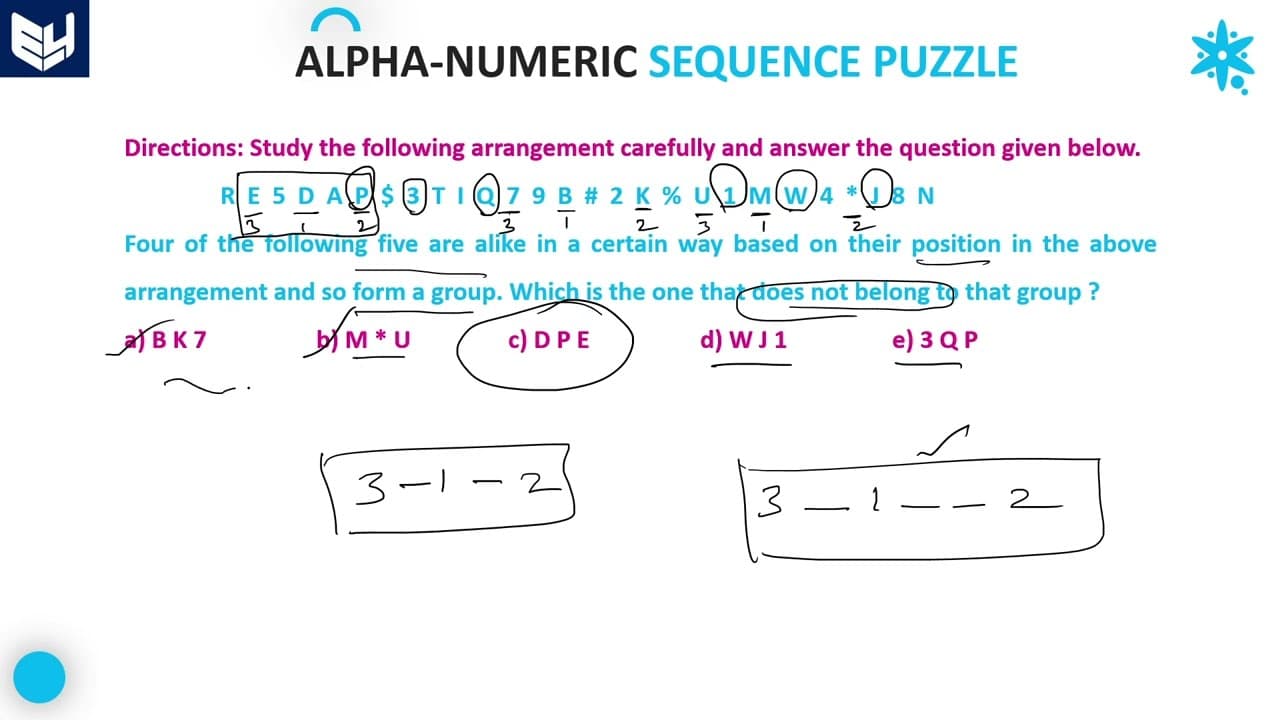
To identify the odd element among several that follow the same grouping pattern, first analyze the established rules based on two or more similar entries. Once observed, if any subsequent entry breaks that rule, it can be considered the outlier, requiring no further examination of the remaining options.
Summary & Key Takeaways
-
The session focuses on alphanumeric sequence puzzles, essential for various competitive exams like banking and UPSC. It explains the components involved, including letters, numbers, and symbols, and how to solve questions based on these sequences.
-
Participants learn how to determine the middle element within a sequence, calculate preceding or following conditions related to consonants and vowels, and utilize both direct counting and shortcuts for efficient problem-solving.
-
The instructor demonstrates several examples of questions, showing how to identify patterns and group similarities to reach correct answers quickly, emphasizing methods applicable in exam settings.
Read in Other Languages (beta)
Share This Summary 📚
Summarize YouTube Videos and Get Video Transcripts with 1-Click
Try YouTube Summary with ChatGPT & Claude or YouTube Transcript Generator