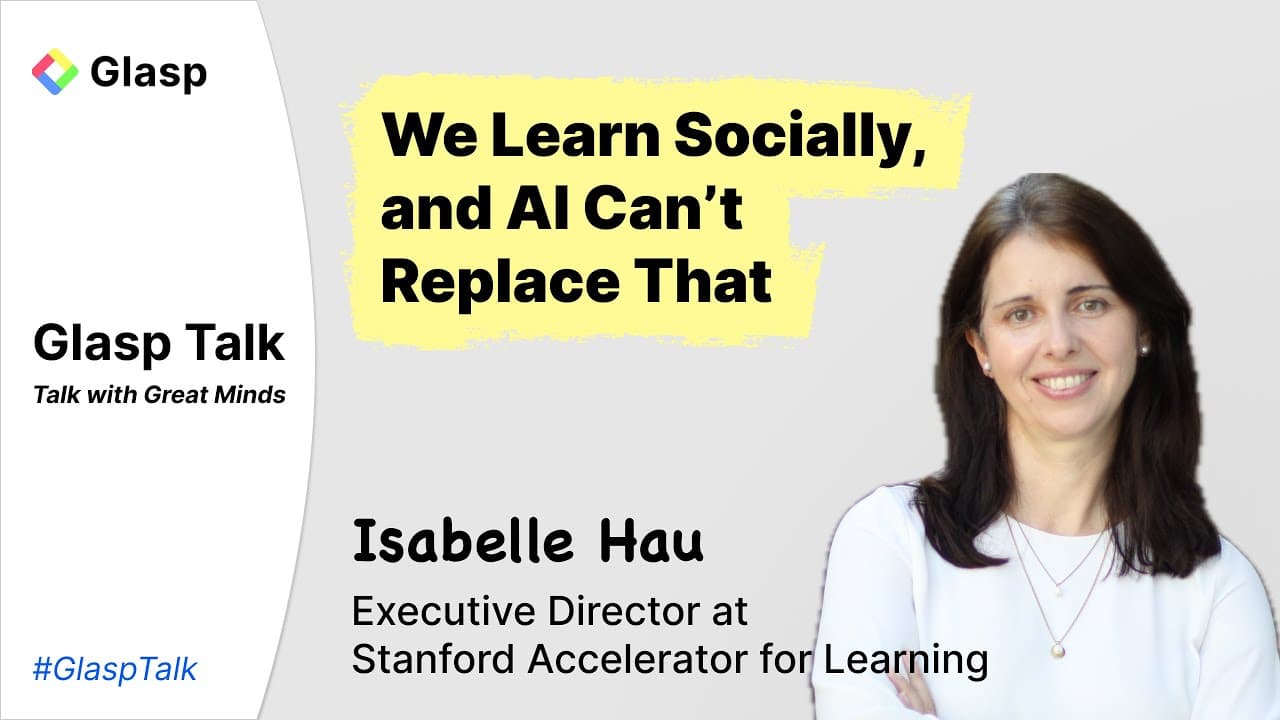
Isabelle Hau: We Learn Socially, Why AI Can’t Replace Human Connection in Education | Glasp Talk #59
TL;DR
AI can enhance education but can't replace human connection.
Transcript
We, as human beings, have social brains. So we learn socially, especially in the earliest years of life, but I would say throughout life. Hi, everyone. Welcome back to another episode of Glasp Talk. Today, we are honored to have Isabelle Hau with us. Isabelle is executive director of the Stanford Accelerator for Learning, where she leads efforts to... Read More
Key Insights
- Isabelle Hau emphasizes the importance of social learning and human connection, especially in early childhood education, as crucial for cognitive and emotional development.
- The Stanford Accelerator for Learning focuses on optimizing education systems around learning rather than just access, aiming for lifelong and life-wide learning opportunities.
- Early childhood education holds significant untapped potential for impact, as strong foundations lead to better long-term outcomes.
- AI's rapid adoption in education presents both opportunities and challenges, with the need to balance technological integration with human interaction.
- Research on AI's impact on learning is mixed, showing both potential hindrances and benefits depending on how and when AI tools are used.
- The future of intelligence may involve a shift from cognitive and emotional intelligence to relational intelligence, emphasizing the ability to connect with others.
- The book 'Love to Learn' highlights the shrinking circles of relationships around children and the importance of nurturing care and connection.
- AI's role in education should be as a catalyst for learning rather than a replacement for human relationships, with careful consideration of its impact on social expectations.
Install to Summarize YouTube Videos and Get Transcripts
Explore YouTube Video Summarizer or Get YouTube Transcript Extractor
Questions & Answers
Q: Can you share your journey from France to the US and what shaped your passion for education and equity?
Isabelle Hau moved to the US 25 years ago, initially working in finance where she learned about scaling impact. Her passion for education and equity was shaped by her work at Omidyar Network, focusing on impact investing, and later establishing education initiatives that expanded access to learning.
Q: At Stanford Accelerator for Learning, what are the most pressing challenges in education that you and your team are focused on right now?
The Stanford Accelerator for Learning is focused on optimizing education systems around learning rather than just access. Key challenges include ensuring lifelong and life-wide learning opportunities, addressing large class sizes, and integrating research on human learning into education systems.
Q: Among early childhood, digital learners, and working learners, which area do you think holds the most untapped potential for impact?
Early childhood education holds significant untapped potential for impact. Investing early in children's education provides strong foundations for long-term success, similar to building a house with a solid foundation. Digital learning and AI also present opportunities for transformation.
Q: Since publishing your book, 'Love to Learn,' earlier this year, have there been any updates in how AI is impacting education?
AI's rapid adoption in education has been faster than expected, with mixed research findings. Some studies show AI tools can hinder learning, while others suggest they can enhance it when used at optimal times. Ongoing research is needed to understand AI's full impact on education.
Q: OpenAI launched Study Mode—do you think it will truly help students use AI better, or is it too early to tell?
It's too early to tell the full impact of OpenAI's Study Mode. While some pilot access has been granted, comprehensive research is needed to evaluate its effectiveness. Upcoming studies, like the one planned for Estonia, will provide insights into AI's impact on student learning at scale.
Q: Have you seen any recent research on the impact of AI in early childhood care or education, beyond studies with university students?
Research on AI's impact in early childhood education is limited but growing. Most studies have focused on older students due to initial technology access restrictions. More research is needed to explore AI's effects on younger learners and how it can support early childhood education.
Q: Could you share the core message of your book 'Love to Learn,' and briefly explain what it’s about for our audience?
The core message of 'Love to Learn' is the transformative power of care and connection in education. It emphasizes the importance of relationships for cognitive and emotional development, highlighting concerns about shrinking social circles and advocating for nurturing connections in children's lives.
Q: You’ve mentioned moving beyond IQ and EQ toward new models of intelligence. Could you explain what you mean by deduction of intelligence models?
Deduction of intelligence models refers to a shift from focusing solely on cognitive (IQ) and emotional intelligence (EQ) to emphasizing relational intelligence. This involves the ability to connect with others, which is becoming increasingly important as AI can replicate cognitive and emotional tasks.
Summary & Key Takeaways
-
Isabelle Hau discusses the importance of social learning and human connection in education, emphasizing that AI should enhance rather than replace these elements. She highlights the need for optimizing education systems around learning and the potential impact of early childhood education.
-
The conversation explores the rapid adoption of AI in education, its mixed impact on learning outcomes, and the importance of relational intelligence in the future. Hau's book 'Love to Learn' stresses the significance of nurturing relationships for children's development.
-
Hau raises concerns about AI companions replacing human interactions and the need for frameworks to guide their use. She advocates for tech-free family time to strengthen relationships and emphasizes the role of relational intelligence in future economies.
Read in Other Languages (beta)
Share This Summary 📚
Summarize YouTube Videos and Get Video Transcripts with 1-Click
Try YouTube Summary with ChatGPT & Claude or YouTube Transcript Generator
Explore More Summaries from Glasp 📚

Summarize YouTube Videos and Get Video Transcripts with 1-Click
Try YouTube Summary with ChatGPT & Claude or YouTube Transcript Generator