Self-assembling robots at MIT | Neil Gershenfeld and Lex Fridman
TL;DR
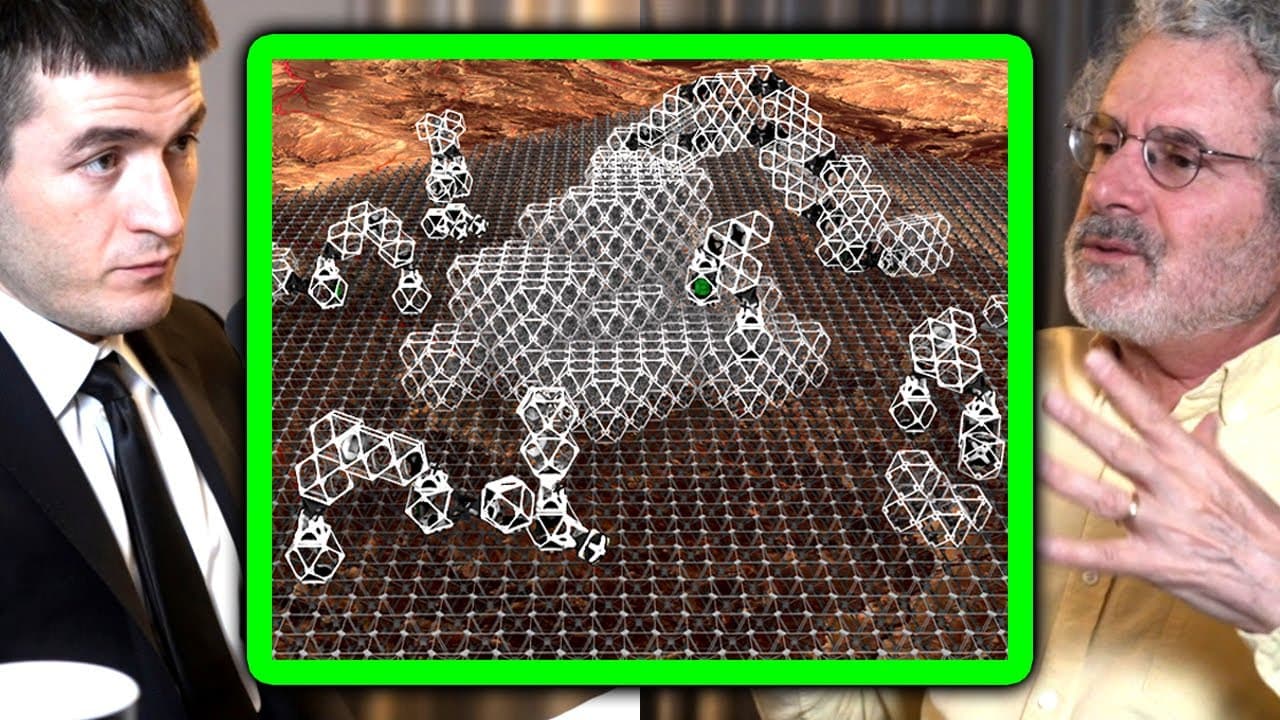
Researchers have developed a method using carbon fiber loops to create lightweight, high modulus materials, enabling the construction of efficient robots and structures with minimal failure points.
Transcript
when you make a composite airplane you make these giant wing and fuselage parts and they asked us for a better way to stick them together because the joints were a place of failure and what we discovered was instead of making a few big Parts if you make little Loops of carbon fiber and you reversibly link them in joints and you do it in a special g... Read More
Key Insights
- 👷 Carbon fiber loops linked in joints offer a more efficient and reliable method for constructing composite airplanes.
- 🖐️ Lightweight materials play a crucial role in improving energy efficiency in various industries.
- 🏗️ Robots that can navigate and build structures with error correction open new possibilities for construction and automation.
- 👻 Self-replicating robots have the potential to revolutionize robotic assembly, allowing for exponential growth in capabilities.
- 🛩️ Using smaller parts to build robots and structures in stages can overcome the limitations of going from the very small to the very large.
- 🤖 Constructing structures using swarms of smaller robots offers increased efficiency and precision compared to traditional methods.
- 🥳 The digitization of materials aims to create a universal inventory of parts for engineering, similar to the 20 amino acids that compose all of biology.
Install to Summarize YouTube Videos and Get Transcripts
Explore YouTube Video Summarizer or Get YouTube Transcript Extractor
Questions & Answers
Q: How did researchers improve the construction of composite airplanes?
Researchers used carbon fiber loops linked in joints to create lightweight materials, reducing failure points and setting a world record for the highest modulus ultralight material.
Q: How are lightweight materials crucial for energy efficiency?
Lighter materials require less energy to move, making them ideal for applications in robotics, aircraft, and other energy-consuming industries.
Q: Can robots make themselves using the parts they create?
Yes, recent research has shown that robots can be made from the parts they create, allowing for self-replication and the potential for exponential growth in robotic assembly.
Q: How are swarms of table-scale robots used in construction?
Swarms of table-scale robots can walk on structures and efficiently place parts, enabling the construction of large-scale structures without the need for massive printers.
Summary & Key Takeaways
-
Researchers discovered that instead of making large parts, using little loops of carbon fiber linked in joints in a specific geometry can create lightweight, high modulus materials.
-
By using a few types of parts, material properties can be tuned, allowing for the creation of versatile robots that can navigate and build structures with error correction.
-
The development of self-replicating robots and the ability to build structures using swarms of table-scale robots are promising advancements.
Read in Other Languages (beta)
Share This Summary 📚
Summarize YouTube Videos and Get Video Transcripts with 1-Click
Try YouTube Summary with ChatGPT & Claude or YouTube Transcript Generator
Explore More Summaries from Lex Clips 📚




Summarize YouTube Videos and Get Video Transcripts with 1-Click
Try YouTube Summary with ChatGPT & Claude or YouTube Transcript Generator