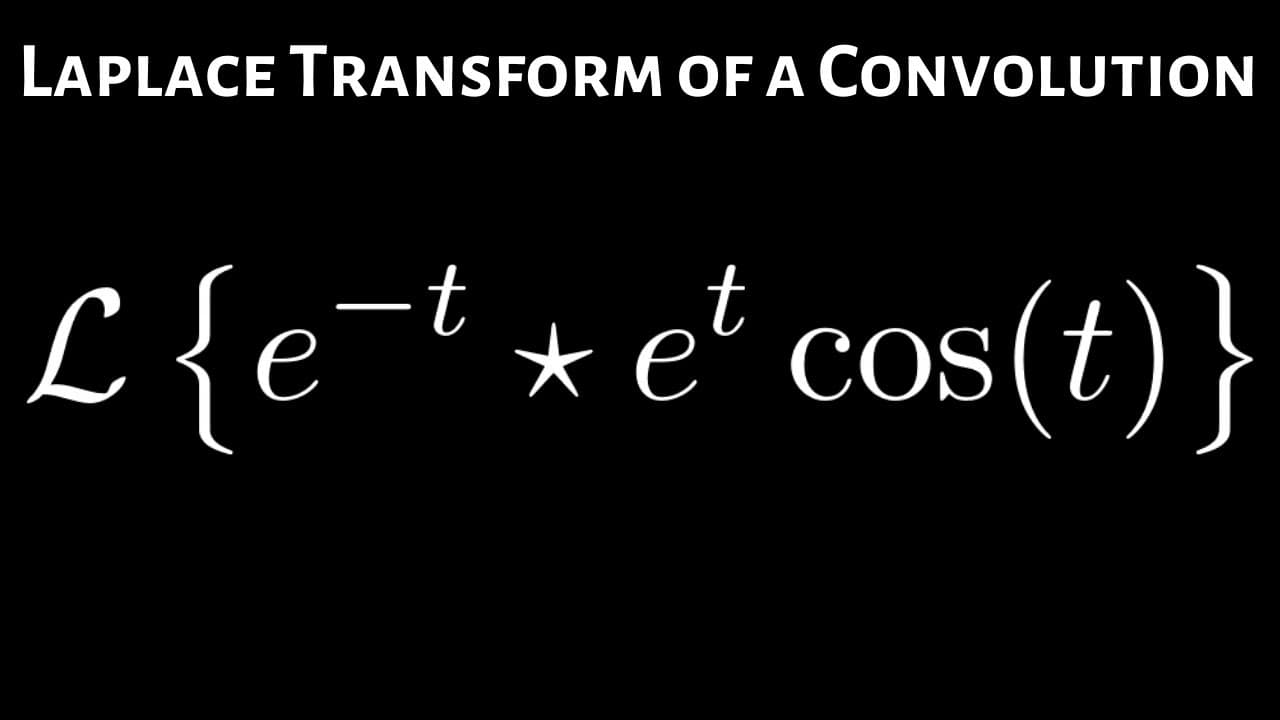
How to Find the Laplace Transform of a Convolution Example with e(-t) and e^tcos(t)
TL;DR
Finding Laplace transform of a convolution using formulas and the convolution theorem.
Transcript
in this problem we're going to find the laplace transform of the convolution of these two functions so it's the convolution of e to the negative t with e to the t cosine t all right so there's a formula or a theorem called the convolution theorem and it basically says to compute this you simply take the laplace of each piece and you multiply them t... Read More
Key Insights
- ❓ Convolution theorem simplifies Laplace transform computations for convolutions.
- ❓ Knowing Laplace transform formulas for exponential functions is crucial in calculations.
- ❓ Utilize the first translation theorem for simplification through shifting in Laplace transforms.
- ❓ Memorize Laplace transform formula for cosine functions to streamline calculations.
- ❓ Pay attention to details like shifts to ensure accurate Laplace transform results.
- ❓ Consistent notation and clarity in mathematical representations enhance understanding.
- ❓ Practice is essential to mastering Laplace transform calculations effectively.
Install to Summarize YouTube Videos and Get Transcripts
Explore YouTube Video Summarizer or Get YouTube Transcript Extractor
Questions & Answers
Q: What is the convolution theorem in Laplace transforms?
The convolution theorem states that to find the Laplace transform of a convolution of two functions, simply multiply the Laplace transforms of each function involved.
Q: How do you calculate the Laplace transform of e^(-t)?
The Laplace transform of e^(-t) is 1/(s+1) using the formula for the Laplace transform of e^(at) as 1/(s-a).
Q: How does the first translation theorem help in Laplace transforms?
The first translation theorem allows simplification of Laplace transforms involving exponential terms by shifting the s variable accordingly.
Q: How is the Laplace transform of cosine function calculated?
The Laplace transform of cosine kt is s/(s^2 + k^2), where k is the constant within the cosine function.
Summary & Key Takeaways
-
Use the convolution theorem to find the Laplace transform of the convolution of two functions.
-
Apply Laplace transform formulas for exponential and cosine functions.
-
Utilize the first translation theorem for shifting in Laplace transforms.
Read in Other Languages (beta)
Share This Summary 📚
Summarize YouTube Videos and Get Video Transcripts with 1-Click
Try YouTube Summary with ChatGPT & Claude or YouTube Transcript Generator
Explore More Summaries from The Math Sorcerer 📚



Summarize YouTube Videos and Get Video Transcripts with 1-Click
Try YouTube Summary with ChatGPT & Claude or YouTube Transcript Generator