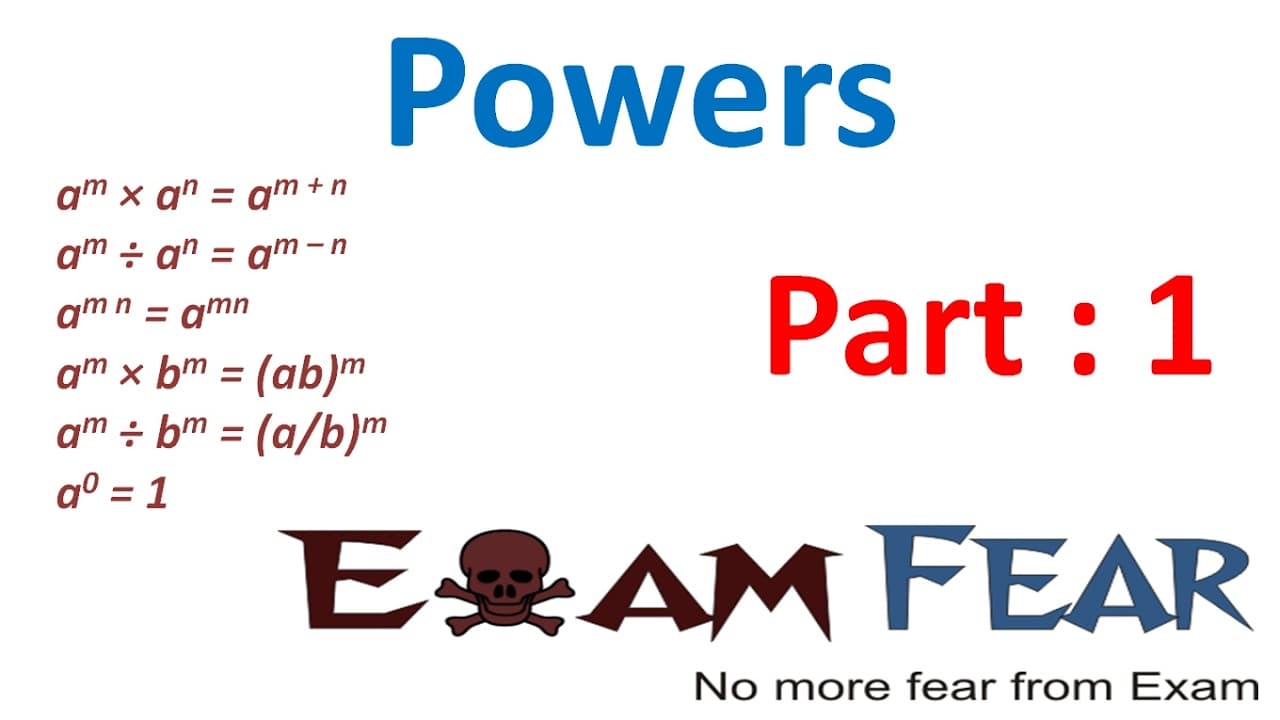
Maths Powers part 1 (Introduction) CBSE Class 8 Mathematics VIII
TL;DR
Powers and exponents make the representation of larger and smaller numbers more convenient.
Transcript
hello friends this video on powers part one is brought to you by example.com no more fear from exam topics to be covered in this lesson are introduction powers with negative exponents expanding decimal numbers laws of exponents smaller numbers in standard form comparing very large and very small numbers let's see if i ask you how far is your school... Read More
Key Insights
- ✊ Powers and exponents facilitate the representation of both large and small numbers.
- 💁 As the magnitude of numbers increases, it becomes more difficult to represent them using standard form.
- ✊ Exponential form, with a base number raised to a power, provides a more convenient and concise representation for big and small quantities.
- ✊ Using powers and exponents simplifies the writing and comprehension of very long or very small distances, sizes, or quantities.
- #️⃣ The exponential form of numbers is read as "number to the power of another number," such as "10 to the power 2" for 10^2.
- 🎮 The video is sponsored by example.com, offering free quality education in various subjects and providing video lessons, notes, question-solving, and online tests.
- 🏛️ example.com covers topics from classes 6 to 12, including physics, chemistry, mathematics, and biology.
Install to Summarize YouTube Videos and Get Transcripts
Explore YouTube Video Summarizer or Get YouTube Transcript Extractor
Questions & Answers
Q: What is the purpose of using powers and exponents in representing numbers?
Powers and exponents make the representation of larger and smaller numbers more convenient, especially when dealing with distances, sizes, or quantities with many zeros.
Q: How does writing a number in exponential form differ from writing it in standard form?
Writing a number in exponential form involves expressing it as a base number raised to a power. This compact representation makes it easier to handle very large or very small numbers compared to writing them out in full in standard form.
Q: What are some examples of larger distances or sizes that require the use of powers and exponents?
Examples include distances between cities or countries, such as Bangalore and Delhi or India and South America. These distances increase significantly, making it impractical to represent them in standard form.
Q: How does the concept of powers and exponents extend to smaller distances or sizes?
Powers and exponents are also helpful in representing very small distances or sizes, such as the microscopic size of cells or electrons. Exponential form provides a more convenient and concise way to express such small quantities.
Summary & Key Takeaways
-
The video introduces the concept of powers and exponents in representing numbers, particularly larger and smaller distances or sizes.
-
It explains how using powers simplifies the representation of big numbers, such as distances between cities or planets, and small numbers, such as the size of cells or electrons.
-
The video emphasizes that exponential form is a more convenient representation for large and small numbers than writing them out in standard form.
Read in Other Languages (beta)
Share This Summary 📚
Summarize YouTube Videos and Get Video Transcripts with 1-Click
Try YouTube Summary with ChatGPT & Claude or YouTube Transcript Generator
Explore More Summaries from LearnoHub - Class 11, 12 📚



Summarize YouTube Videos and Get Video Transcripts with 1-Click
Try YouTube Summary with ChatGPT & Claude or YouTube Transcript Generator