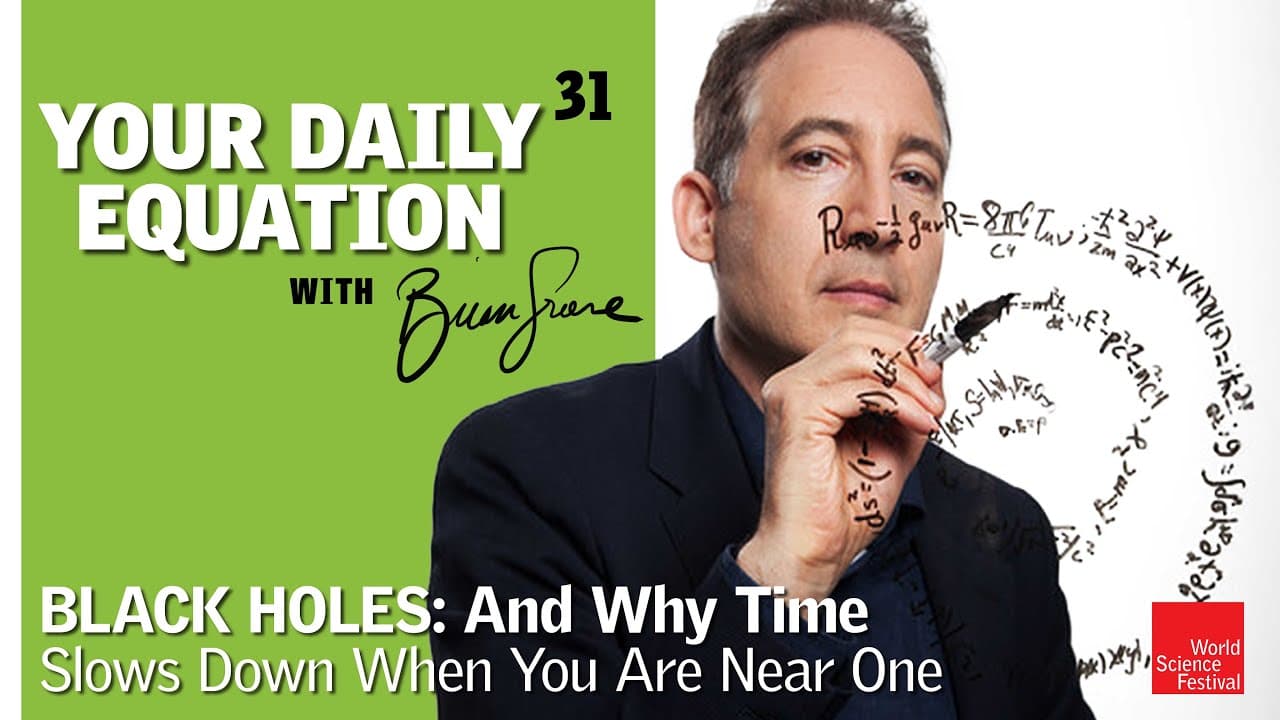
Your Daily Equation #31: BLACK HOLES: And Why Time Slows Down When You Are Near One
TL;DR
Schwarzschild's solution leads to insights on black holes' creation, time dilation, and spatial distortion, expanding our understanding of these mysterious phenomena.
Transcript
hey everyone welcome to this next episode of your daily equation or maybe it's going to be or every other day daily equation your semi daily equation whatever it is your by daily equation I never know what the right usage of those words actually is but in any event I'm going to focus today on the question the issue the subject of black holes black ... Read More
Key Insights
- 🥺 Schwarzschild's solution revolutionized black hole theory, leading to an understanding of gravitational effects on space and time near these massive objects.
- 🖤 The Schwarzschild radius marks a critical limit for objects to become black holes, showcasing the spatial distortion effects of extreme gravity.
- 🖤 Observational confirmations, like gravitational wave detection and imaging from the Event Horizon Telescope, provide concrete evidence for the existence of real black holes in the universe.
- ⌛ Time dilation near black holes demonstrates how gravity impacts the perception of time, showcasing the fascinating interplay between gravity, space, and time in extreme environments.
Install to Summarize YouTube Videos and Get Transcripts
Explore YouTube Video Summarizer or Get YouTube Transcript Extractor
Questions & Answers
Q: How did Karl Schwarzschild contribute to the understanding of black holes?
Karl Schwarzschild's solution to Einstein's field equations defined the geometry of space around a spherical mass, leading to the concept of black holes forming from massive objects crushed to tiny sizes.
Q: What is the significance of the Schwarzschild radius in the context of black holes?
The Schwarzschild radius determines the size at which an object becomes a black hole, with spacetime distortion increasing as objects are squeezed beyond this critical limit, affecting time and spatial measurements.
Q: How does the slowing of time near a black hole's event horizon manifest in the equations?
As objects approach a black hole, the coefficient in the metric affecting time intervals approaches zero, causing clocks to tick slower, showcasing the impact of gravity on time near massive bodies.
Q: What are some unresolved puzzles surrounding black holes mentioned in the content?
The content hints at unresolved mysteries, including the nature of black hole singularities, the quantum mechanics effects near event horizons, and the internal structure beyond the Schwarzschild radius, presenting ongoing scientific challenges in understanding black holes.
Summary & Key Takeaways
-
Black holes are a rich arena for exploring gravity's interaction with quantum mechanics and are studied through theoretical ideas, like Schwarzschild's solution.
-
Schwarzschild's solution reveals how crushed spherical masses create black holes by warping space beyond a point where light cannot escape.
-
Observational evidence, including the detection of gravitational waves and the image from the Event Horizon Telescope, supports the existence of real black holes.
Read in Other Languages (beta)
Share This Summary 📚
Summarize YouTube Videos and Get Video Transcripts with 1-Click
Try YouTube Summary with ChatGPT & Claude or YouTube Transcript Generator
Explore More Summaries from World Science Festival 📚


Summarize YouTube Videos and Get Video Transcripts with 1-Click
Try YouTube Summary with ChatGPT & Claude or YouTube Transcript Generator