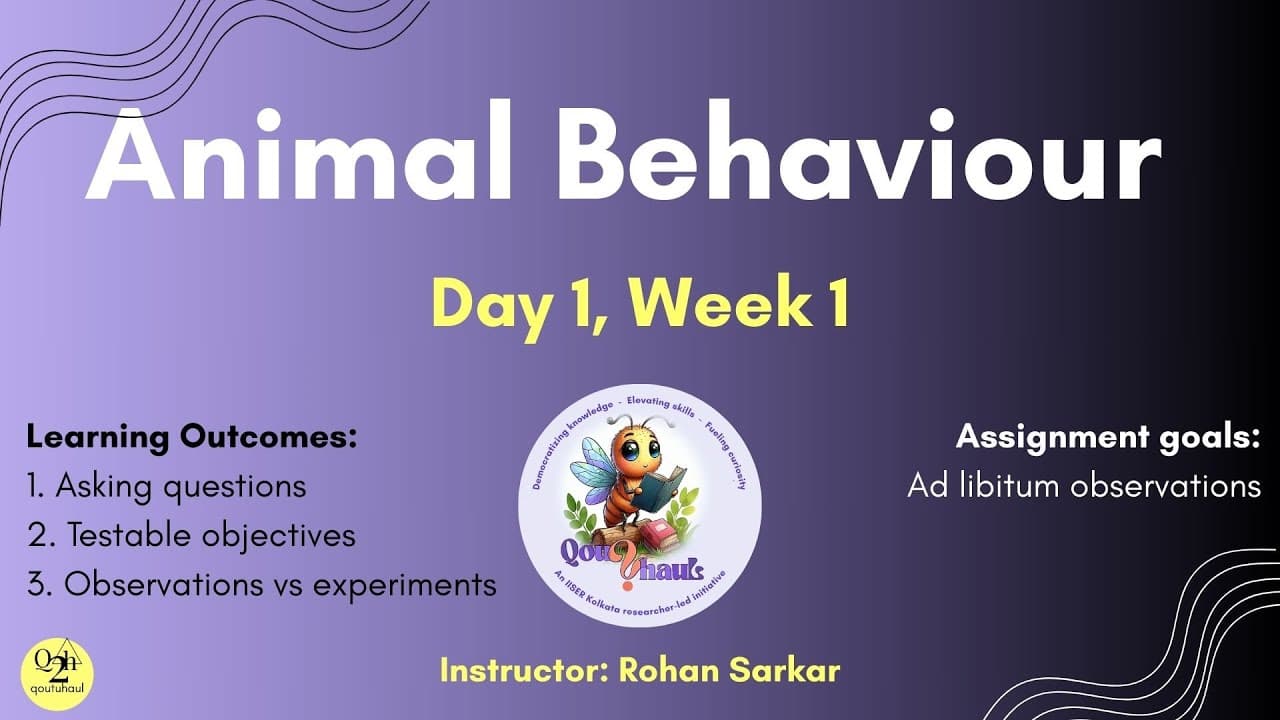
Day 1 Week 1 | Animal Behaviour | Summer Research Bootcamp 2025
TL;DR
Introduction to animal behavior research and ad libitum observation.
Transcript
show you guys. Hey guys. Uh so welcome to day one of SRB 2025. Uh we will start by let's say 7 6 or 7 7. We'll wait a few minutes for people. So yesterday we had a nice round of introduction. I liked the enthusiasm. We have a lot of uh people who are animal enthusiasts. Some people have pets. Um I think I saw a couple of people who are already um y... Read More
Key Insights
- Animal behavior research is categorized into blue sky and applied research, with blue sky focusing on curiosity-driven questions.
- Blue sky research often leads to fundamental discoveries that later become applied technologies.
- Animal behavior can be studied at individual, group, and population levels, each with different influencing factors.
- Key questions in behavior study include functional, evolutionary, causation, and ontogeny aspects.
- Hypothesis formation is crucial; null hypotheses should be falsifiable, and alternative hypotheses should be testable.
- Descriptive studies focus on observation and correlation, while experimental studies identify cause and effect.
- Ad libitum observation is the initial step in behavior study, emphasizing detailed and unbiased data collection.
- Effective observation requires noting time, place, and detailed animal identification without influencing the subject.
Install to Summarize YouTube Videos and Get Transcripts
Explore YouTube Video Summarizer or Get YouTube Transcript Extractor
Questions & Answers
Q: What is the difference between blue sky and applied research in animal behavior?
Blue sky research in animal behavior is curiosity-driven, focusing on fundamental questions without immediate practical applications. It often leads to foundational discoveries that later become applied technologies. Applied research, on the other hand, uses these foundational discoveries to develop practical applications and technologies that address specific real-world problems.
Q: How do animal behavior studies categorize questions?
Animal behavior studies categorize questions into four main types: functional, evolutionary, causation, and ontogeny. Functional questions explore the purpose of a behavior, evolutionary questions investigate how a behavior evolved, causation questions focus on the immediate triggers of a behavior, and ontogeny questions examine how a behavior develops over an individual's lifetime.
Q: What is the importance of forming a hypothesis in behavior research?
Forming a hypothesis is crucial in behavior research as it sets the expectations for the study. A hypothesis provides a probable answer based on current information, guiding the research direction. It can never be proven, only falsified, as alternative hypotheses may also explain the phenomena. This approach helps in systematically testing and refining scientific theories.
Q: What are the differences between descriptive and experimental studies in animal behavior?
Descriptive studies in animal behavior focus on observing and recording behaviors in their natural settings, identifying correlations but not cause and effect. They are useful for common behaviors and initial observations. Experimental studies, however, involve manipulating variables to identify cause and effect relationships, useful for uncommon behaviors or abstract concepts like decision-making and learning.
Q: How is ad libitum observation conducted in animal behavior studies?
Ad libitum observation involves detailed and unbiased data collection of animal behaviors. Researchers note the date, time, place, and detailed identification of the animal without influencing its behavior. This method helps researchers familiarize themselves with different behaviors, train their observational skills, and collect as much behavioral data as possible within a given timeframe.
Q: Why is it important to differentiate between seeing and observing in animal behavior studies?
Differentiating between seeing and observing is important in animal behavior studies because observing involves watching with a scientific eye, asking questions, and noting specific behaviors and patterns. This approach helps researchers gather meaningful data, understand animal behaviors in detail, and avoid biases that might arise from casual observation or interpretation.
Q: What precautions should be taken during ad libitum observation?
During ad libitum observation, researchers should avoid interacting with the animals to prevent influencing their behavior. They should observe from a safe distance, avoid familiar animals, and ensure their presence does not alter the natural behavior of the subjects. Observations should be conducted at different times and locations to capture a wide range of behaviors.
Q: How can literature review aid in animal behavior research?
A literature review aids in animal behavior research by providing background information, identifying existing studies, and revealing gaps in knowledge. It helps researchers refine their questions, form hypotheses, and design experiments based on previous findings. Using resources like Google Scholar, researchers can access peer-reviewed articles to ensure their work builds on credible and validated scientific knowledge.
Summary & Key Takeaways
-
Animal behavior research is divided into blue sky and applied research. Blue sky research, driven by curiosity, often leads to fundamental discoveries that become applied technologies. Examples include drone technology inspired by honeybee behavior and bullet train design influenced by kingfisher beak structure.
-
Behavior study involves asking questions about individual, group, and population behaviors, focusing on functional, evolutionary, causation, and ontogeny aspects. Hypotheses are formed, with null hypotheses being falsifiable and alternative hypotheses being testable.
-
Descriptive studies involve observation and correlation, while experimental studies focus on cause and effect. Ad libitum observation is a key tool in behavior study, requiring detailed and unbiased data collection, noting time, place, and detailed animal identification without influencing the subject.
Read in Other Languages (beta)
Share This Summary 📚
Summarize YouTube Videos and Get Video Transcripts with 1-Click
Try YouTube Summary with ChatGPT & Claude or YouTube Transcript Generator