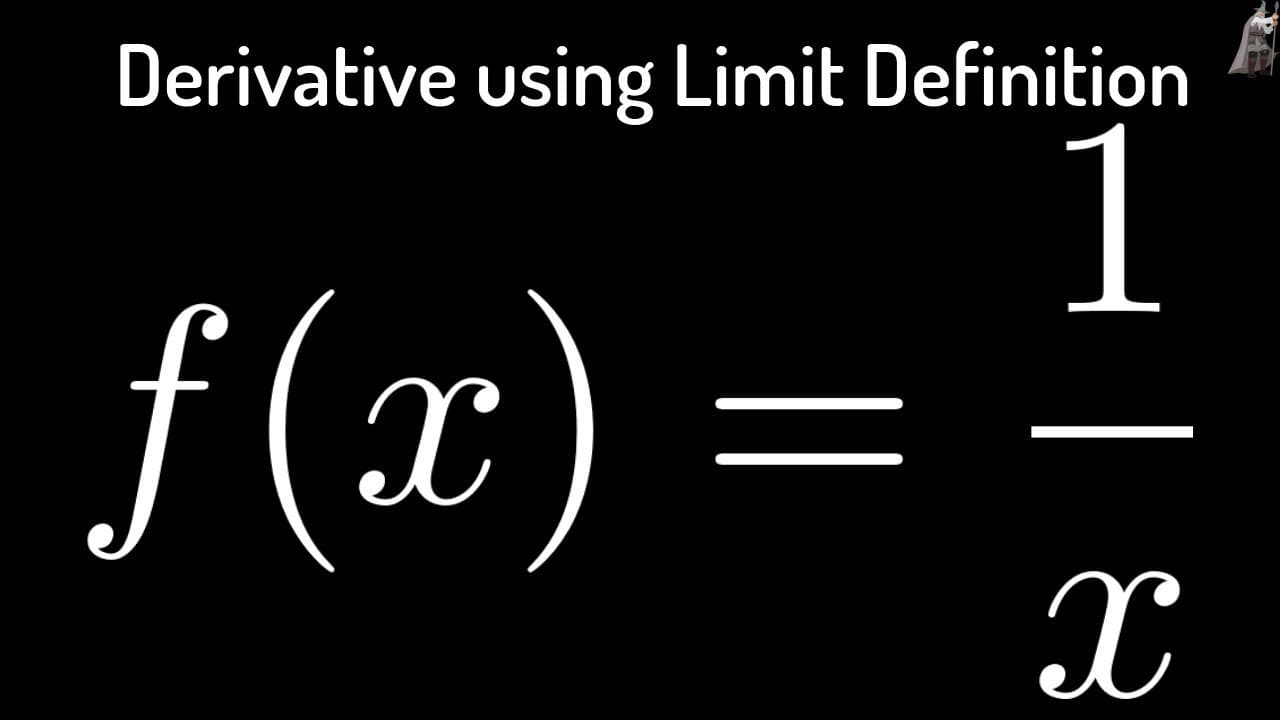
Derivative of f(x) = 1/x Using the Limit Definition
TL;DR
Calculating the derivative of 1/X using the limit definition step by step.
Transcript
we're being asked to find the derivative of 1 over X using the limit definition let's go ahead and do it so the first step is to compute the difference quotients so that's f of X plus h minus f of X all divided by H so this is equal to well f of X plus h you just replace X with X plus h so this is 1 over X plus h minus 1 over X because that's f of ... Read More
Key Insights
- ⛔ Understanding the limit definition is crucial for finding derivatives accurately.
- ❓ Subtraction with a common denominator simplifies complex functions for differentiation.
- 🦻 The process of finding the derivative step by step aids in comprehension and accuracy.
- ☠️ Taking the limit as H approaches 0 helps determine the instantaneous rate of change.
- 😑 Calculating derivatives involves manipulation of expressions and applying mathematical principles.
- ❓ The final answer, -1/X^2, is obtained by following a systematic derivative calculation process.
- ❓ Differentiation is a fundamental concept in calculus to analyze functions and their behavior.
Install to Summarize YouTube Videos and Get Transcripts
Explore YouTube Video Summarizer or Get YouTube Transcript Extractor
Questions & Answers
Q: How do you find the derivative of 1/X using the limit definition?
To find the derivative of 1/X using the limit definition, start by calculating the difference quotient, performing subtraction with a common denominator, simplifying the expression, and then taking the limit as H approaches 0.
Q: Why is it necessary to find the derivative of 1/X step by step?
Finding the derivative of 1/X step by step using the limit definition ensures accuracy and understanding of the mathematical process involved in deriving functions with complex expressions.
Q: What role does the limit as H approaches 0 play in calculating the derivative of 1/X?
The limit as H approaches 0 in the derivative calculation of 1/X determines the precise rate of change at a specific point, helping to find the slope of the curve tangent to the function at that point.
Q: Why couldn't the limit be taken right away in finding the derivative of 1/X?
The limit couldn't be taken immediately in calculating the derivative of 1/X due to the presence of H in the denominator, which would result in an undefined value if H was directly plugged in without simplification.
Summary & Key Takeaways
-
Deriving 1/X involves computing the limit definition with a difference quotient.
-
Subtraction with a common denominator leads to simplification of the expression.
-
Finally, the limit as H approaches 0 results in the derivative of -1/X^2.
Read in Other Languages (beta)
Share This Summary 📚
Summarize YouTube Videos and Get Video Transcripts with 1-Click
Try YouTube Summary with ChatGPT & Claude or YouTube Transcript Generator
Explore More Summaries from The Math Sorcerer 📚



Summarize YouTube Videos and Get Video Transcripts with 1-Click
Try YouTube Summary with ChatGPT & Claude or YouTube Transcript Generator