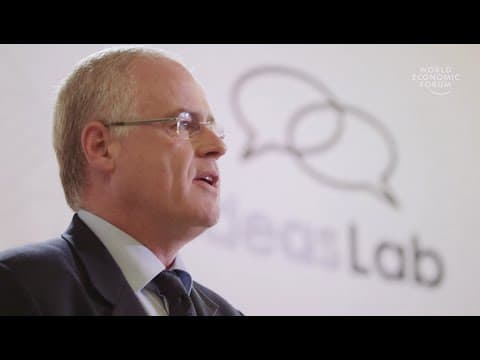
IdeasLabs 2010 - Innovating with Risk and Uncertainty - Anil Gaba

TL;DR
Understanding decision-making with risks and uncertainties, emphasizing the limits of control and the need for practical heuristics.
Transcript
trying to predict the future it's a constant human endeavor I mean it's a very integral part of being human you want to control the environment you want to look into the future predicted planet and try and twist it in the direction that's consistent with the desires and goals and so on however we often go too far in that direction and we often fall... Read More
Key Insights
- 🎮 Predicting the future is a common human endeavor, driven by the desire for control.
- ❓ Psychological biases influence decision-making, creating tensions within organizations.
- *️⃣ Managing risk and uncertainty is a key challenge in innovation and R&D efforts.
- 😀 Decision-makers face the dilemma of balancing control and acknowledging the limits of predictability.
- 😀 Practical heuristics are essential for making better decisions in the face of uncertainties.
- ✳️ Recognizing the distinction between risk and uncertainty is crucial for effective decision-making.
- 🥺 Embracing uncertainty can lead to more beneficial outcomes than trying to control everything.
Install to Summarize YouTube Videos and Get Transcripts
Explore YouTube Video Summarizer or Get YouTube Transcript Extractor
Questions & Answers
Q: How do psychological biases affect decision-making in organizations?
Psychological biases at various levels of an organization create tensions that need to be managed carefully. These biases can impact risk perception and decisions made within the organization, affecting outcomes significantly.
Q: What is the difference between risk and uncertainty in decision-making?
Risk involves quantifiable probabilities, like tossing a coin, while uncertainty refers to situations where probabilities cannot be estimated, such as predicting financial market bubbles. Managing uncertainty is a greater challenge in decision-making.
Q: Why is it crucial to understand the limits of control in decision-making?
Recognizing the limits of control helps individuals and organizations avoid the trap of assuming they can control everything. Embracing uncertainty and acknowledging what cannot be predicted can lead to more favorable outcomes.
Q: How can practical heuristics help improve decision-making in real-life situations?
Practical heuristics provide simple yet effective rules for decision-makers to navigate uncertainties. These rules can help individuals, from medical doctors to policymakers, make better decisions despite the inherent unpredictability of the future.
Summary & Key Takeaways
-
Predicting the future is a human desire, but we often fall into the illusion of control.
-
Decision-making involves managing psychological biases, paradoxes of control, and the distinction between risk and uncertainty.
-
The challenge lies in developing practical rules and heuristics to navigate complex decisions in the face of uncertainty.
Read in Other Languages (beta)
Share This Summary 📚
Summarize YouTube Videos and Get Video Transcripts with 1-Click
Try YouTube Summary with ChatGPT & Claude or YouTube Transcript Generator
Explore More Summaries from World Economic Forum 📚
Summarize YouTube Videos and Get Video Transcripts with 1-Click
Try YouTube Summary with ChatGPT & Claude or YouTube Transcript Generator