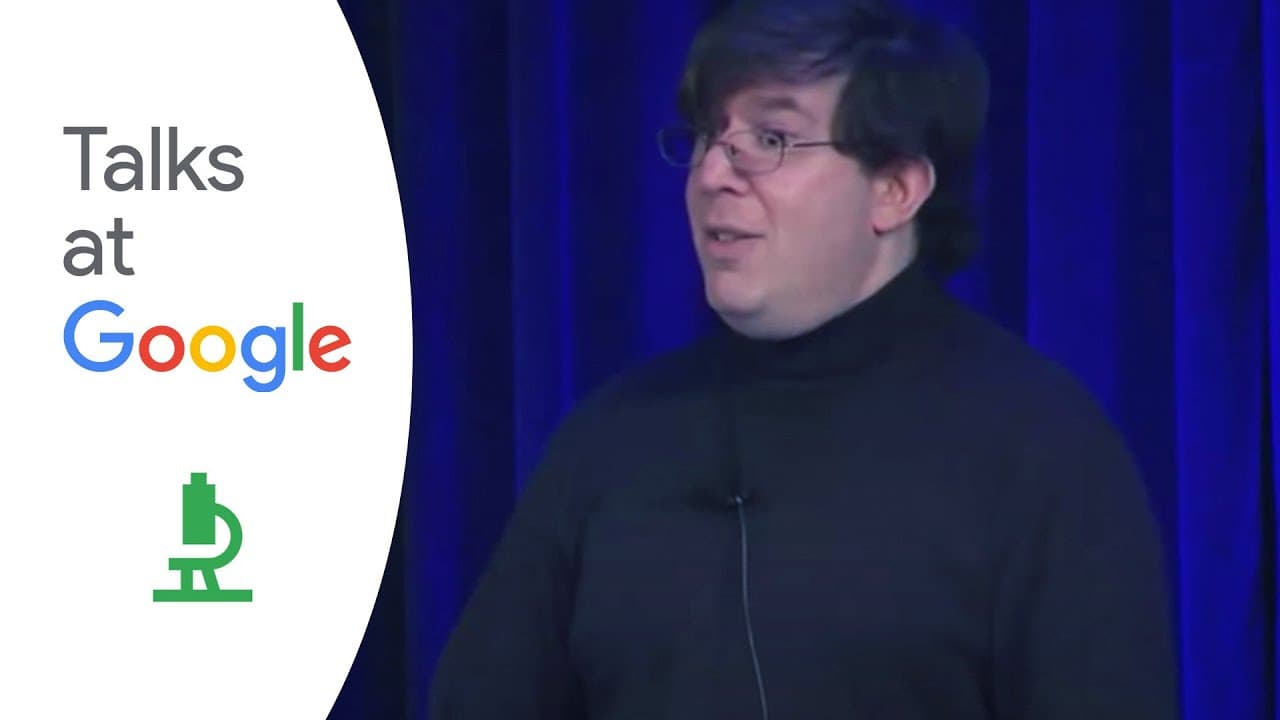
Proofiness: The Dark Arts of Mathematical Deception | Charles Seife | Talks at Google
TL;DR
Mathematical manipulation and errors in public perception lead to misconceptions and false beliefs.
Transcript
good afternoon everyone authors at Google New York today is pleased to present Charles Seife the author of proof eNOS the dark arts of mathematical deception he is an American author journalist and professor his first public published book was zero the biography of a dangerous idea he has written within the scientific community for years before thi... Read More
Key Insights
- 🥺 Mathematical illiteracy and misconceptions in society lead to the fetishization of quantifiable statements.
- 🔉 Bogus formulas and numerical nonsense pervade media coverage, creating false impressions of scientific validity.
- 👨🔬 Errors in statistical significance tests and publication biases result in misleading and incorrect conclusions in research studies.
Install to Summarize YouTube Videos and Get Transcripts
Explore YouTube Video Summarizer or Get YouTube Transcript Extractor
Questions & Answers
Q: How does society's lack of mathematical understanding lead to misconceptions?
Society's discomfort with math causes a tendency to fetishize quantitative statements, even when based on bogus mathematics, leading to widespread misunderstandings and false beliefs.
Q: How are bogus formulas used in various fields to manipulate public perception?
Bogus formulas, such as those for determining perfection in various aspects of life, are used to garner attention and media coverage, perpetuating false information as scientific truth.
Q: What are some examples of numerical distortions in respected peer-reviewed journals?
Respected journals have published studies with erroneous projections, such as predicting absurd sprint times or marathon records, highlighting the prevalence of mathematical misunderstandings in academia.
Q: How do inaccuracies in surveys and polls impact public perception and decision-making?
Surveys often contain fabricated numbers or biased questions, leading to false conclusions and manipulative results that sway public opinion and influence policy decisions.
Summary & Key Takeaways
-
Charles Seife discusses how society misconstrues mathematical concepts, leading to misinformation.
-
The public and researchers are fooled by bogus formulas and false numerical representations.
-
Statistical significance and errors in studies perpetuate misconceptions in various fields.
Read in Other Languages (beta)
Share This Summary 📚
Summarize YouTube Videos and Get Video Transcripts with 1-Click
Try YouTube Summary with ChatGPT & Claude or YouTube Transcript Generator
Explore More Summaries from Talks at Google 📚
Summarize YouTube Videos and Get Video Transcripts with 1-Click
Try YouTube Summary with ChatGPT & Claude or YouTube Transcript Generator