Introduction to Analog and Digital Communication | The Basic Block Diagram of Communication System
TL;DR
This video provides a basic overview of analog and digital communication, including terminologies, block diagrams, and important aspects of the communication system.
Transcript
Hey friends welcome to the YouTube channel ALL ABOUT ELECTRONICS. So this is the introductory video on the analog and the digital communication. And we will see some basic terminologies, and the basic block diagram of the communication system. So in a very basic sense the communication is the exchange of information between the two points... Read More
Key Insights
- 😥 Communication involves the exchange of information between two points using electronic devices.
- ☠️ Analog and digital communication systems have different characteristics, such as signal type, frequency range, and data rate.
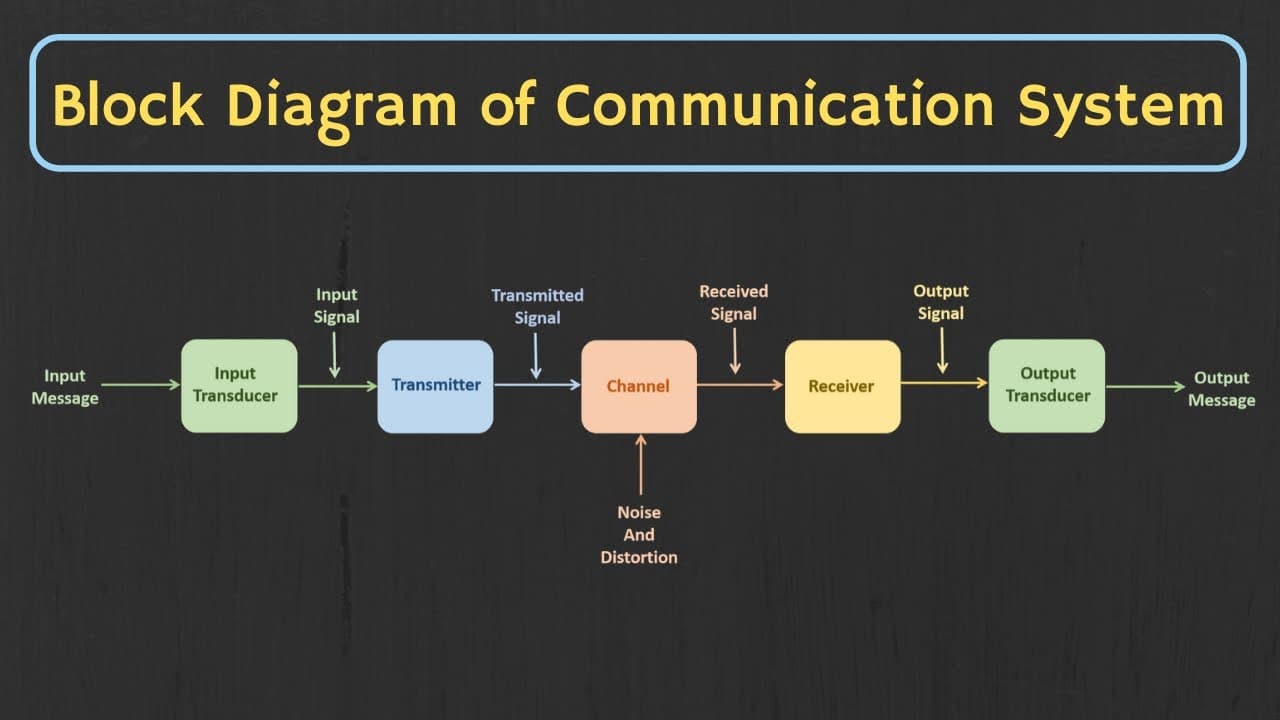
- 📡 Transducers play a vital role in converting non-electric signals into electrical signals for transmission.
- 📡 The transmitter module modifies and prepares the input signal for efficient transmission.
- 📡 The channel, whether physical or wireless, attenuates and distorts the transmitted signal and may introduce noise.
- 📡 The signal-to-noise ratio is an important parameter in determining the quality of signal transmission and reception.
- 📡 Regenerative repeaters and error correction mechanisms can be employed to extend signal transmission distance and reduce errors.
Install to Summarize YouTube Videos and Get Transcripts
Explore YouTube Video Summarizer or Get YouTube Transcript Extractor
Questions & Answers
Q: What is the purpose of a transducer in a communication system?
A transducer converts non-electric forms of information, such as voice or images, into electrical signals that can be transmitted through a communication system. It plays a crucial role in converting various forms of information into a format that can be processed and transmitted.
Q: What subsystems are present in a transmitter module?
A transmitter module consists of several subsystems, including the modulator, analog to digital converter, encoder, and sometimes an amplifier system. The modulator alters the properties of a periodic signal according to the input signal, while the analog to digital converter converts analog signals into digital format. The encoder encodes the signal in a specific format for efficient transmission.
Q: How does the channel affect the transmitted signal?
The channel, whether physical or wireless, acts as a medium through which the signal is transmitted. It behaves like a filter, attenuating different frequencies of the transmitted signal differently. The channel length determines the amount of attenuation and distortion the signal undergoes, and noise may also be superimposed on the signal during transmission.
Q: How can the signal-to-noise ratio be improved in a communication system?
Increasing the signal power can improve the signal-to-noise ratio, allowing the signal to be transmitted over a longer distance faithfully. Regenerative repeaters can also be used to detect and regenerate the signal after a certain distance. Additionally, for digital signals, error correction mechanisms and redundancy can be employed to reduce errors in the received signal.
Key Insights:
- Communication involves the exchange of information between two points using electronic devices.
- Analog and digital communication systems have different characteristics, such as signal type, frequency range, and data rate.
- Transducers play a vital role in converting non-electric signals into electrical signals for transmission.
- The transmitter module modifies and prepares the input signal for efficient transmission.
- The channel, whether physical or wireless, attenuates and distorts the transmitted signal and may introduce noise.
- The signal-to-noise ratio is an important parameter in determining the quality of signal transmission and reception.
- Regenerative repeaters and error correction mechanisms can be employed to extend signal transmission distance and reduce errors.
- Important specifications for a transmitting medium include channel length, bandwidth, and data rate.
Summary & Key Takeaways
-
The video explains that communication is the exchange of information between two points, which can be done through electronic devices via wired or wireless methods.
-
It covers different types of communication, such as point-to-point, point-to-multi-point, network, and broadcast.
-
The video introduces the basic block diagram of a communication system, including the source, transducer, transmitter, channel, and receiver.
Read in Other Languages (beta)
Share This Summary 📚
Summarize YouTube Videos and Get Video Transcripts with 1-Click
Try YouTube Summary with ChatGPT & Claude or YouTube Transcript Generator
Explore More Summaries from ALL ABOUT ELECTRONICS 📚
Summarize YouTube Videos and Get Video Transcripts with 1-Click
Try YouTube Summary with ChatGPT & Claude or YouTube Transcript Generator