How Do Times Tables Create Mathematical Patterns?
TL;DR
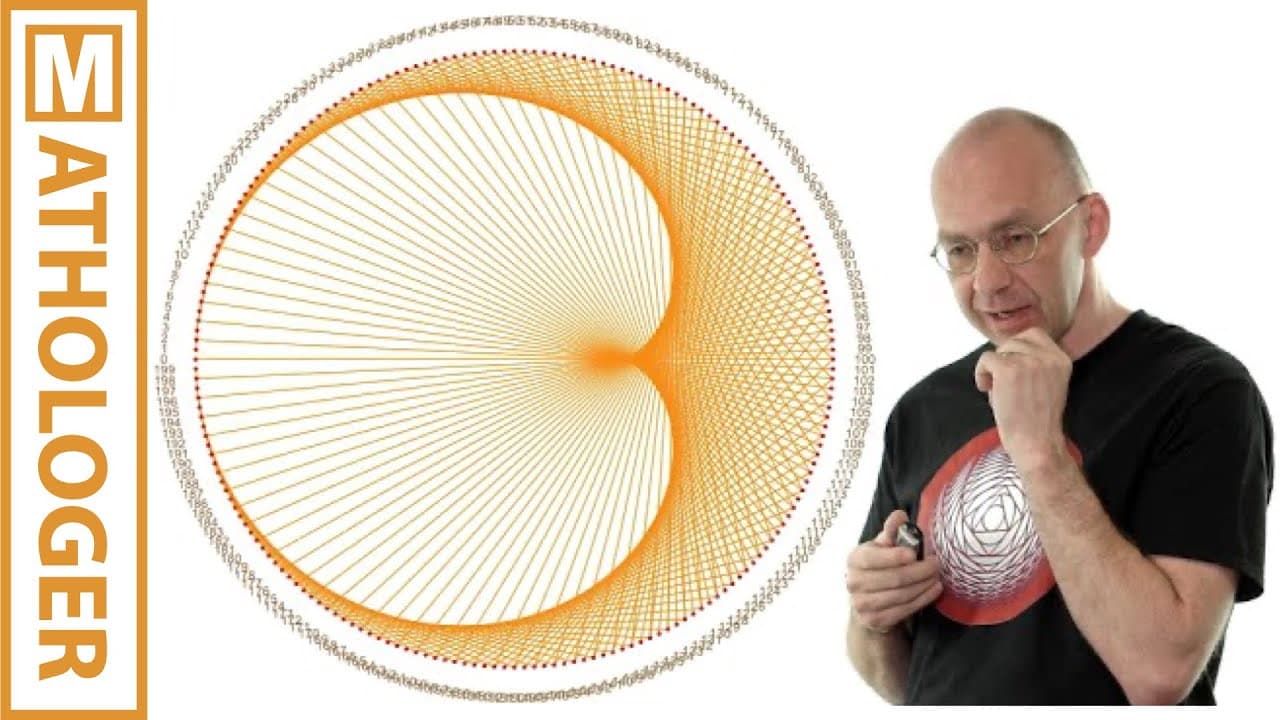
Times tables can produce distinct mathematical patterns like the cardioid and nephroid by connecting points on a circle based on multiplication results. The cardioid, resembling a heart, appears in various contexts, including the Mandelbrot set and rolling curves. Patterns can change with different base numbers and can also be analyzed through modular arithmetic.
Transcript
ok so to start off I've got 4 images for you. Quick question what do all of them have in common. Well, I would be very surprised if you guess this one here. (Giuseppe) They are full of lines. (M) They are full of lines, they are in a circle. But actually they are pictures of times tables. I better explain this. So to get these pictures what you do ... Read More
Key Insights
- ⌛ Pictures of times tables can reveal patterns and curves, such as the cardioid and nephroid.
- 🥰 The cardioid pattern is named after its resemblance to a heart shape and can be observed in various mathematical and real-life contexts.
- ⌛ Different numbers chosen for the times table result in different patterns and shapes.
- 🤣 The patterns created by times tables can also be seen in rolling curves, conical coffee cups, and the Mandelbrot set.
- ⌛ Continuous increments in the times table values can show the transformation of one pattern into another.
- ⌛ The times table values can be analyzed using modular arithmetic, which has important applications in various fields.
- #️⃣ The number of petals in the patterns corresponds to the chosen number for the times table, minus one.
Install to Summarize YouTube Videos and Get Transcripts
Explore YouTube Video Summarizer or Get YouTube Transcript Extractor
Questions & Answers
Q: How are the pictures of times tables created?
To create pictures of times tables, start with a circle and place equally spaced points on its perimeter. Label these points with numbers based on the times table being used. Connect the points based on the multiplication results.
Q: Why do the pictures have a horizontal symmetry axis?
The reason for the horizontal symmetry axis in the pictures of times tables is left as a homework assignment. However, it is an interesting concept for readers to explore and figure out.
Q: Where else can the cardioid pattern be observed?
The cardioid pattern can be seen in rolling curves, conical coffee cups when the sun is in a specific direction, and the Mandelbrot set.
Q: What is the significance of the number of petals in the patterns created by times tables?
The number of petals in the patterns created by times tables is equal to the chosen number for the times table, minus one. This pattern continues as the times table values increase.
Summary & Key Takeaways
-
The content demonstrates how to create pictures of times tables by placing points on a circle and connecting them based on the multiplication results.
-
Different numbers chosen for the times table result in different patterns and curves, such as the cardioid and nephroid.
-
These patterns can also be observed in rolling curves, conical coffee cups, the Mandelbrot set, and through modular arithmetic.
Read in Other Languages (beta)
Share This Summary 📚
Summarize YouTube Videos and Get Video Transcripts with 1-Click
Try YouTube Summary with ChatGPT & Claude or YouTube Transcript Generator
Explore More Summaries from Mathologer 📚






Summarize YouTube Videos and Get Video Transcripts with 1-Click
Try YouTube Summary with ChatGPT & Claude or YouTube Transcript Generator