Impedance Matching using single Stub in Microwave Engineering by Engineering Funda
TL;DR
Learn how to achieve impedance matching using a single stub.
Transcript
welcome to microwave and electromagnetics lecture series i professor ritas dulakia is going to explain you single stub impedance matching in this video so this video is quite interesting in that i'll explain you how we can have impedance matching using one step and in that i'll derive length and position of stub in transmission line... Read More
Key Insights
- Impedance matching is crucial in transmission lines to reduce signal reflection and ensure efficient signal transfer.
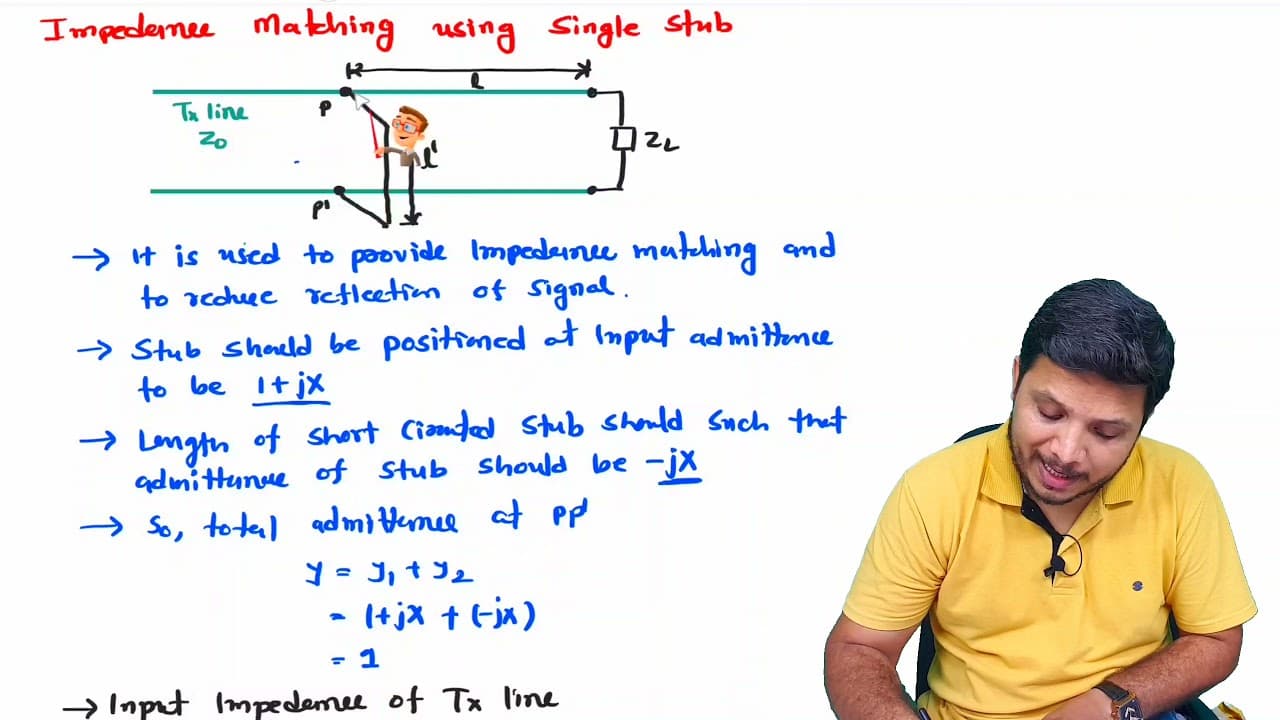
- A single short-circuited stub can be used for impedance matching by strategically placing it along the transmission line.
- The location of the stub is determined by ensuring the input admittance is 1 plus jx, leading to perfect impedance matching.
- The length of the short-circuited stub is chosen so that its admittance is minus jx, balancing the input admittance.
- Normalization of impedances and conversion to admittance are essential steps in calculating the stub's position and length.
- The derived formulas for the stub's position and length involve the use of trigonometric functions and normalized impedances.
- The process requires understanding complex conjugates, real and imaginary components, and their role in parallel admittance.
- Practical application of these calculations involves practice and familiarity with the derived formulas and their implications.
Install to Summarize YouTube Videos and Get Transcripts
Explore YouTube Video Summarizer or Get YouTube Transcript Extractor
Questions & Answers
Q: What is the main purpose of using a single stub in transmission lines?
The main purpose of using a single stub in transmission lines is to achieve impedance matching. This is essential to minimize signal reflection and ensure efficient transmission of signals through the line. By strategically placing and sizing the stub, engineers can adjust the line's input admittance to match the load, leading to optimal performance.
Q: How is the location of the stub determined?
The location of the stub is determined by ensuring that the input admittance at that point is 1 plus jx. This condition is critical for achieving perfect impedance matching. The calculation involves using normalized impedances and admittances, and applying trigonometric functions to derive the exact position where the stub should be placed along the transmission line.
Q: What role does the length of the stub play in impedance matching?
The length of the stub plays a crucial role in ensuring that its admittance is minus jx. This is necessary to counterbalance the input admittance of the transmission line, which should be 1 plus jx. By achieving this balance, the total admittance becomes normalized to 1, resulting in effective impedance matching and reduced signal reflection.
Q: What mathematical concepts are involved in deriving the stub parameters?
The derivation of stub parameters involves mathematical concepts such as normalization of impedances, conversion to admittance, complex conjugates, and separation of real and imaginary components. Trigonometric functions like tangent and cotangent are used to calculate the stub's position and length, and these calculations require an understanding of complex numbers and their properties.
Q: Why is it important to normalize impedances in this process?
Normalizing impedances is important because it simplifies the mathematical calculations involved in determining the stub's parameters. By expressing impedances relative to a reference value, typically the characteristic impedance of the line, engineers can more easily manipulate and compare values, leading to more straightforward derivations of the necessary formulas for impedance matching.
Q: How does the stub's admittance affect the total admittance at its location?
The stub's admittance affects the total admittance at its location by being in parallel with the input admittance of the transmission line. In a parallel configuration, admittances add together. Therefore, by setting the stub's admittance to minus jx, it cancels out the imaginary part of the input admittance, resulting in a total normalized admittance of 1, which indicates perfect impedance matching.
Q: What is the significance of the condition '1 plus jx' for input admittance?
The condition '1 plus jx' for input admittance is significant because it represents the desired state for impedance matching. The real part (1) indicates unity admittance, while the imaginary part (jx) must be countered by the stub's admittance. Achieving this condition ensures that the transmission line is optimally matched to the load, minimizing reflections and maximizing signal transfer.
Q: What are the challenges in applying these impedance matching techniques?
Challenges in applying these impedance matching techniques include accurately calculating the stub's position and length, understanding and manipulating complex numbers, and ensuring that all components are correctly normalized. Additionally, practical implementation requires precise measurement and adjustment of physical components, and any errors in calculation or setup can lead to suboptimal performance and increased signal reflection.
Summary & Key Takeaways
-
The video explains how to achieve impedance matching in transmission lines using a single short-circuited stub. Key steps include determining the stub's position and length to ensure the input admittance is balanced, minimizing signal reflection.
-
Impedance matching is achieved by placing the stub at a location where the input admittance equals 1 plus jx, with the stub's admittance being minus jx. This ensures the total admittance is normalized to 1.
-
The derivation involves normalizing impedances, converting them to admittance, and using trigonometric identities to calculate the stub's position and length. The process requires understanding complex numbers and their properties.
Read in Other Languages (beta)
Share This Summary 📚
Summarize YouTube Videos and Get Video Transcripts with 1-Click
Try YouTube Summary with ChatGPT & Claude or YouTube Transcript Generator
Explore More Summaries from Engineering Funda 📚




Summarize YouTube Videos and Get Video Transcripts with 1-Click
Try YouTube Summary with ChatGPT & Claude or YouTube Transcript Generator