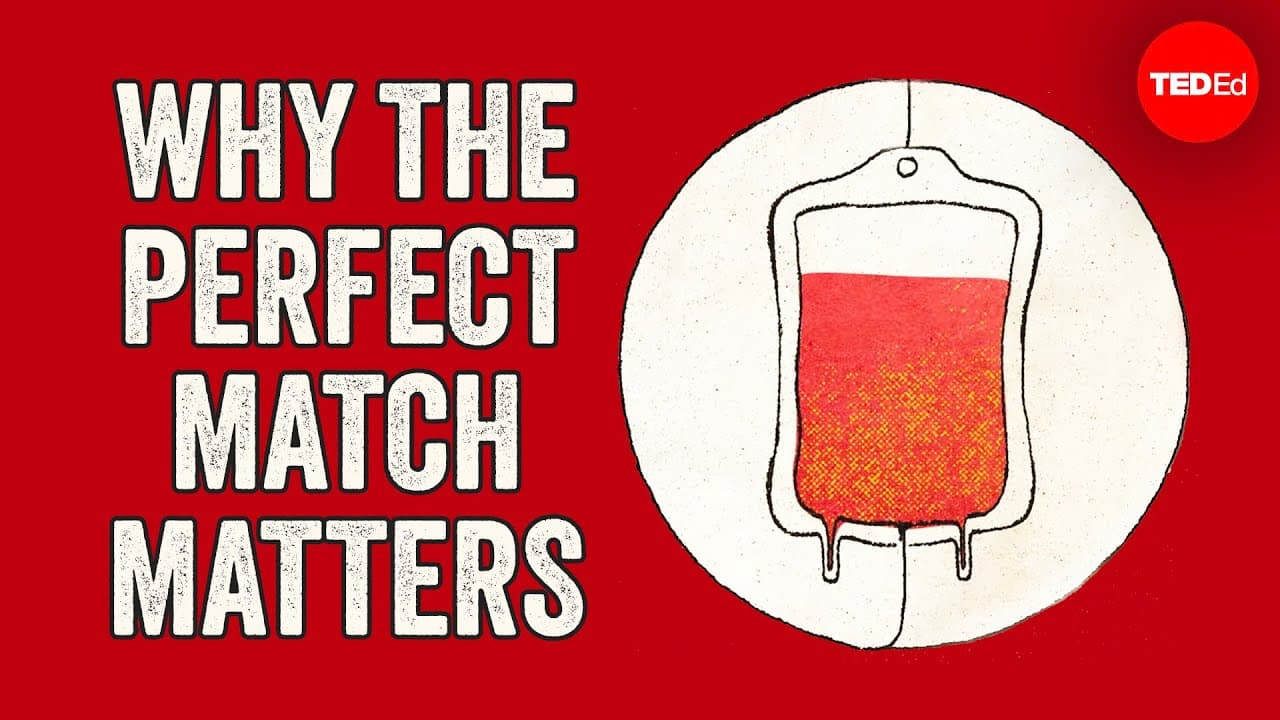
How do blood transfusions work? - Bill Schutt
TL;DR
From risky historic attempts to modern successes, blood transfusions evolved, saving lives through matching blood types.
Transcript
In 1881, doctor William Halsted rushed to help his sister Minnie, who was hemorrhaging after childbirth. He quickly inserted a needle into his arm, withdrew his own blood, and transferred it to her. After a few uncertain minutes, she began to recover. Halsted didn’t know how lucky they’d gotten. His transfusion only worked because he and his ... Read More
Key Insights
- 🥺 Early blood transfusion attempts were risky and often led to dangerous immune responses.
- 🅰️ Karl Landsteiner's discovery of blood types revolutionized transfusion medicine.
- 🩸 Anticoagulants like heparin and portable blood transport machines were crucial for the development of blood banks.
- 🩸 Blood clotting issues during storage were addressed with the discovery of anticoagulants like heparin.
- 🩸 World War I accelerated the development of blood transfusion techniques and the establishment of blood banks.
- 🅰️ Modern blood transfusion practices rely on matching blood types between donors and recipients to prevent adverse reactions.
- 🩸 Portable blood transport machines were crucial for delivering blood transfusions on the battlefield during World War I.
Install to Summarize YouTube Videos and Get Transcripts
Explore YouTube Video Summarizer or Get YouTube Transcript Extractor
Questions & Answers
Q: What was the significance of William Halsted's transfusion attempt on his sister?
William Halsted's successful transfusion on his sister showcased the importance of blood type matching in transfusions and highlighted the risks of incompatible blood transfusions.
Q: How did the discovery of blood types change the landscape of transfusions?
Karl Landsteiner's discovery of blood types in 1901 enabled doctors to match donor and recipient blood types, drastically reducing the risks associated with transfusions and increasing success rates.
Q: How did researchers address the issue of blood clotting during storage for transfusions?
The discovery of anticoagulants like sodium citrate and heparin in the early 1900s allowed for the safe storage and preservation of blood, making large-scale transfusions possible by preventing blood clotting.
Q: How did World War I impact the development of blood transfusions?
The need for blood transfusions on the battlefield during World War I led to the invention of portable blood transport machines and the establishment of blood banks, significantly advancing the field of transfusion medicine.
Summary & Key Takeaways
-
Blood transfusions had risky beginnings, with experiments centuries ago often leading to fatal immune responses.
-
The discovery of blood types by Karl Landsteiner in 1901 was crucial for successful human-to-human transfusions.
-
Advances like heparin and portable blood transport led to the establishment of modern blood banks.
Read in Other Languages (beta)
Share This Summary 📚
Summarize YouTube Videos and Get Video Transcripts with 1-Click
Try YouTube Summary with ChatGPT & Claude or YouTube Transcript Generator
Explore More Summaries from TED-Ed 📚





Summarize YouTube Videos and Get Video Transcripts with 1-Click
Try YouTube Summary with ChatGPT & Claude or YouTube Transcript Generator