How Do Linear Classifiers Work in Image Classification?
TL;DR
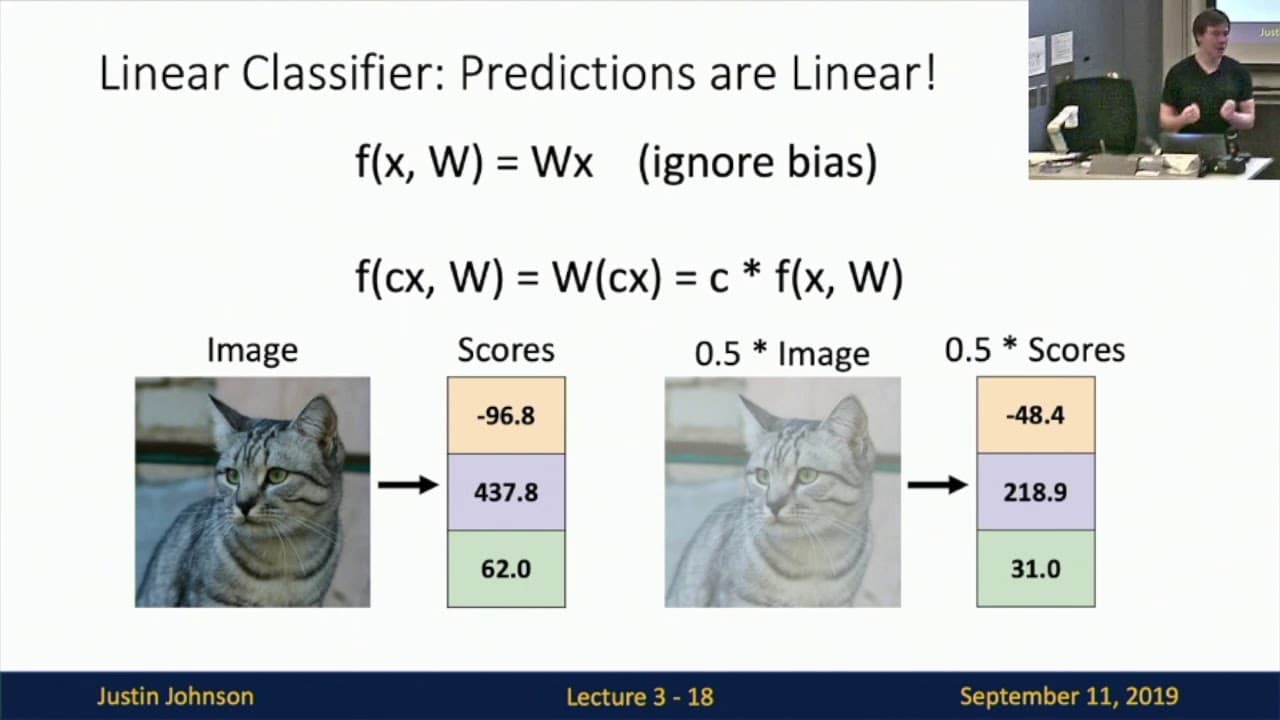
Linear classifiers are essential for image classification, forming the basic structure for more complex neural networks. This lecture covers their algebraic, visual, and geometric perspectives, revealing their strengths and limitations. It also discusses loss functions like multi-class SVM, their role in evaluating model performance, and the necessity of regularization to enhance generalization.
Transcript
so welcome back to welcome back to lecture three today we're going to talk about linear classifiers so a quick recap let in the last lecture we talked about this image classification problem and you'll recall that this was a foundational problem in computer vision where we had to take this input image and then our network or system had to predict a... Read More
Key Insights
- Linear classifiers are fundamental in computer vision, serving as building blocks for more complex neural networks by providing basic classification capabilities.
- The lecture covers three perspectives on linear classifiers: algebraic, visual, and geometric, each offering unique insights into how classifiers make decisions.
- Loss functions like multi-class SVM and cross-entropy are crucial for evaluating classifier performance, with each inducing different model preferences.
- Regularization is introduced as a technique to prevent overfitting by penalizing overly complex models, ensuring better generalization to unseen data.
- The lecture emphasizes the importance of understanding loss functions for debugging and optimizing machine learning models effectively.
- Linear classifiers face challenges with mode splitting and context reliance, which can limit their effectiveness in certain image classification scenarios.
- The geometric viewpoint reveals the limitations of linear classifiers in recognizing complex patterns, such as XOR, due to their linear decision boundaries.
- Regularization techniques, like L1 and L2, allow for expressing preferences over models, impacting how features are utilized in classification tasks.
Install to Summarize YouTube Videos and Get Transcripts
Explore YouTube Video Summarizer or Get YouTube Transcript Extractor
Questions & Answers
Q: What are linear classifiers and why are they important?
Linear classifiers are models used in machine learning to categorize input data into different classes based on a linear decision boundary. They are important because they serve as the basic building blocks for more complex models, like neural networks, and are essential for understanding the fundamentals of machine learning and computer vision.
Q: How do the algebraic, visual, and geometric viewpoints of linear classifiers differ?
The algebraic viewpoint focuses on linear classifiers as matrix-vector multiplications, highlighting computational aspects. The visual viewpoint interprets classifiers as template matching, offering intuition on how classifiers learn patterns. The geometric viewpoint considers classifiers as hyperplanes in high-dimensional spaces, illustrating decision boundaries and limitations in recognizing complex patterns.
Q: What role do loss functions play in linear classifiers?
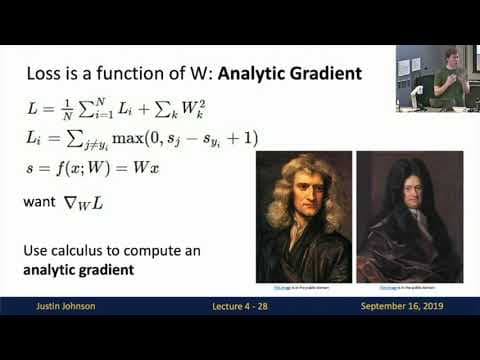
Loss functions quantify the performance of linear classifiers by measuring the difference between predicted and true labels. They guide the training process by providing feedback on how well a model is performing, helping to optimize parameters for better accuracy. Different loss functions, like multi-class SVM and cross-entropy, induce different preferences and behaviors in classifiers.
Q: Why is regularization important in machine learning models?
Regularization is crucial because it prevents overfitting, where a model performs well on training data but poorly on unseen data. By adding a penalty for complexity, regularization encourages simpler models that generalize better. It also allows for expressing preferences over models, influencing how features are used and improving robustness and interpretability.
Q: What are the limitations of linear classifiers?
Linear classifiers are limited by their linear decision boundaries, which can struggle with complex patterns like XOR or datasets with multiple modes. They rely heavily on context, which can lead to incorrect classifications in unusual settings. These limitations highlight the need for more complex models, like neural networks, for advanced tasks.
Q: How do multi-class SVM and cross-entropy loss functions differ?
Multi-class SVM loss focuses on ensuring the correct class score is higher than incorrect ones by a margin, often achieving zero loss when conditions are met. Cross-entropy loss interprets scores as probabilities, aiming to maximize the probability of the correct class. It never achieves zero loss but continuously pushes for more accurate probability distributions.
Q: What is the significance of the geometric viewpoint of linear classifiers?
The geometric viewpoint illustrates linear classifiers as hyperplanes dividing high-dimensional spaces, offering insight into their decision boundaries. It helps identify scenarios where linear classifiers may fail, such as recognizing complex patterns or disjoint regions, emphasizing the need for advanced models with non-linear capabilities.
Q: How can regularization express preferences over models?
Regularization expresses preferences by penalizing certain model characteristics, like complexity. L1 regularization encourages sparsity, focusing on fewer features, while L2 regularization spreads weights across features. These preferences guide models to align with prior knowledge or assumptions, impacting feature utilization and model behavior.
Summary & Key Takeaways
-
This lecture introduces linear classifiers as a foundational concept in computer vision, explaining their role in image classification tasks. It discusses different ways to understand linear classifiers: algebraic, visual, and geometric viewpoints, which help in grasping their decision-making processes and limitations.
-
The lecture delves into loss functions, specifically multi-class SVM and cross-entropy, highlighting how they evaluate classifier performance and induce different preferences. It also introduces regularization as a means to penalize complex models, preventing overfitting and ensuring better generalization.
-
By exploring the limitations of linear classifiers, such as mode splitting and context reliance, the lecture provides insights into their challenges. It also discusses the importance of regularization and loss functions for model optimization and debugging, setting the stage for future discussions on neural networks.
Read in Other Languages (beta)
Share This Summary 📚
Summarize YouTube Videos and Get Video Transcripts with 1-Click
Try YouTube Summary with ChatGPT & Claude or YouTube Transcript Generator
Explore More Summaries from Michigan Online 📚
Summarize YouTube Videos and Get Video Transcripts with 1-Click
Try YouTube Summary with ChatGPT & Claude or YouTube Transcript Generator