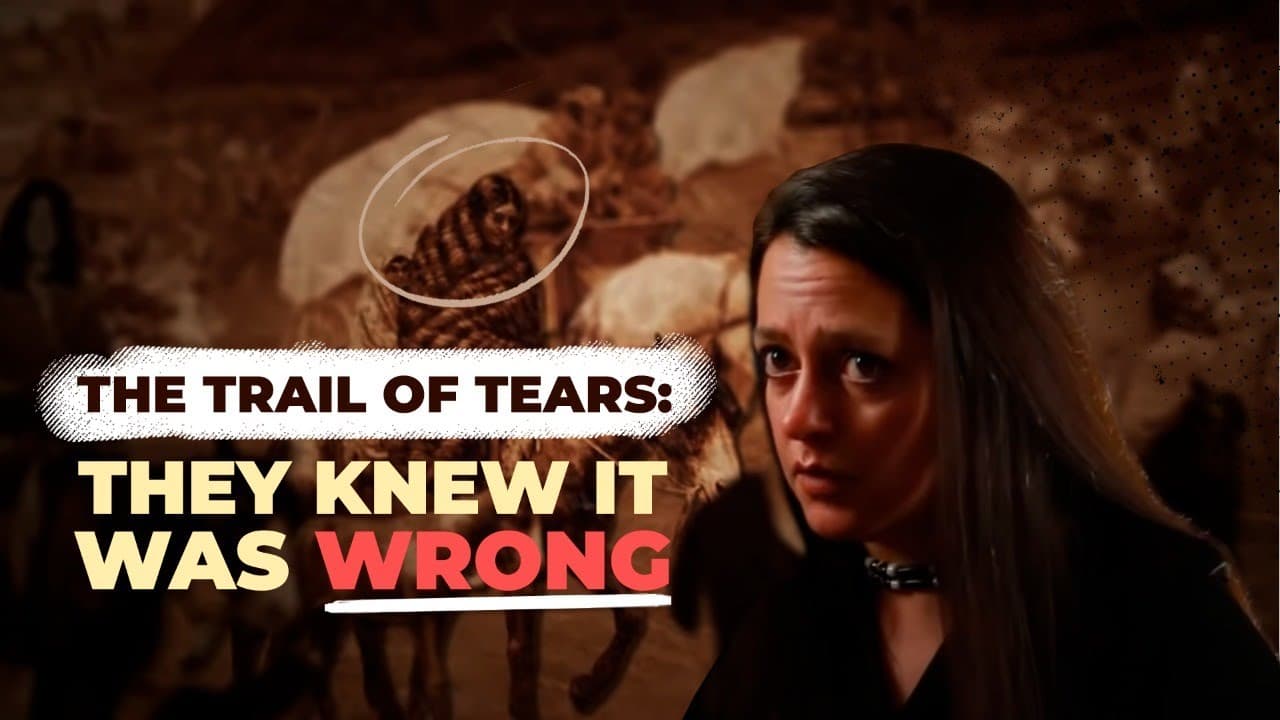
The Trail of Tears: They Knew It Was Wrong
TL;DR
The Trail of Tears was a morally wrong, unconstitutional, and illegal event that forcibly removed the Cherokee Nation from their homeland, resulting in the loss of thousands of lives.
Transcript
People at the time knew it was wrong. People at the time knew it was illegal. People at the time knew it was unconstitutional. And it happened anyway. The Trail of Tears shouldn’t have happened. At some level, I’m making a moral statement, a normative claim that the United States should not have forcibly removed the Cherokee Nation from its homelan... Read More
Key Insights
- 🙈 The Trail of Tears was not only a moral wrong but also a violation of the Constitution, as the Supreme Court's decision was ignored.
- 🌸 The forced removal resulted in the loss of thousands of lives, particularly the elderly and infants.
- ✋ The Cherokee Nation had a well-developed society with its own laws, language, and institutions of higher learning.
- 🌍 The Trail of Tears serves as a reminder of the injustices committed against Native American tribes and the need for humility in understanding our nation's history.
- 🙊 Individuals like Davy Crockett and Ralph Waldo Emerson demonstrated courage and moral conviction in speaking out against the Trail of Tears.
- 😫 The Trail of Tears set precedents for future forced removals and the disregard for indigenous peoples' rights.
Install to Summarize YouTube Videos and Get Transcripts
Explore YouTube Video Summarizer or Get YouTube Transcript Extractor
Questions & Answers
Q: How many Cherokees were estimated to have died during the Trail of Tears?
Official reports suggest around 400 deaths, but eyewitnesses and scholars believe the number to be around 4,000, with the most vulnerable members of the Cherokee Nation being the most affected.
Q: What was the justification used for the Trail of Tears, and why was it false?
The idea that the Cherokees could not adapt to the new United States was used as a justification. However, the Cherokees had a written language, a constitution, and institutions of higher learning, making this argument baseless.
Q: Were there any legal obstacles to the Trail of Tears?
Yes, the Supreme Court ruled in Worcester v. Georgia that the Cherokee Nation's sovereignty should be recognized. However, President Andrew Jackson ignored this decision, representing a failure of the checks and balances system.
Q: Who were some of the individuals who stood up against the Trail of Tears?
Principal Chief John Ross, Davy Crockett, Ralph Waldo Emerson, and former President John Quincy Adams were among those who voiced their opposition to the forced removal.
Key Insights:
- The Trail of Tears was not only a moral wrong but also a violation of the Constitution, as the Supreme Court's decision was ignored.
- The forced removal resulted in the loss of thousands of lives, particularly the elderly and infants.
- The Cherokee Nation had a well-developed society with its own laws, language, and institutions of higher learning.
- The Trail of Tears serves as a reminder of the injustices committed against Native American tribes and the need for humility in understanding our nation's history.
- Individuals like Davy Crockett and Ralph Waldo Emerson demonstrated courage and moral conviction in speaking out against the Trail of Tears.
- The Trail of Tears set precedents for future forced removals and the disregard for indigenous peoples' rights.
- It is important to remember and learn from the Trail of Tears to avoid repeating similar injustices in the future.
Summary & Key Takeaways
-
The Trail of Tears involved the forced removal of the Cherokee Nation from their homeland, resulting in the death of thousands due to starvation, exposure, and difficult marches.
-
The actions taken against the Cherokees were morally wrong, as they were a unified people who had chosen to live together and had developed a sophisticated common law.
-
The Trail of Tears was not only a moral wrong but also a violation of the Constitution, as the Supreme Court had ruled in favor of the Cherokees' sovereignty.
Read in Other Languages (beta)
Share This Summary 📚
Summarize YouTube Videos and Get Video Transcripts with 1-Click
Try YouTube Summary with ChatGPT & Claude or YouTube Transcript Generator
Explore More Summaries from Learn Liberty 📚
Summarize YouTube Videos and Get Video Transcripts with 1-Click
Try YouTube Summary with ChatGPT & Claude or YouTube Transcript Generator