On the Measure of Intelligence (Introduction)
TL;DR
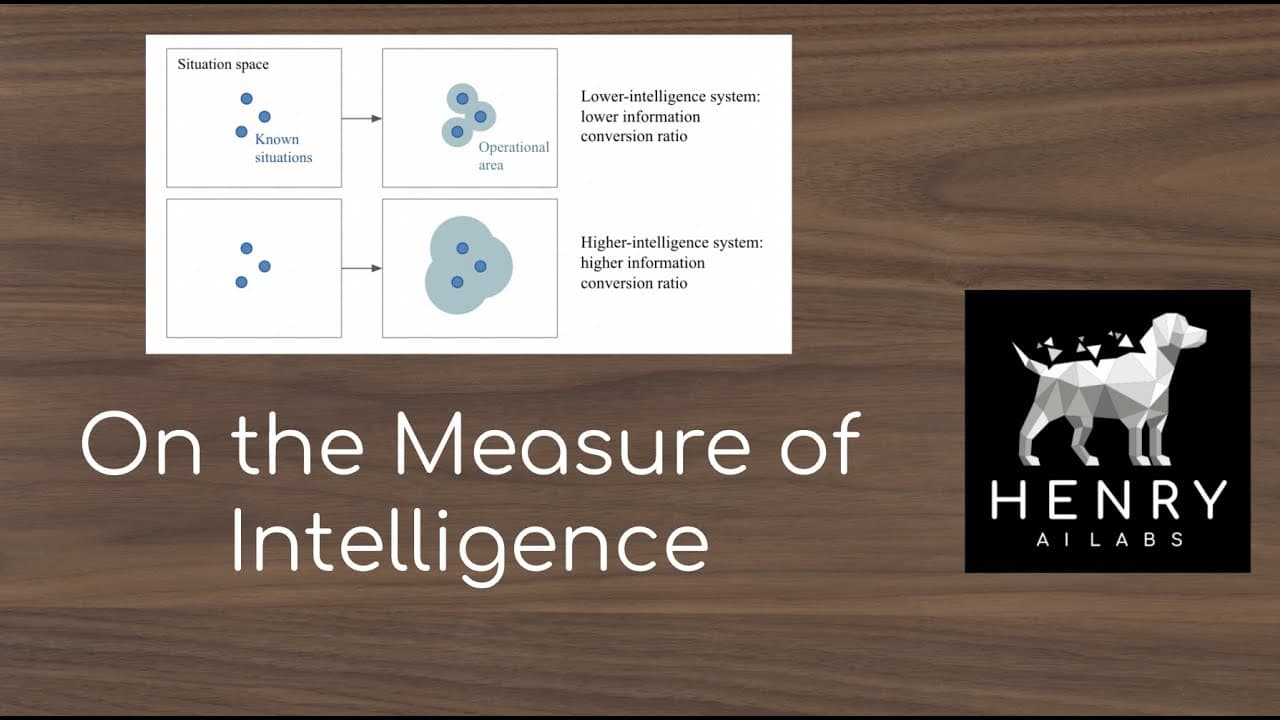
This video analyzes François Chalay's intelligence measurement framework, focusing on generalization and cognitive hierarchy.
Transcript
this video will present some of my thoughts on the famous paper on the measure of intelligence by Francois shalay this video will explore the levels of generalization the cognitive hierarchy and existence of a G factor shared ability across these different cognitive tasks core knowledge and human priors chilles criticism of AI benchmarks and a quic... Read More
Key Insights
- ❓ François Chalay's framework offers a structured approach to understanding intelligence measurement in AI, emphasizing the significance of generalization.
- 👶 Generalization is categorized into four levels: absent, local, broad, and extreme, each reflecting varying capabilities in learning and adapting to new information.
- 🔬 The "G factor" is a central concept in cognitive science, highlighting shared capabilities among tasks that could be mirrored in AI systems.
- 💁 Human priors serve as foundational cognitive tendencies that should inform AI design to improve task efficiency and understanding.
- 🌍 Traditional benchmarks may inadequately measure AI intelligence, advocating for more holistic evaluations simulating real-world challenges.
- ❓ Data augmentation techniques enhance the capacity of AI to generalize by exposing models to diverse variations of data.
- 🏆 The AARC challenge exemplifies the need for AI to infer complex relationships and patterns from minimal input, testing its generative capacities.
Install to Summarize YouTube Videos and Get Transcripts
Explore YouTube Video Summarizer or Get YouTube Transcript Extractor
Questions & Answers
Q: What are the different levels of generalization discussed in the video?
The video outlines several levels of generalization: absent generalization, where no new information is inferred; local generalization, which applies to known scenarios; broad generalization capable of coping with new data types; and extreme generalization, which encompasses unknown unknowns not anticipated by developers. These levels illustrate how systems can improve adaptability over time through experience and augmented data.
Q: How does the cognitive hierarchy relate to measuring intelligence?
The cognitive hierarchy reflects an organized structure of abilities underlying cognitive tasks, often represented by a G factor, akin to a shared capability across diverse IQ tests. This suggests that just as individuals possess general abilities affecting performance in physical tasks, AI systems should also exhibit foundational competencies across various cognitive functions, leading to a more holistic understanding of intelligence.
Q: What are human priors, and how do they relate to AI development?
Human priors refer to innate cognitive frameworks that guide human understanding and learning, such as object permanence or agent perception. The video connects these priors to AI systems, debating how algorithms could incorporate similar structures through mechanisms like convolutional layers or data augmentation, aiming to enhance their learning efficiency and adaptability across tasks.
Q: Why does Chalay criticize traditional AI benchmarks?
Chalay argues that conventional benchmarks, like ImageNet, often fail to assess true intelligence because they focus on specific tasks rather than evaluating a system’s overall adaptability. He prefers innovative benchmarks, like the Animal AI Olympics, which better simulate real-world challenges, enabling assessment of a system's ability to adapt to novel situations beyond predefined tasks.
Q: What role does data augmentation play in generalization within AI?
Data augmentation is crucial for enhancing generalization in AI, as it creates synthetic variations of existing data, allowing models to learn from a broader set of examples. This process helps transition from local to broader generalization by preparing systems for known unknowns, thereby improving their robustness and reducing the impact of adversarial examples when deployed in variable environments.
Q: Can you explain the significance of the AARC challenge introduced in the video?
The AARC challenge focuses on few-shot generative modeling tasks, requiring AI systems to complete puzzles based on limited examples. This task assesses a system’s ability to infer patterns and draw conclusions from minimal data, testing its capacity for generalization and adaptability, which are critical traits in real-world applications where data may be scarce or insufficient.
Q: What is the connection between machine learning algorithms and human cognition?
The video discusses how machine learning algorithms may parallel human cognition through the incorporation of core knowledge and priors. By embedding similar cognitive structures in AI, such as understanding spatial relationships or temporal sequences, developers can enhance AI's learning efficiency, allowing it to tackle tasks more naturally and effectively, as humans do.
Summary & Key Takeaways
-
The video reviews François Chalay's framework on intelligence measurement, discussing generalization levels, including absent, local, broad, and extreme generalization, and distinguishes between system-centric and developer-aware approaches.
-
It explores the cognitive hierarchy and the G factor, examining how shared abilities affect performance across various cognitive tasks, drawing parallels to core knowledge in human intelligence.
-
Critiques of existing AI benchmarks are presented, favoring innovative measures like the Animal AI Olympics, and introducing the AARC challenge which assesses few-shot generative modeling tasks.
Read in Other Languages (beta)
Share This Summary 📚
Summarize YouTube Videos and Get Video Transcripts with 1-Click
Try YouTube Summary with ChatGPT & Claude or YouTube Transcript Generator
Explore More Summaries from Connor Shorten 📚
Summarize YouTube Videos and Get Video Transcripts with 1-Click
Try YouTube Summary with ChatGPT & Claude or YouTube Transcript Generator