The Divided States of America
TL;DR
Affective polarization, driven by the emotional and identity-based attachment to political parties, has become endemic in America, hindering political agreement and influencing civic life.
Transcript
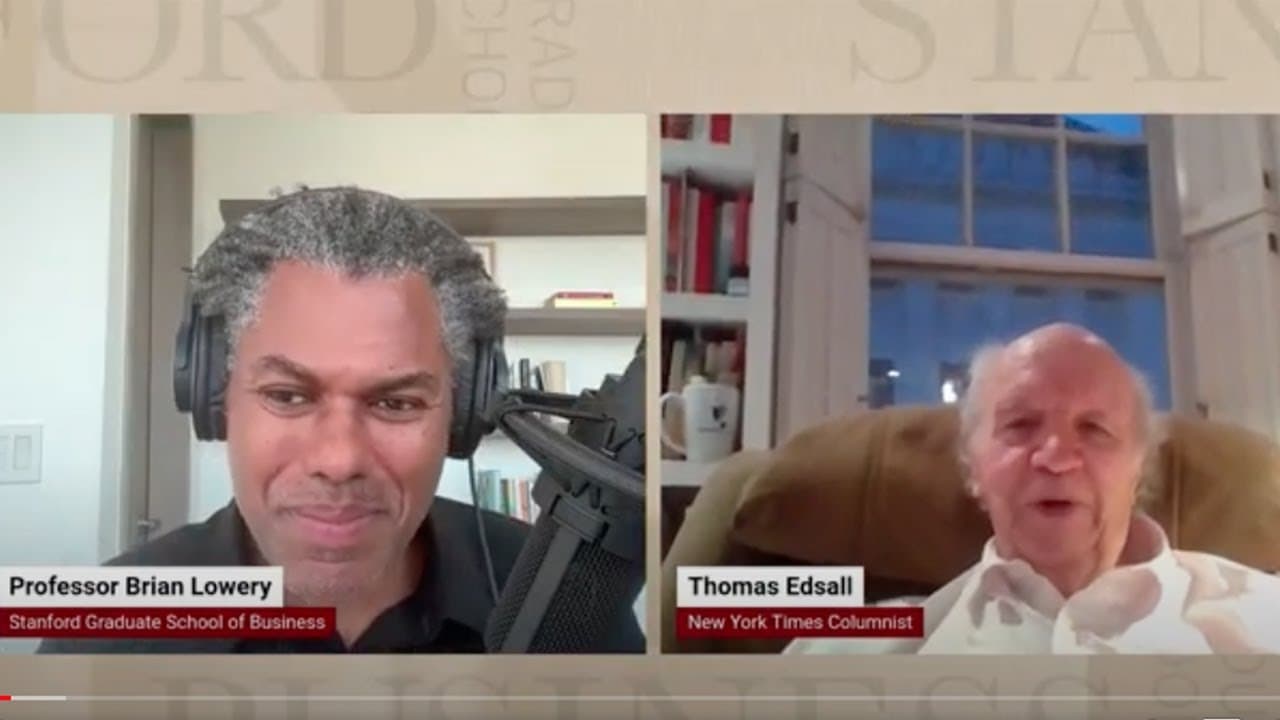
Welcome to the Leadership Society Speaker Series. The theme this year is Tensions, Business, Civic Society, and Politics. I'm Brian Lowery, professor of Organizational Behavior at the Stanford Graduate School of Business, and today I am speaking with Thomas Edsall. And Thomas is a New York Times Columnist and the author of multiple books, most rece... Read More
Key Insights
- 🥳 Polarization in America has shifted from ideological differences to affective polarization, where party affiliation becomes intertwined with personal identity.
- 🥳 Affective polarization hampers political cooperation and agreement, as parties view each other as enemies and compromise becomes virtually impossible.
- 🥺 In civic life, affective polarization leads to geographic and cultural segregation, as individuals choose to live among those who share their political beliefs.
- 🌎 The dominance of political elites and corporate America in shaping policy has contributed to the rise of right-wing populism, as Trump aimed to challenge the traditional Republican establishment.
- 😚 Growing income inequality has created an opening for politicians like Trump, as he appealed to those affected by globalization and lost manufacturing jobs.
- ❓ Reconciliation and a healthy democracy require addressing the concerns and beliefs of a significant portion of the population that may doubt the legitimacy of elections. Proportional representation and providing more choices in the electoral system may reduce polarization, but no clear solutions exist.
Install to Summarize YouTube Videos and Get Transcripts
Explore YouTube Video Summarizer or Get YouTube Transcript Extractor
Questions & Answers
Q: What is affective polarization, and how does it differ from traditional polarization?
Affective polarization involves an emotional response to one's own political party and a hostile sentiment towards the opposing party. It has become deeply embedded in individuals' identities and affects their views and interactions with the other party. Traditional polarization focused more on policy differences.
Q: How does affective polarization impact politics?
Affective polarization makes it challenging for political parties to reach agreements and compromises. As parties view each other as enemies, cooperation becomes nearly impossible. This hinders effective governance and prevents the resolution of urgent issues.
Q: What are the consequences of affective polarization for civic life?
Affective polarization leads to the geographic and cultural separation of individuals based on their political beliefs. People increasingly choose to live among like-minded individuals and attend churches and communities aligned with their political affiliations. This segregation further perpetuates divisions within society.
Q: Why has affective polarization intensified in recent years?
Affective polarization has intensified due to various factors. The rise of divisive culture war issues, such as abortion and gay rights, ingrained emotional responses and made compromise difficult. The separation of political elites and the top quintile of the income distribution from the general population has also fueled this polarization.
Summary & Key Takeaways
-
Polarization initially stemmed from ideological differences on specific issues, but it has evolved into affective polarization, where individuals emotionally identify with their party and view the other party as an enemy.
-
Affective polarization affects politics by making it difficult to reach agreements and compromises, as deals with the "enemy" are seen as unacceptable.
-
In civic life, affective polarization leads to geographic and cultural segregation, with people choosing to live in areas that align with their political beliefs, further deepening divides.
Read in Other Languages (beta)
Share This Summary 📚
Summarize YouTube Videos and Get Video Transcripts with 1-Click
Try YouTube Summary with ChatGPT & Claude or YouTube Transcript Generator
Explore More Summaries from Stanford Graduate School of Business 📚


Summarize YouTube Videos and Get Video Transcripts with 1-Click
Try YouTube Summary with ChatGPT & Claude or YouTube Transcript Generator