How to Convert Analog Signals to Digital
TL;DR
Analog to digital conversion involves sampling, quantization, and encoding. Sampling converts a continuous signal into discrete intervals, while quantization assigns these samples to fixed levels. Encoding then represents these levels in binary form. Proper sampling frequency, at least twice the input frequency, ensures accurate signal reconstruction. Sample and hold circuits stabilize signals for precise conversion.
Transcript
so in today's lecture I'm going to start discussion on data converters and in data converters uh analog to digital converter or digital to analog conversion process is going to be discussed now we will start with the analog to digital conversion process and uh in order to uh discuss the process I can show you this basic blog diagram so the ADC proc... Read More
Key Insights
- Analog to digital conversion starts with sampling the analog signal to create discrete time intervals.
- Quantization assigns each sample to a fixed level, reducing the continuous range to discrete values.
- Encoding converts quantized levels into binary code, representing the analog signal digitally.
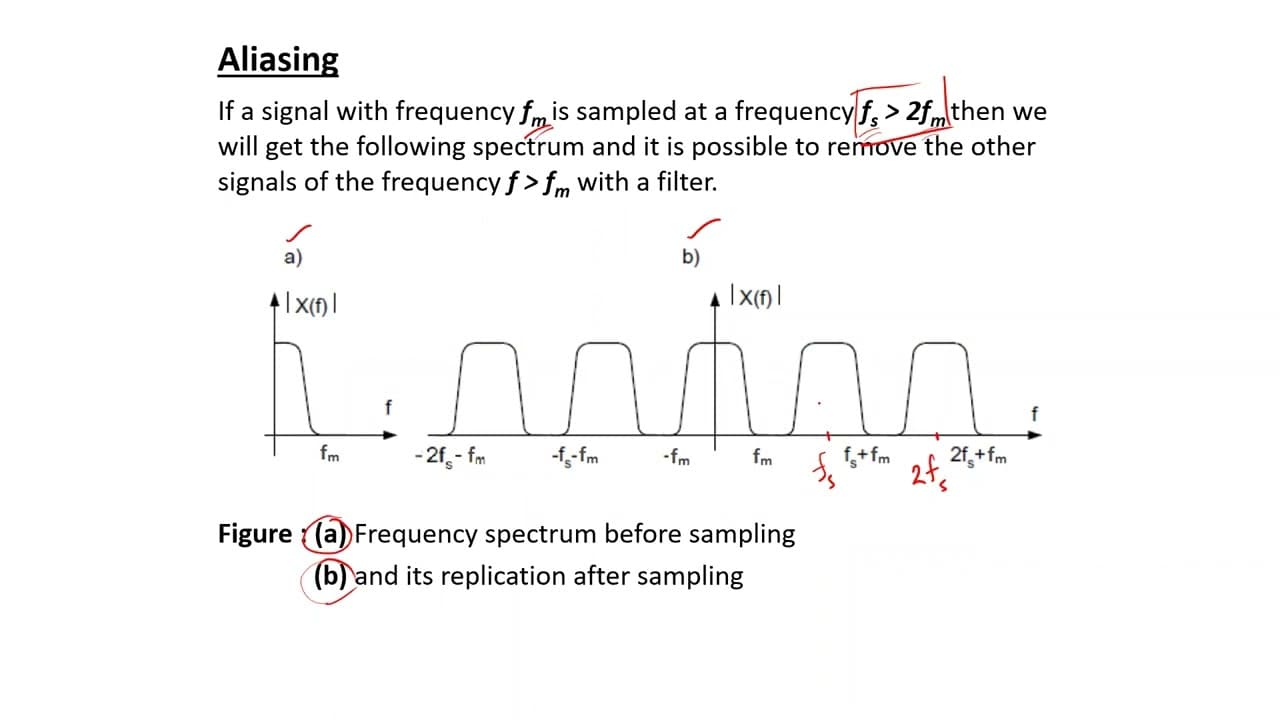
- The Nyquist criterion states that sampling frequency must be at least twice the input frequency to avoid aliasing.
- Sample and hold circuits stabilize the input signal, allowing accurate quantization and encoding.
- Aliasing occurs when the sampling frequency is too low, causing overlapping frequency spectrums.
- Anti-aliasing filters can minimize aliasing effects but may not perfectly reconstruct the original signal.
- The resolution of a quantizer depends on the number of bits used, affecting the precision of the digital representation.
Install to Summarize YouTube Videos and Get Transcripts
Explore YouTube Video Summarizer or Get YouTube Transcript Extractor
Questions & Answers
Q: What is the process of analog to digital conversion?
Analog to digital conversion involves sampling the analog signal to create discrete time intervals, quantizing these samples to fixed levels, and encoding the quantized levels into binary code. This process allows continuous analog signals to be represented in a digital format, facilitating electronic processing and storage.
Q: Why is the Nyquist criterion important in sampling?
The Nyquist criterion is crucial because it dictates that the sampling frequency must be at least twice the highest frequency of the input signal to avoid aliasing. Aliasing occurs when lower sampling frequencies cause overlapping frequency spectrums, leading to inaccurate signal reconstruction.
Q: How do sample and hold circuits function?
Sample and hold circuits function by stabilizing the input signal for accurate quantization and encoding. They use a capacitor to store the voltage level of the sampled signal, maintaining it constant while the quantizer and encoder process the data. This prevents distortion from continuous changes in the input signal.
Q: What is aliasing in the context of signal processing?
Aliasing in signal processing occurs when the sampling frequency is too low, causing the frequency spectrums of the sampled signal to overlap. This overlap prevents accurate reconstruction of the original signal, as the aliasing introduces errors that distort the digital representation of the analog input.
Q: How can aliasing be minimized?
Aliasing can be minimized using anti-aliasing filters, which limit the input signal's frequency range before sampling. By setting the cutoff frequency to half the sampling frequency, these filters reduce the overlap between frequency spectrums, although perfect reconstruction is not always possible.
Q: What is the role of quantization in ADC?
Quantization in analog to digital conversion involves assigning each sampled value to a fixed level, reducing the continuous range of the analog signal to discrete values. This step is essential for converting the sampled signal into a digital format, as it simplifies the representation into quantized states.
Q: How does the resolution of a quantizer affect digital conversion?
The resolution of a quantizer affects digital conversion by determining the precision of the digital representation. Higher resolution, achieved with more bits, allows for smaller increments between quantized levels, resulting in a more accurate digital approximation of the analog signal.
Q: What is the purpose of encoding in ADC?
Encoding in analog to digital conversion assigns a binary sequence to each quantized level, transforming the quantized signal into a digital format. This step is crucial for representing the analog signal in binary code, enabling electronic devices to process and store the data efficiently.
Summary & Key Takeaways
-
Analog to digital conversion involves three main steps: sampling, quantization, and encoding. Sampling converts a continuous signal into discrete intervals, while quantization assigns these samples to fixed levels. Encoding then represents these levels in binary form. Proper sampling frequency, at least twice the input frequency, ensures accurate signal reconstruction.
-
Sample and hold circuits are crucial in analog to digital conversion, as they stabilize the input signal for accurate quantization and encoding. These circuits use a capacitor to hold the voltage level, allowing the quantizer and encoder to process the signal without distortion from continuous input changes.
-
Aliasing is a critical issue in analog to digital conversion, occurring when the sampling frequency is too low, causing overlapping frequency spectrums. Anti-aliasing filters can minimize these effects but may not perfectly reconstruct the original signal. The resolution of a quantizer, determined by the number of bits, affects the precision of the digital representation.
Read in Other Languages (beta)
Share This Summary 📚
Summarize YouTube Videos and Get Video Transcripts with 1-Click
Try YouTube Summary with ChatGPT & Claude or YouTube Transcript Generator