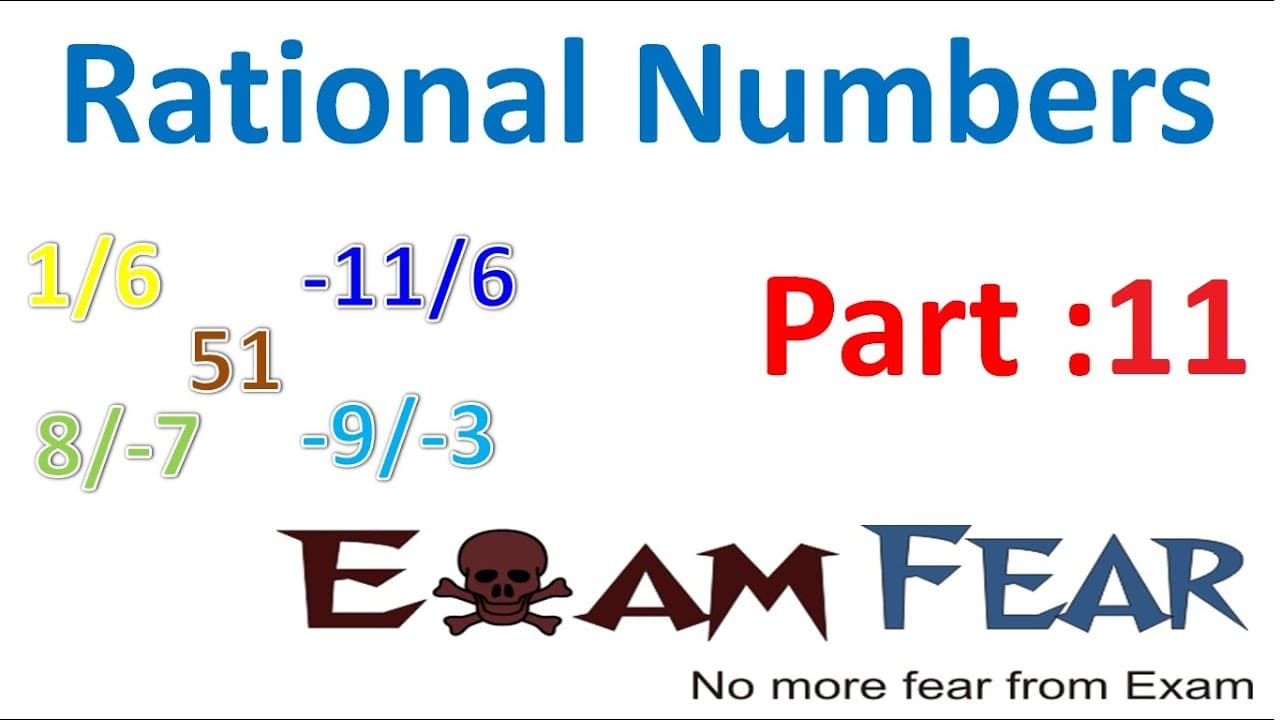
Maths Rational Numbers part 11 (Distributive Property of Rational Number) CBSE Class 8
TL;DR
The distributive property of multiplication over addition and subtraction in rational numbers is explained and proven.
Transcript
hello friends this video on rational numbers part 11 is brought to you by exam fee or comp normal fear from exam hello friends this video on rational numbers part 21 is brought to you by example comp no more fear from exam so now we are going to talk about the fourth property that is the distributive property for rational numbers now what is this d... Read More
Key Insights
- ✖️ The distributive property of multiplication over addition and subtraction is an important concept in rational numbers.
- 😑 The distributive property allows for simplification of expressions involving rational numbers.
- 🥹 The distributive property holds true for multiplication over addition and subtraction, but not for division.
- 🙃 The distributive property can be proven by substituting values and showing the equality of both sides of the equation.
Install to Summarize YouTube Videos and Get Transcripts
Explore YouTube Video Summarizer or Get YouTube Transcript Extractor
Questions & Answers
Q: What is the distributive property of multiplication over addition in rational numbers?
The distributive property states that for rational numbers a, b, and c, a multiplied by (b plus c) is equal to a multiplied by b plus a multiplied by c. This property allows us to simplify expressions involving rational numbers.
Q: Does the distributive property hold for division as well?
No, the distributive property does not hold for division. For example, a divided by (b plus c) is not equal to a divided by b plus a divided by c. Division does not have a similar property like the distributive property of multiplication.
Q: How is the distributive property proven for multiplication over subtraction?
The distributive property of multiplication over subtraction states that for rational numbers a, b, and c, a multiplied by (b minus c) is equal to a multiplied by b minus a multiplied by c. This can be proven by substituting values for a, b, and c and showing that both sides of the equation are equal.
Q: Can you provide an example of the distributive property in action?
Sure! Let's take a = 3/8, b = -2/5, and c = 6/7. Using the distributive property for multiplication over addition, we have 3/8 multiplied by (-2/5 + 6/7) equals (3/8 multiplied by -2/5) + (3/8 multiplied by 6/7). This can be simplified and calculated to prove the property.
Summary & Key Takeaways
-
The video explains the distributive property of multiplication over addition and subtraction in rational numbers.
-
The distributive property states that for rational numbers a, b, and c, a multiplied by (b plus c) is equal to a multiplied by b plus a multiplied by c.
-
The video provides an example and proves the distributive property for multiplication over addition and subtraction.
Read in Other Languages (beta)
Share This Summary 📚
Summarize YouTube Videos and Get Video Transcripts with 1-Click
Try YouTube Summary with ChatGPT & Claude or YouTube Transcript Generator
Explore More Summaries from LearnoHub - Class 11, 12 📚


Summarize YouTube Videos and Get Video Transcripts with 1-Click
Try YouTube Summary with ChatGPT & Claude or YouTube Transcript Generator