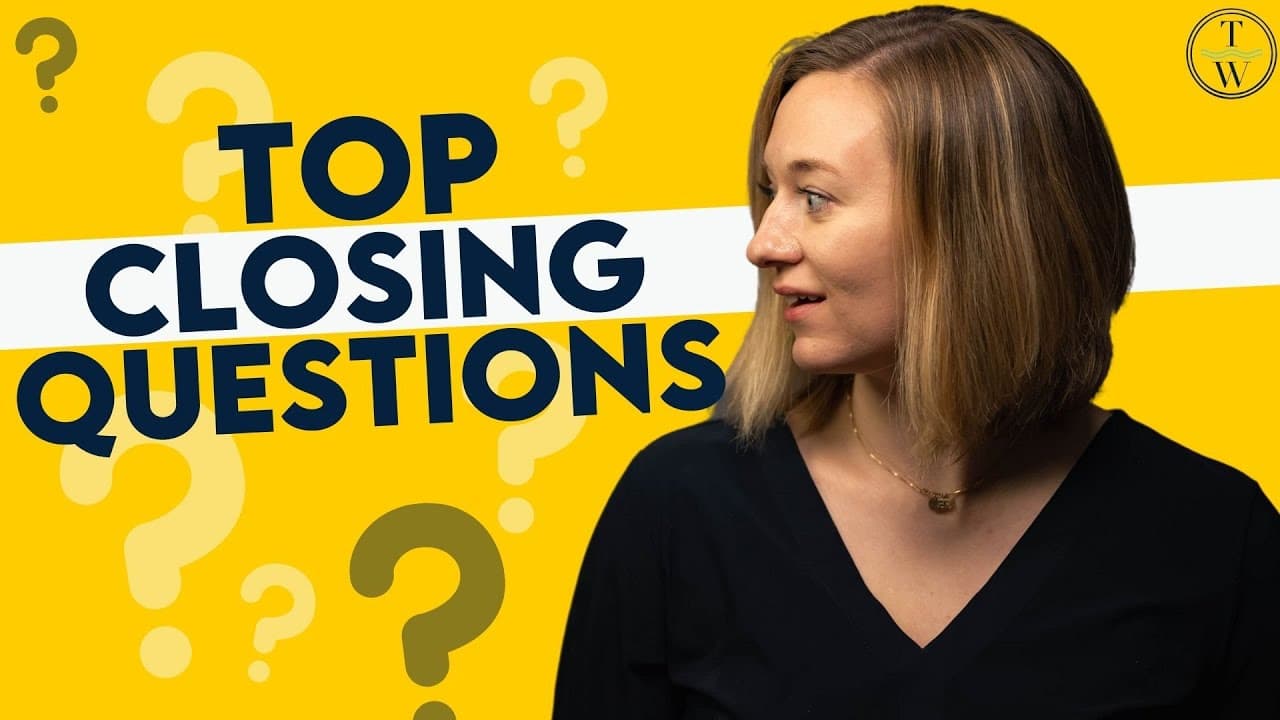
Most Common Questions Asked During A Real Estate Closing
TL;DR
Real estate attorney Tiffany Weber answers common questions about real estate closings, including first payment dates, escrow accounts, required signatures, property ownership after marriage, PMI removal, and the process after closing.
Transcript
everybody i'm tiffany weber and i'm a real estate attorney in north carolina and today i'm going to talk to you about the most common questions that i get asked in closings now i'm not the only attorney in my office that does closing so i crowdsource this a bit and asked the two other attorneys that are in my office every day what do you get asked ... Read More
Key Insights
- 🧑🤝🧑 First payments in real estate closings are typically due in the first complete month after the closing date.
- ❓ An escrow account is a savings account for future expenses like insurance, taxes, and PMI, and it is usually required for loans with PMI.
- 📜 All necessary documents must be signed during a real estate closing, and alterations to standard documents are rare.
- 🥶 Single persons buying property can later add their spouse as a co-owner through a deed.
- 👍 PMI removal requires paying down the loan or proving increased property value through a reappraisal.
- 🤩 After a closing, the deed needs to be recorded before keys are given and payment is made.
- 🚰 Cash is not exchanged immediately at the closing table, and there might be a delay before gaining access to the property.
Install to Summarize YouTube Videos and Get Transcripts
Explore YouTube Video Summarizer or Get YouTube Transcript Extractor
Questions & Answers
Q: When is the first payment due in a real estate closing?
The first payment is typically scheduled for the first complete month after the closing. For example, if the closing is on March 14th, the first payment would be due on May 1st.
Q: What is an escrow account, and is it mandatory?
An escrow account is a savings account for future expenses such as homeowners insurance, taxes, and PMI. While it is usually required for loans with PMI, some lenders may waive it under specific circumstances.
Q: Do I have to sign all the documents in a real estate closing?
Yes, you are required to sign all documents necessary for the loan and the purchase, as outlined by your lender and the contract. Requests for alterations to standard documents are rare.
Q: What should I do with the property if I get married?
If there is no agreement indicating otherwise, it is recommended to re-deed the property as tenants by the entirety if you want your spouse to co-own it. This ownership type provides creditor protection and avoids probate.
Q: How can I remove PMI from my loan?
The specific requirements for PMI removal will be outlined in your loan package. Generally, you need to pay down your loan to 80% of the property's value at the time of purchase. Some lenders may allow a reappraisal if substantial improvements have been made.
Q: What happens after a real estate closing?
After signing all the documents, the deed needs to be recorded before the new buyers can receive the keys to the property and the sellers can receive payment. The recording process may take some time and is not immediate.
Summary & Key Takeaways
-
Tiffany Weber, a real estate attorney, shares the most commonly asked questions in real estate closings.
-
Questions include when the first payment is due, the purpose of an escrow account and its requirement, whether all documents need to be signed, and what to do with the property after marriage.
-
Additional questions cover how to remove PMI, the process after closing, and the timeline for receiving keys and payment.
Read in Other Languages (beta)
Share This Summary 📚
Summarize YouTube Videos and Get Video Transcripts with 1-Click
Try YouTube Summary with ChatGPT & Claude or YouTube Transcript Generator
Explore More Summaries from The Real Estate Lawyer 📚


Summarize YouTube Videos and Get Video Transcripts with 1-Click
Try YouTube Summary with ChatGPT & Claude or YouTube Transcript Generator