How to Fix Physics Glitches in Water Simulations
TL;DR
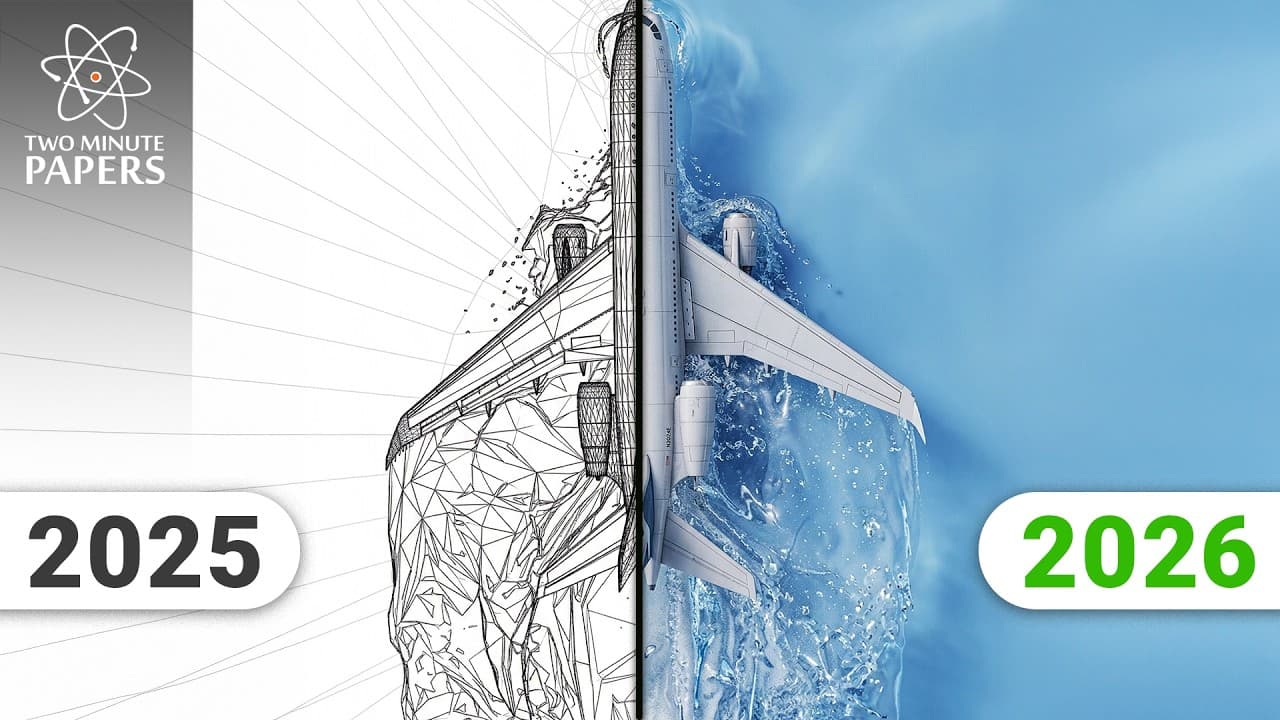
A new technique effectively solves the problem of objects clipping through water in simulations by employing the Lattice Boltzmann Method. This method uses two-way coupling, allowing both water and objects to influence each other, resulting in realistic simulations. It's faster and more accurate than previous methods, providing a breakthrough in simulating complex fluid dynamics.
Transcript
Finally! This amazing technique solves the problem of this physics glitch where objects just clip through water. By the end of the video, I’ll tell you how it works in very simple words, but it turns out, there’s more to this. There is excellent life advice in this research paper. And you will also see if this can get close to reality or ... Read More
Key Insights
- The Lattice Boltzmann Method is used to simulate fluid dynamics accurately.
- Two-way coupling allows objects and water to interact realistically.
- This method is 4x faster and more accurate than previous techniques.
- The technique prevents objects from clipping through water surfaces.
- Hybrid moving bounce-back technique ensures realistic particle interaction.
- Simulations can now handle complex scenarios like stone skipping on water.
- The method provides life-like air and water interaction, enhancing realism.
- This advancement can transform how fluid simulations are used in media.
Install to Summarize YouTube Videos and Get Transcripts
Explore YouTube Video Summarizer or Get YouTube Transcript Extractor
Questions & Answers
Q: How does the Lattice Boltzmann Method improve fluid simulations?
The Lattice Boltzmann Method improves fluid simulations by using a two-step process that allows particles to move freely and interact separately. This method enables realistic two-way coupling between water and objects, allowing them to influence each other. The result is a more accurate and faster simulation of fluid dynamics, capable of handling complex scenarios.
Q: What is two-way coupling in fluid simulations?
Two-way coupling in fluid simulations refers to the interaction between objects and fluids, where both can influence each other's behavior. This method allows for realistic simulations where the fluid can push objects, and objects can also affect the fluid. It results in more accurate and dynamic simulations, enhancing the realism of fluid interactions.
Q: Why is the new simulation method faster than previous techniques?
The new simulation method is faster than previous techniques because it employs the Lattice Boltzmann Method, which uses a more efficient approach to simulate particle interactions. By allowing particles to move and interact in separate steps, the method reduces computational complexity, making it 4x faster while maintaining accuracy and realism.
Q: What challenges do traditional fluid simulations face?
Traditional fluid simulations face challenges in accurately representing the interaction between fluids and objects, often resulting in clipping or unrealistic behavior. They struggle with complex scenarios like stone skipping due to limitations in simulating the air layer between objects and water. These methods often resort to simplifications that compromise realism.
Q: How does the new method handle stone skipping simulations?
The new method handles stone skipping simulations by accurately simulating the air layer between the stone and water. This allows the stone to bounce multiple times, replicating the real-life phenomenon. The technique's ability to simulate intricate details like air and water interaction enables it to handle complex scenarios that traditional methods struggle with.
Q: What is the hybrid moving bounce-back technique?
The hybrid moving bounce-back technique is a method used in the new simulation approach to ensure realistic particle interactions. It instructs particles on how to bounce back upon collision, maintaining the appropriate energy and momentum. This technique is crucial for achieving two-way coupling, allowing for more accurate and lifelike simulations of fluid dynamics.
Q: What are the benefits of the new simulation technique?
The benefits of the new simulation technique include increased accuracy and speed, with simulations being 4x faster than previous methods. It allows for realistic two-way coupling between fluids and objects, enabling accurate simulations of complex scenarios. The technique enhances the realism of fluid interactions, offering significant advancements for media and gaming applications.
Q: Why is two-way coupling considered a breakthrough in simulations?
Two-way coupling is considered a breakthrough because it allows for realistic interactions between fluids and objects, where both can influence each other. This capability results in more accurate and dynamic simulations, overcoming limitations of traditional methods that often resorted to simplifications. It marks a significant advancement in simulating complex fluid dynamics.
Summary & Key Takeaways
-
The new simulation technique solves the issue of objects clipping through water by using the Lattice Boltzmann Method. This method incorporates two-way coupling, allowing both the water and the objects to interact with each other, resulting in highly realistic simulations. It is not only more accurate but also 4x faster than previous methods.
-
The innovative technique employs a hybrid moving bounce-back method, ensuring that particles interact in a lifelike manner. This allows simulations to handle complex scenarios, such as stone skipping on water, which was previously difficult due to sticky simulations that couldn't replicate the air layer between the stone and water.
-
This breakthrough in physics simulations can significantly impact media and gaming, providing more realistic and dynamic fluid interactions. The method's ability to simulate intricate details, like air bubbles and object-water interactions, marks a substantial advancement in simulation technology.
Read in Other Languages (beta)
Share This Summary 📚
Summarize YouTube Videos and Get Video Transcripts with 1-Click
Try YouTube Summary with ChatGPT & Claude or YouTube Transcript Generator
Explore More Summaries from Two Minute Papers 📚



Summarize YouTube Videos and Get Video Transcripts with 1-Click
Try YouTube Summary with ChatGPT & Claude or YouTube Transcript Generator