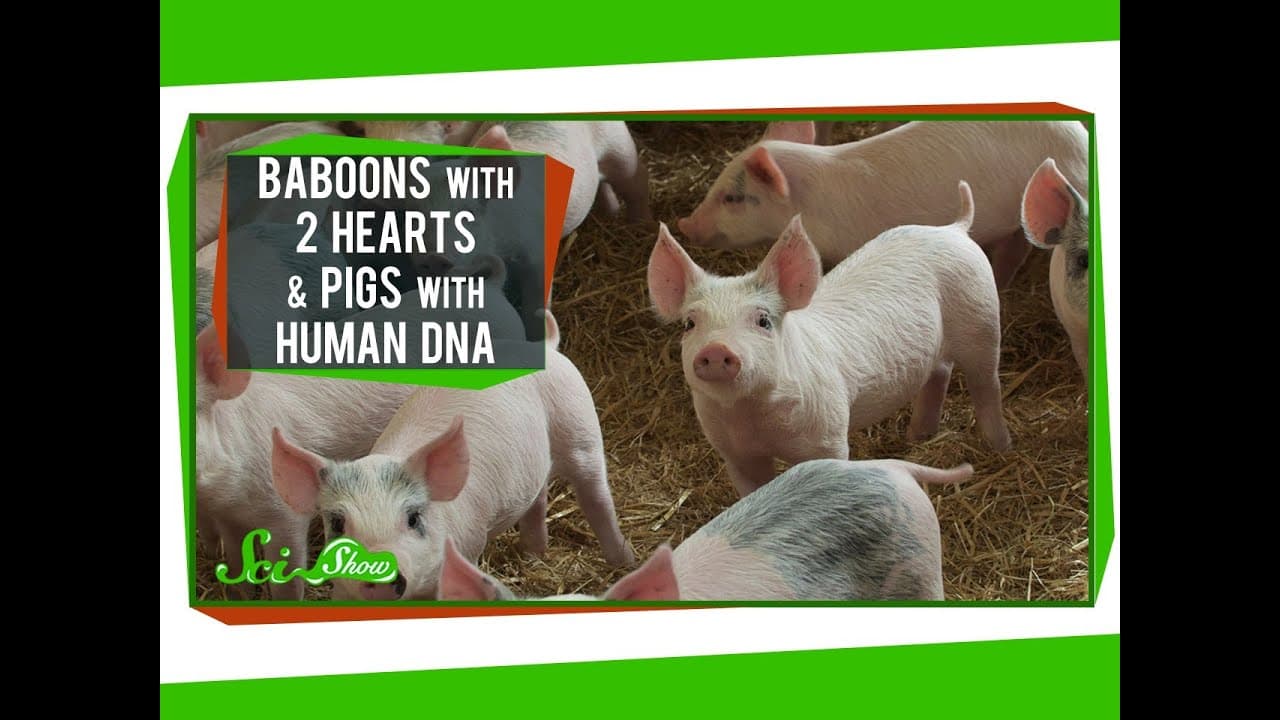
Baboons With 2 Hearts & Pigs With Human DNA
TL;DR
Genetically engineered pigs with human DNA lead to successful pig heart transplants in baboons and muscle regeneration in humans.
Transcript
Baboons with two hearts. Pigs with human DNA. These things exist -- in labs, at least -- because researchers have engineered them to help answer some basic questions in the emerging field of xenotransplantation. Xenotransplantation is the transplant of organs or tissues between species. And it might sound a little weird, but it has the potential to... Read More
Key Insights
- 🐷 Xenotransplantation utilizes genetically modified pigs with human DNA to overcome rejection in organ transplants.
- 🥰 Successful pig heart transplants in baboons suggest potential for human transplants using the same technique.
- 💪 Muscle regeneration in humans using pig muscle matrix shows promising results in improving limb function post-injury.
- 😷 Transplanting tissues between species offers new hope for organ shortages and tissue regeneration in the medical field.
- 😵 Genetic modification and immune-suppressant drugs play crucial roles in successful cross-species transplants.
- 💪 The extracellular matrix from pig muscle acts as a guide for stem cells in tissue regeneration.
- ❓ Xenotransplantation may revolutionize organ transplantation practices and reduce the reliance on human donors.
Install to Summarize YouTube Videos and Get Transcripts
Explore YouTube Video Summarizer or Get YouTube Transcript Extractor
Questions & Answers
Q: How have researchers addressed rejection issues in xenotransplantation?
Researchers have genetically engineered pigs with human DNA to prevent rejection in baboon hosts, showing successful prolonged pig heart transplants in the study.
Q: What is the significance of the muscle regeneration technique involving pig muscle matrix?
The technique uses pig muscle matrix to guide stem cells, leading to muscle regeneration in humans with volumetric muscle loss, showing potential for improved limb function and reduced amputations.
Q: What were the results of the muscle regeneration technique on human subjects?
After six months of therapy, all patients reported improvement, with three experiencing a 25% increase in limb function, showcasing the effectiveness of the pig muscle matrix in tissue regeneration.
Q: How could xenotransplantation impact the medical field in the future?
Xenotransplantation has the potential to alleviate organ shortages globally, reduce the illicit human organ trade, and offer new solutions for organ and tissue regeneration through cross-species transplants.
Summary & Key Takeaways
-
Scientists have genetically engineered pigs with human DNA to address rejection issues in xenotransplantation.
-
Successful pig heart transplants in baboons suggest potential for human transplants.
-
Muscle regeneration in humans using pig muscle matrix shows promise for future medical treatments.
Read in Other Languages (beta)
Share This Summary 📚
Summarize YouTube Videos and Get Video Transcripts with 1-Click
Try YouTube Summary with ChatGPT & Claude or YouTube Transcript Generator
Explore More Summaries from SciShow 📚


Summarize YouTube Videos and Get Video Transcripts with 1-Click
Try YouTube Summary with ChatGPT & Claude or YouTube Transcript Generator